
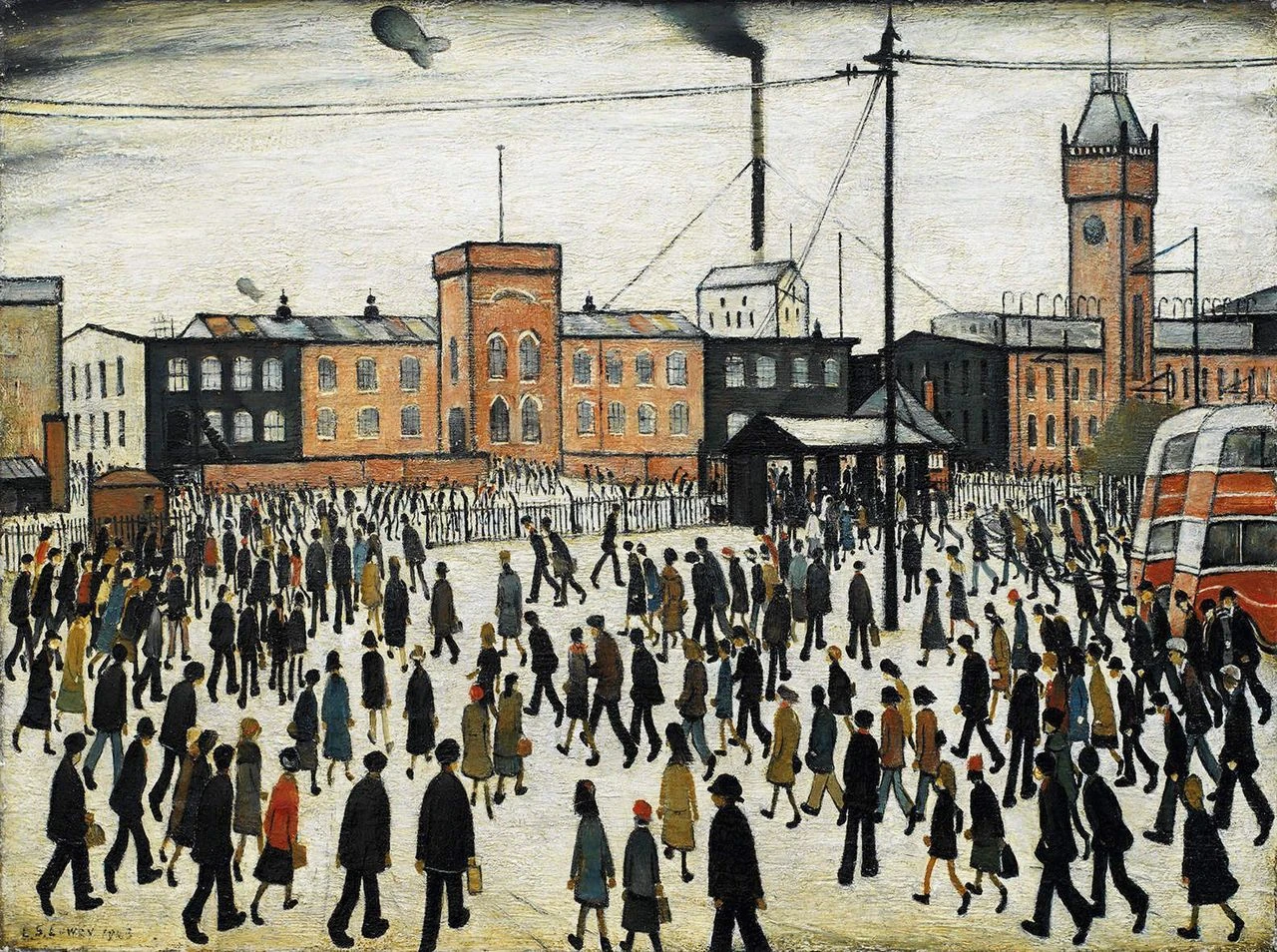
Laurence Stephen Lowry is best known for paintings of industrial towns crowded with small, sharply observed figures. Often called “matchstick men”, they move beneath mills and chimneys in scenes that became an instantly recognisable image of northern England. Lowry’s art was not confined to factories or streets: he also painted seascapes, portraits and unfamiliar, sparsely populated landscapes. His achievement lies in a body of work that gave the changing places and ordinary routines of the North a singular presence in British art.
A move that changed what he saw
Lowry was born in Stretford, Lancashire, on 1 November 1887. He spent much of his early life in the Manchester suburb of Victoria Park, Rusholme. In 1909, financial pressures led his family to move to 117 Station Road in Pendlebury, an industrial town of textile mills and factory chimneys. At first, he disliked the place. In time, its streets and industrial buildings absorbed him. He later recalled noticing the Acme Spinning Company’s mill after missing a train: a structure of yellow-lit windows against a damp afternoon sky. He said he had looked at the scene many times without seeing it.
That gradual change of attention became central to his work. Lowry did not simply record a landscape that had always seemed picturesque to him; he found a subject in a place he had initially rejected. His account of Pendlebury describes an artist learning to look closely at the built environment around him, until mills, streets and people became material for a sustained artistic practice.
After leaving school, Lowry worked for the Pall Mall Company, later collecting rents. He took private lessons in antique and freehand drawing and, in 1905, entered the Manchester School of Art, where he studied under the French Impressionist Pierre Adolphe Valette. In 1915 he continued his studies at the Royal Technical Institute in Salford, remaining there until 1925. His training helped him develop as a painter, but his eventual subject and style grew from his own close attention to the industrial districts he knew.
Finding a style for an industrial landscape
Lowry’s early oil paintings were impressionistic and dark in tone. Encouraged by D. B. Taylor of the Manchester Guardian, he began using a white background to lighten his pictures. He developed a distinctive approach to urban landscape, placing stylised human figures among streets, mills and other buildings. Their small scale gives a sense of people moving through a larger environment, but it does not make them incidental: crowds and everyday activity are fundamental to the scenes.
Critics sometimes described him as a naïve “Sunday painter”, pointing to figures without cast shadows and the absence of weather effects in many of his landscapes. That label risks mistaking simplicity for lack of skill. Art critic Simon Hucker, quoted in the account of Lowry’s career, argued that the artist was much more sophisticated than the reputation suggested, able to make a figure legible with just a few brushstrokes. Lowry’s work includes more than his familiar crowded townscapes: he made brooding portraits, mysterious unpopulated landscapes and seascapes of sea and sky. A body of unpublished works depicting marionette-like figures was found after his death.
Coming from the Mill (1930) is among his notable works, alongside Going to Work (1943), Going to the Match (1953) and Industrial Landscape (1955). The titles alone suggest the breadth of his interest in work, movement and place. The current account describes Coming from the Mill as a scene of workers leaving a factory; the painting belongs to a wider body of work in which industrial surroundings and human figures are joined in a distinctive visual language.
Work, war and recognition
Lowry continued working at the Pall Mall Property Company until his retirement in 1952, on his 65th birthday. Painting developed alongside his employment and study. During the Second World War he volunteered as a fire watcher and became an official war artist in 1943. In 1953 he was appointed Official Artist at the Coronation of Queen Elizabeth II. These appointments placed an artist so closely associated with the industrial North within wider accounts of national public life.
His standing grew over the following decades. Lowry was elected an Associate Member of the Royal Academy of Arts in 1955 and became a full Royal Academician in 1962. He received honorary degrees from the University of Manchester, Salford and Liverpool, and the freedom of the city of Salford in 1965. In 1968, the Post Office included his painting Coming Out of School on a stamp in a series honouring British artists.
Recognition did not mean that Lowry accepted every honour offered to him. He declined appointment as an Officer of the Order of the British Empire in 1955 and as a Commander in 1961, as well as a knighthood in 1968 and appointments to the Order of the Companions of Honour in 1972 and 1976. His repeated refusals form an unusual part of his public story, alongside the many institutional honours he did accept.
A lasting presence in Salford
Lowry died of pneumonia at Woods Hospital in Glossop, Derbyshire, on 23 February 1976, aged 88, and was buried in Manchester’s Southern Cemetery. His work continued to reach new audiences. A major retrospective opened at Tate Britain in 2013, and the following year his first solo exhibition outside the UK was held in Nanjing, China.
The Lowry, the gallery and theatre complex at Salford Quays named after him, opened in 2000. Its collection is the largest of his work, with about 400 pieces held by Salford City Council; the gallery’s account lists 55 paintings and 278 drawings. Among the works shown there is Going to the Match, formerly owned by the Professional Footballers’ Association, together with a preparatory pencil sketch. The gallery’s collection offers visitors a concentrated encounter with an artist whose subjects were rooted in the region around Salford and Manchester.
His work has also entered popular culture. Status Quo paid tribute to Lowry in their 1968 single “Pictures of Matchstick Men”, and Brian and Michael reached number one in the UK singles chart in 1978 with “Matchstalk Men and Matchstalk Cats and Dogs”. These responses show how readily the visual language of his paintings could be recognised and reinterpreted beyond galleries.
Why L. S. Lowry deserves a place in British Legacy
Lowry deserves a place in British Legacy because he made the industrial life of north-west England a sustained and distinctive subject for art. His move to Pendlebury brought him into closer contact with mills and factory streets; his response was neither to idealise the landscape nor to turn it into mere background. He developed a visual language in which buildings, crowds and individuals belong to the same scene. Works such as Coming from the Mill and Going to Work preserve the presence of workers and the rhythms of industrial towns in paintings that remain identifiable as his.
His legacy is also visible in the institutions and public culture built around his work. The Lowry in Salford Quays holds the largest collection of his paintings and drawings, keeping his art accessible in the region that shaped so much of its subject matter. Exhibitions at Tate Britain and in Nanjing show that the work has travelled beyond its local setting, while the popular songs inspired by his paintings demonstrate its reach beyond the art world. Lowry’s British significance is therefore specific, not merely a matter of national acclaim: he gave lasting form to places and people often absent from grand historical narratives, and left a body of work through which audiences can encounter the industrial North on its own terms.
Sources
Adapted in part from L. S. Lowry by Wikipedia contributors, under CC BY-SA 4.0. Text has been edited and combined with the existing article; this adapted text is shared under the same licence. Contributor history.
.jpg)