Leon Kossoff made London his subject not as a distant panorama but as a place repeatedly encountered: its streets and railway stations, its swimming pools and building sites, and the people who lived within it. In thick, worked paint, ordinary urban scenes became records of sustained looking. His portraits and drawings shared that attention, linking the changing city to the particular lives of family, friends and sitters.
Growing up and learning to draw
Kossoff was born on 10 December 1926 on City Road in Islington, London. His parents were Jewish immigrants from Ukraine, and his father was a baker. In 1938 he attended Hackney Downs School. The following year, as the Second World War began, the school was evacuated to King’s Lynn in Norfolk. Kossoff lived there with Mr and Mrs R. C. Bishop, who encouraged his interest in art; during this period he made his first paintings.
He returned to London in 1943 and studied commercial art at Saint Martin’s School of Art, while also attending evening life-drawing classes at Toynbee Hall. His education was interrupted by military service: he spent three years with the Royal Fusiliers, attached to the 2nd Battalion of the Jewish Brigade, serving in Italy, the Netherlands, Belgium and Germany. On his return, he went back to Saint Martin’s in 1949. From 1950 to 1952 he took special classes at Borough Polytechnic with the painter David Bomberg.
Drawing remained central to Kossoff’s practice. Bomberg’s teaching offered an important foundation, while fellow student Frank Auerbach, another of Bomberg’s pupils, became a close artistic counterpart. Both artists worked with emotionally charged subjects and dense paint. Kossoff’s choice of subject was often local: he repeatedly returned to places around London where he had lived and worked.
A city made through repeated looking
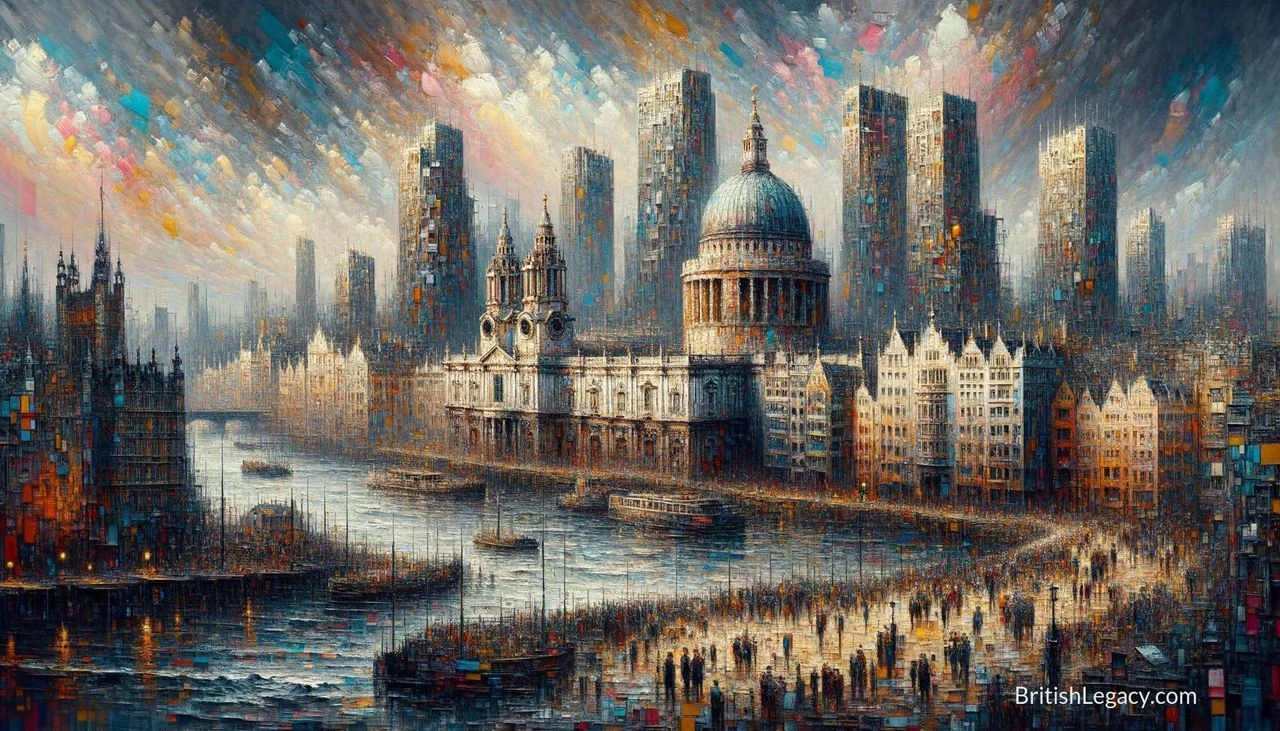
Kossoff’s London is made up of specific places rather than a single defining view. Railway stations, streets, building sites and public swimming pools recur in his paintings and drawings. These subjects may appear commonplace, but the accumulated marks make them feel unsettled and alive: buildings, crowds and movement take shape through the pressure and density of the paint.
One notable example is Children’s Swimming Pool, Autumn Afternoon. Its public pool is not presented as a quiet architectural study. The busy, heavily worked surface conveys activity and movement, turning a familiar communal space into a scene of concentrated human life. The work belongs to a wider practice in which drawing, redrawing and painting could continue over an extended period. That process matters: the paintings’ weight and texture reflect not only a visual style but also the repeated effort of returning to a subject.
His urban scenes have a particular connection to the history of London after the war. Kossoff’s subjects include places undergoing change, alongside the everyday routines of people using the city. His work can therefore be read as a record of how a city is inhabited and remade, without reducing those places to illustrations of a single historical message. A station or building site is both a real location and a setting in which human presence is felt.
Portraits, teaching and exhibitions
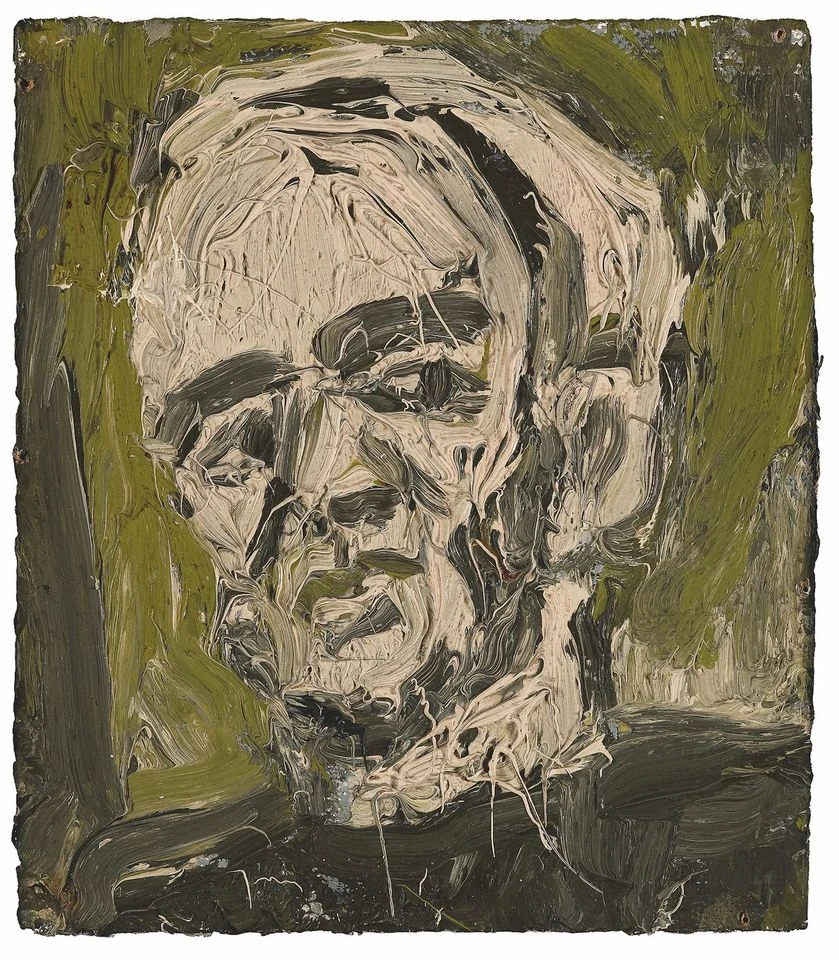
Kossoff’s attention to people was as sustained as his attention to place. He made portraits of friends and family, including a series of works depicting his father. Seen across time, such portraits register changes in the sitter’s appearance and in the artist’s continuing engagement with the person before him. The thickly worked surfaces give these images a physical presence, while the repeated act of looking makes them more than straightforward likenesses.
In 1950 Kossoff established a studio at Mornington Crescent. He moved to Bethnal Green in 1953 and lived there until 1961; later studios included Willesden Junction and, from 1966, Willesden Green. These changes of address accompanied a career rooted in the city’s geography. In 1956 he joined the Beaux Arts Gallery, and from 1959 he taught at Regent Street Polytechnic, the Chelsea School of Art and Saint Martin’s School of Art while continuing to make and exhibit work.
His exhibition history included the 46th Venice Biennale in 1995 and a Tate Gallery retrospective in 1996. The National Gallery presented Leon Kossoff: Drawing from Painting in 2007, placing the relationship between his drawing and painting at the centre of its exhibition. In 2010, a travelling show of new paintings and drawings began in London before moving to New York and Los Angeles. His London landscapes were also the subject of an international touring exhibition in 2013–14.
Later work and remembrance
Kossoff continued to exhibit in his later years, and his work remained in conversation with artists and institutions beyond Britain. He declined appointment as a Commander of the Order of the British Empire. In 2019, aged 92, he died in London from complications of a stroke. Later exhibitions included a two-person presentation with Chaïm Soutine at Hastings Contemporary in 2023 and Close Encounters: Paintings and Drawings at Xavier Hufkens in 2024.
His work also attracted attention in the art market. In March 2026, Children’s Swimming Pool, Autumn Afternoon sold at Sotheby’s London for £5.2 million, according to the reported figures. The sale followed the previous record for a Kossoff work, set by Willesden Junction – Autumn Afternoon at Christie’s in 2018. These prices are one measure of later interest, but they do not explain the paintings’ significance on their own: the work’s sustained attention to place and people offers a more lasting way into it.
Why Leon Kossoff deserves a place in British Legacy
Kossoff deserves a place in British Legacy because his art gives a distinct, sustained account of London through the places its inhabitants use and the lives they lead there. He returned to stations, streets, pools and building sites, treating them not as background scenery but as subjects worth looking at repeatedly. His thickly worked paintings preserve the intensity of that attention. In works such as Children’s Swimming Pool, Autumn Afternoon, a familiar public space becomes a vivid record of movement and shared life. The city in his work is specific and recognisable, yet never merely documentary: the physical act of painting gives its changing surroundings a force of their own.
That achievement was built through a career closely connected to British art and education. Kossoff studied in London, learned from David Bomberg at Borough Polytechnic, taught at several London art schools and exhibited at the Tate and National Gallery. His portraits, including those of his father, extend the same patient engagement from city spaces to individual people. Together, these works offer a way to encounter post-war and later London through both its transformed landscapes and its human presence. Kossoff’s legacy is not a generic claim to represent the whole city, but a substantial body of British painting and drawing shaped by returning to particular places and looking closely at the people within them.
Sources
Leon Kossoff — Wikipedia, revision 1372467180
Adapted in part from Leon Kossoff by Wikipedia contributors, under CC BY-SA 4.0. Text has been edited and combined with the existing article; this adapted text is shared under the same licence. Contributor history.