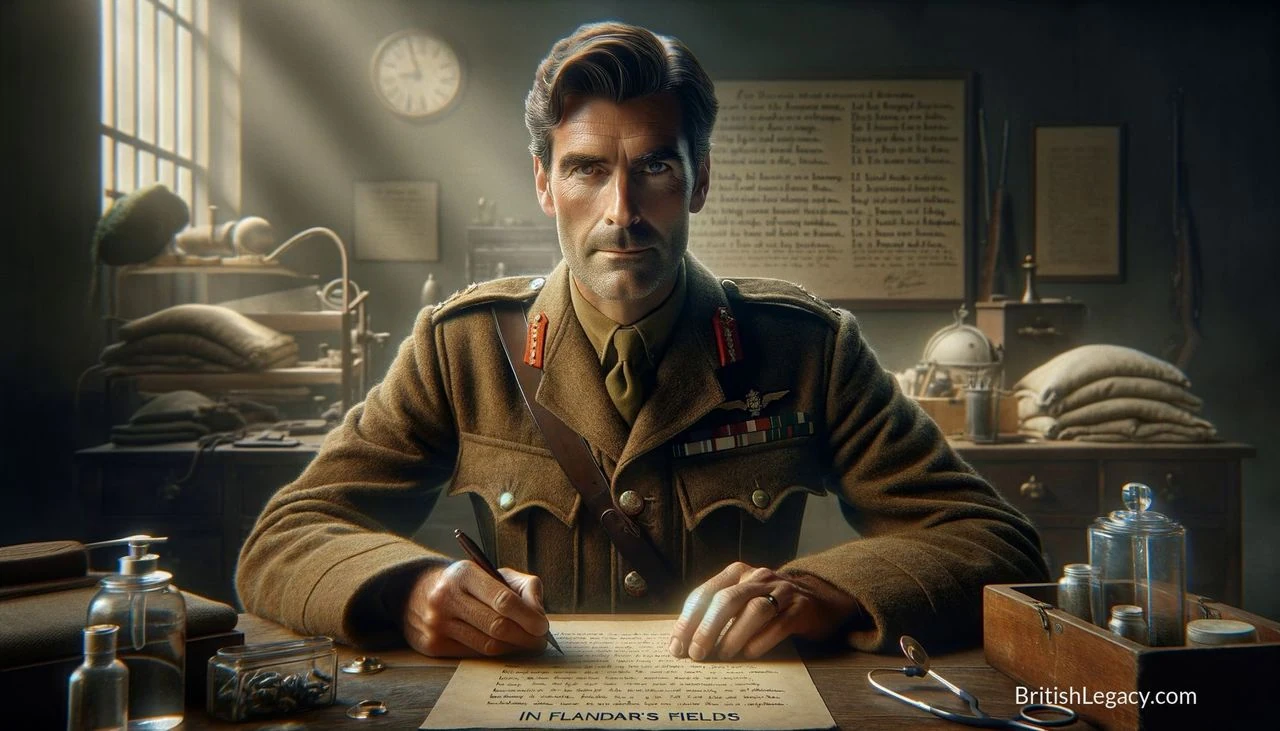
Lieutenant Colonel John McCrae: The Poet Doctor Who Immortalised Flanders Fields in Verses
At the crossroads of chilling warfare and poignant poetry stands Lieutenant Colonel John McCrae, a name forever etched in the annals of British legacy. Though Canadian-born, McCrae’s profound contributions to British heritage and his lasting impact on the world cannot be overstated. His elegantly penned poem “In Flanders Fields” resonates as a timeless reminder of sacrifice, courage, and resilience.
Early Life and Military Career
John McCrae was born on 30 November 1872 in Guelph, Ontario, Canada, to British loyalist parents. His father, who was a Scottish immigrant, instilled in him a sense of duty and the value of service. McCrae’s intellectual prowess and deep sense of duty led him to pursue a career in both medicine and the military, a rare combination that would later define his legacy.
McCrae’s journey began with an education at the University of Toronto, where he excelled academically and showed a fervent interest in poetry. Following graduation, he served as a medical officer in the South African War (also known as the Second Boer War) from 1899 to 1902—a prologue to his more famous role in the First World War.
World War I and 'In Flanders Fields'
The outbreak of the First World War in 1914 saw McCrae re-enlist with the British Army, serving with the Canadian Expeditionary Force. His steadfast dedication to the allied cause and his compassionate nature distinguished him in the harsh theatre of war. It was amidst the tragic Second Battle of Ypres in April 1915 that McCrae would find his enduring voice.
Witnessing the grim reality of war and the death of his close friend, Lieutenant Alexis Helmer, McCrae channelled his grief and resolve into the immortal lines of “In Flanders Fields.” Written amidst the rudimentary surroundings of a makeshift dressing station, the poem captured the haunting beauty of the poppy fields that sprung from soldiers’ graves and the stark juxtaposition between life and death.
“In Flanders fields the poppies blow Between the crosses, row on row, That mark our place; and in the sky The larks, still bravely singing, fly Scarce heard amid the guns below.”
These opening lines of the poem evoke a potent image of the fallen soldiers’ resting place, eloquently marrying the serenity of nature and the violent interruption of war. McCrae’s “In Flanders Fields” is not just a recollection of sorrow but a clarion call to the living to continue the fight for freedom and peace.
Legacy and Impact
While McCrae succumbed to pneumonia on 28 January 1918, his legacy lived on through his evocative poetry. “In Flanders Fields” was published in Punch magazine in December 1915 and quickly became emblematic of the First World War’s human cost. Its vivid imagery and solemn tone resonated deeply with readers across the world, prompting the adoption of the poppy as a symbol of remembrance.
Today, the humble poppy, first conjured by McCrae’s pen, adorns lapels and wreaths each November during Remembrance Day ceremonies across the Commonwealth. The poetic voice of McCrae continues to echo through the ages, reminding us of the profound sacrifices made during times of conflict.
Conclusion
Lieutenant Colonel John McCrae’s contribution to the British legacy is profoundly marked by the duality of his service as a healer and a poet. Though Canada was his homeland, his work transcended borders, leaving an indelible mark on Britain’s cultural and historical landscape. “In Flanders Fields” endures as a haunting, yet hopeful testament to the resilience of the human spirit in the face of unspeakable devastation. McCrae’s words serve as a perpetual bridge between the past and the future, galvanising us to remember those who fell and inspiring us to uphold the peace for which they fought.
In reminiscing about John McCrae, we celebrate not only a man but a legacy of enduring courage, compassion, and the power of words to shape a nation’s collective memory.
This engaging article weaves through the life and contributions of Lieutenant Colonel John McCrae, underscoring his integral role in shaping the British legacy through literature that moves the soul and stirs the mind.