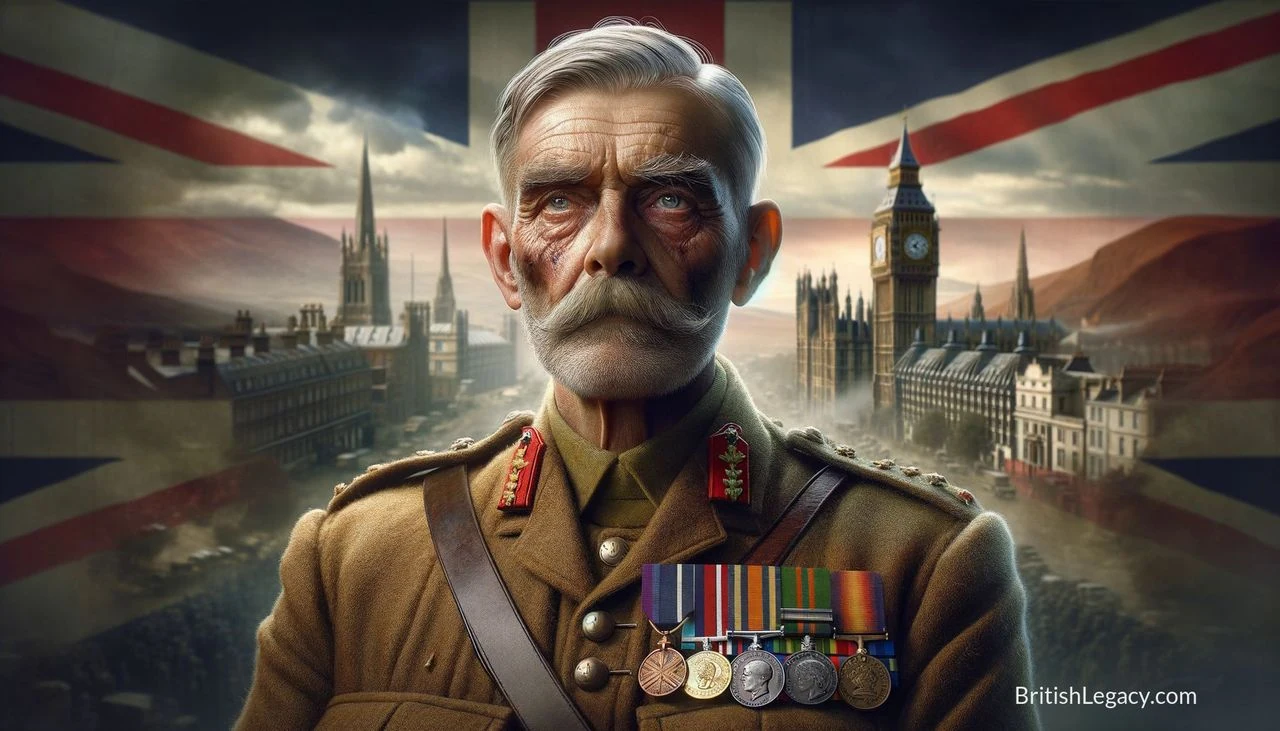
Adrian Carton de Wiart’s military career crossed continents and two world wars. He was wounded repeatedly, lost an eye and a hand, survived plane crashes and spent two years as an Italian prisoner of war. Yet his life was not simply a sequence of feats of endurance: it included command on the Western Front, a difficult diplomatic mission in Poland and service as Winston Churchill’s personal representative in China. Born in Brussels, he became a British subject in 1907 and served the British Army across three conflicts.
From Brussels to the British Army
Carton de Wiart was born in Brussels on 5 May 1880, the eldest son of a lawyer and magistrate. He spent parts of his early life in Belgium and England, and went to the Oratory School before entering Balliol College, Oxford. He left Oxford around 1899 to join the army as the Second Boer War began, falsifying his name and age to enlist as “Trooper Carton”.
He was wounded in the stomach and groin in South Africa and sent home. After a brief return to Oxford, he received a commission in the Second Imperial Light Horse and saw further service in South Africa. In 1901 he was commissioned as a second lieutenant in the 4th Dragoon Guards; the following year he was transferred to India. Although he had served in the British Army for years, he remained a Belgian subject until he took the oath of allegiance to Edward VII and became a naturalised British subject in 1907.
Before the First World War, he served as aide-de-camp to Lieutenant-General Sir Henry Hildyard and as adjutant of the Royal Gloucestershire Hussars. He married Countess Friederike Fugger von Babenhausen in 1908; they had two daughters. Sport and physical fitness remained important to him, alongside his military duties.
Somaliland, the Western Front and the Victoria Cross
When war broke out in 1914, Carton de Wiart was serving with the Somaliland Camel Corps in British Somaliland, in a campaign against the Dervish forces. During an attack on a fort at Shimber Berris, he was shot in the face, losing his left eye and part of his ear. He received the Distinguished Service Order in 1915. He reached France in February that year and went on to command infantry battalions and a brigade on the Western Front.
He was wounded seven more times during the war. He lost his left hand in 1915 and, after a doctor declined to amputate his injured fingers, removed them himself. Later wounds included shots to the head and ankle at the Somme, the hip at Passchendaele, the leg at Cambrai and the ear at Arras. These injuries were severe; they did not prevent him from returning to command.
His Victoria Cross recognised his actions at La Boiselle during the opening days of the Somme, on 2 and 3 July 1916. Then a temporary lieutenant-colonel commanding the 8th Battalion, Gloucestershire Regiment, he took over the commands of three battalion commanders who had become casualties. The official citation credited his courage and example with helping to avert a serious reverse, and described him exposing himself to intense fire while organising positions and supplies.
Carton de Wiart rose to temporary brigadier-general in 1917 and was given command of a brigade shortly before the Armistice in November 1918. His wartime decorations included the DSO, the Belgian Croix de Guerre and appointment as a Companion of the Order of St Michael and St George.
Poland between the wars—and back into service
After the First World War, Carton de Wiart joined the British military mission to Poland, initially as second in command and later as its head. The new Polish state faced conflict with Bolshevik Russia, Ukrainian forces and Lithuania, among other border disputes. Carton de Wiart travelled between the front and diplomatic centres, met Polish leaders including Józef Piłsudski, and argued for support for Poland. He was appointed a Companion of the Order of the Bath in 1919.
He retired from the army in 1923 with the honorary rank of major-general. A Polish friend, Prince Karol Radziwiłł, offered him the use of an estate in the Pripet Marshes, where Carton de Wiart lived for much of the interwar period. As another European war approached, he again became head of the British military mission to Poland.
In 1939, he met Poland’s commander-in-chief, Edward Rydz-Śmigły, and urged him to withdraw forces behind the Vistula. He also advocated removing Polish destroyers from the Baltic; the resulting evacuation plan allowed the ships to continue fighting alongside the Allies. When Germany invaded, followed by the Soviet Union, Carton de Wiart helped evacuate the British mission from Warsaw. He escaped Romania by plane and returned to British service.
Norway, captivity and the China mission
In 1940, Carton de Wiart commanded an Anglo-French force sent to Norway. The plan to take Trondheim faltered: the town of Namsos was bombed, the troops lacked essential equipment and air support, and the intended naval attack did not take place. Carton de Wiart recommended withdrawal. After delays, the force was evacuated under German bombardment, and he returned to Britain in May.
In 1941, he was ordered to form a British military mission to Yugoslavia. His aircraft crashed off the coast of Italian-controlled Libya after both engines failed. He survived the crash but was captured by Italian authorities. Held with other senior Allied officers, he made several attempts to escape, including a prolonged tunnel effort and an attempt to pass himself off as an Italian peasant. In August 1943, the Italian government took him from prison to help carry a secret surrender approach to Allied contacts. He reached England later that month.
Churchill then appointed Carton de Wiart his personal representative in China. On the way, he attended the Cairo Conference. In China he reported on political and military developments, liaised with British officials and met Nationalist leader Chiang Kai-shek and Communist leader Mao Zedong. He also visited the Burma front and travelled around South-East Asia. Promoted to temporary lieutenant-general in 1944, he was appointed Knight Commander of the Order of the British Empire in the 1945 New Year Honours. He retired in 1947.
Retirement, honours and remembrance
Carton de Wiart settled in County Cork, Ireland, after retiring. He married Joan Sutherland in 1951, following the death of his first wife. His memoir, Happy Odyssey, appeared in 1950. He died at Aghinagh House on 5 June 1963, aged 83, and was buried in County Cork.
His British and international decorations reflected a career spent in the service of the British Army and in diplomatic and military missions abroad. Alongside the Victoria Cross, they included the KBE, CB, CMG and DSO, as well as awards from Belgium, Poland and France. The Victoria Cross is held by the National Army Museum in Chelsea.
Why Adrian Carton de Wiart deserves a place in British Legacy
Carton de Wiart belongs in British Legacy not because his life can be reduced to a story of invulnerability, but because it shows the reach and variety of British military service across the first half of the twentieth century. Born in Belgium, he made a deliberate formal commitment to Britain, becoming a naturalised British subject in 1907. He served in the Boer War, the First World War and the Second World War, and his Victoria Cross recognised a specific act of command under fire: taking control after three battalion commanders became casualties and helping preserve ground already won. That record connects an individual career to the institutions, campaigns and alliances through which Britain acted abroad.
His later work also extended beyond the battlefield. In Poland, he served as head of a British military mission through conflicts that shaped the country’s borders and argued for support for a state under pressure. In the Second World War, he commanded a force in Norway, endured captivity in Italy and then served as Churchill’s personal representative in China, reporting on a difficult wartime relationship between Britain and its ally. His life therefore offers more than an endurance legend: it records the changing demands placed on a British officer, from combat command to diplomacy. Remembering him in British Legacy makes room for that fuller history, while recognising that his story was international in origin, experience and consequence.
Sources
Adrian Carton de Wiart (revision 1379826399) · Adrian Carton de Wiart
Adapted in part from Adrian Carton de Wiart by Wikipedia contributors, under CC BY-SA 4.0. Text has been edited and combined with the existing article; this adapted text is shared under the same licence. Contributor history.