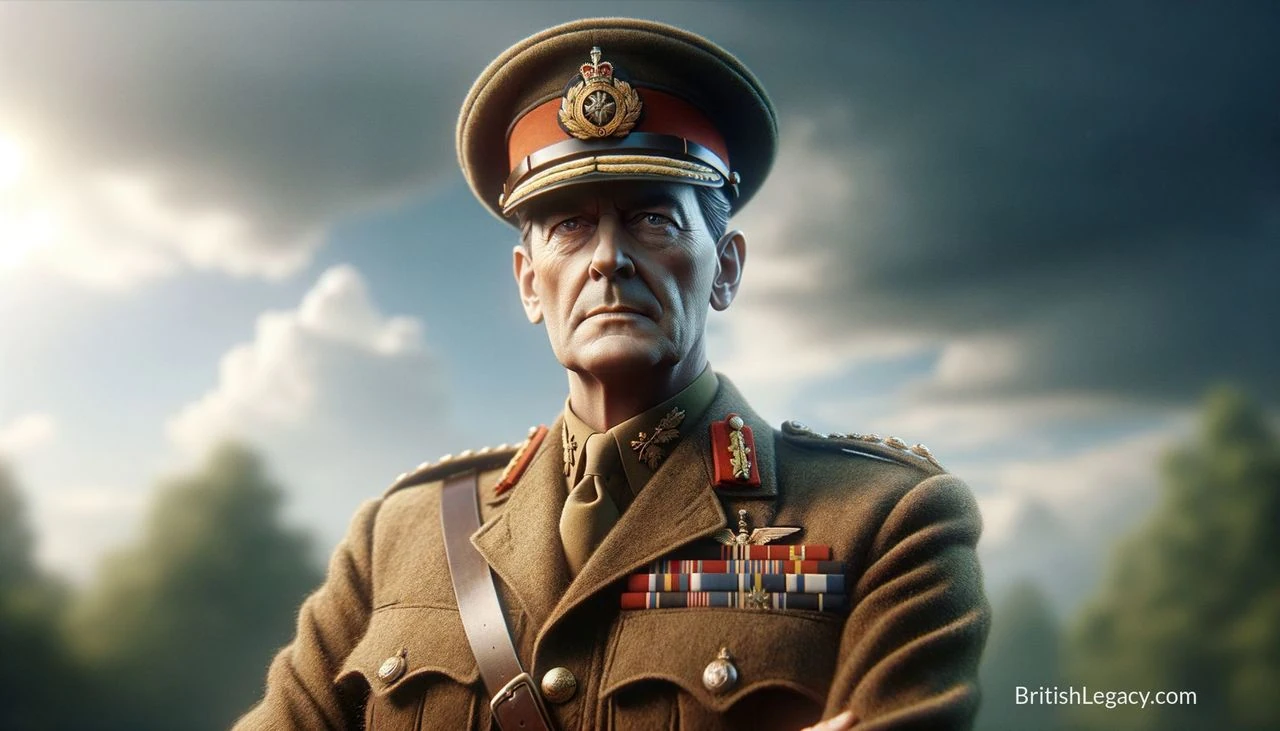
Lieutenant-General Sir Brian Horrocks spent much of his army career moving between demanding commands and difficult campaigns. He was wounded and captured in the First World War, served in the Russian Civil War, and led formations in North Africa before taking command of XXX Corps in north-west Europe. That command made him best known for Operation Market Garden, the 1944 Allied attempt to reach Arnhem and cross the Rhine. The operation failed to achieve its objective, but its story is only one part of a career that also included the liberation of Tunis, the advance into Germany and, after his retirement, fourteen years as Black Rod in the House of Lords.
A young officer shaped by war and sport
Horrocks was born in Ranikhet, British India, on 7 September 1895. His father, Sir William Horrocks, was a doctor in the Royal Army Medical Corps and held the rank of colonel; his mother was Minna Horrocks. The family returned to Britain, where Brian attended Bow School in Durham and later Uppingham School in Rutland. He entered the Royal Military College, Sandhurst, in 1912 and received his commission as a second lieutenant in the Middlesex Regiment on 8 August 1914, shortly after the outbreak of war.
Sent to France with the British Expeditionary Force, Horrocks was wounded in October 1914 while defending Maisnil and taken prisoner. He spent the remainder of the war in German captivity. He tried repeatedly to escape, learned Russian while held among Russian officers, and came close to reaching the Dutch border before being recaptured. His Military Cross, awarded in 1920, recognised his conduct in captivity.
In 1919, Horrocks joined the Allied intervention in the Russian Civil War. His duties included escorting a train carrying ammunition across Siberia and helping to train troops of the White Army. Fluent in Russian, he dealt with the many practical difficulties of the assignment. In January 1920, the Red Army captured him near Krasnoyarsk. He spent ten months as a prisoner, narrowly surviving typhus, before a negotiated release brought him home.
His inter-war career combined army postings with sport. Horrocks competed in the modern pentathlon at the 1924 Paris Olympics, finishing nineteenth out of 38 competitors. He served with the Territorial Army, studied at the Staff College at Camberley, worked at the War Office and later became an instructor. His experience with Territorial soldiers would prove useful in the expanding wartime army. In 1928 he married Nancy Kitchin; they had a daughter, Gillian.
Command in the Second World War
Horrocks first served under Bernard Montgomery in France in 1940. After commanding the 2nd Battalion, Middlesex Regiment, during the retreat to Dunkirk, he was given command of the 11th Brigade. Back in Britain, he led the 9th Brigade and then the 44th (Home Counties) Infantry Division, which prepared to defend the coast of Kent against a possible German invasion. In 1942 he took command of the 9th Armoured Division and was sent to Egypt to lead XIII Corps in the Eighth Army.
At Alam el Halfa, Horrocks’s corps helped repel the German attack on the ridge in August 1942. Montgomery had instructed him to prevent a breakthrough without suffering unnecessary losses. Horrocks retained command of XIII Corps for the Battle of El Alamein, where its role was to make a diversion to the south while the main attack went in farther north. Later that year he took over X Corps and took part in the advance through North Africa.
In March 1943, during the campaign in Tunisia, Horrocks led X Corps in a flanking move through a pass considered impassable by the German defenders. The operation made the Mareth Line untenable and helped force another Axis retreat. He later commanded IX Corps during the final Allied offensive in Tunisia, which captured Tunis and brought the surrender of the remaining Axis forces in North Africa.
His return to command was interrupted by a severe injury. In June 1943, while watching an amphibious exercise near Bizerte, Horrocks was hit by bullets from a German aircraft. His lungs, stomach and intestines were pierced. He underwent five operations and spent fourteen months recovering. In August 1944 he returned to active command, taking over XXX Corps during the fighting in France. The corps advanced through Belgium and captured Brussels; it was also diverted to secure the port of Antwerp, which fell to the 11th Armoured Division in early September.
XXX Corps and the road to Arnhem
In September 1944, Montgomery made Operation Market Garden the priority for the 21st Army Group. The plan was to send airborne forces to seize bridges in the Netherlands while XXX Corps advanced along a narrow route through their positions, crossed the bridges and reached the British 1st Airborne Division at Arnhem. The ground advance began on 17 September. The airborne force at Arnhem was expected to hold its position, but German resistance was stronger than the Allies had anticipated.
XXX Corps faced a single raised highway bordered by flat or flooded ground. Its advance was delayed by German counter-attacks and by the need to secure the route and its flanks. The bridge at Nijmegen, only eight miles from Arnhem, was not captured on the first day as planned. XXX Corps helped take it after reaching Nijmegen, but the delay cost time the operation could not recover. The British 1st Airborne Division held at Arnhem for several more days before the surviving troops were withdrawn or captured. Market Garden failed to secure the intended crossing of the Rhine.
Assessments of the operation have differed over the pace of the ground advance and the Allies’ mistaken picture of German strength. Horrocks later accepted responsibility for the corps’s progress, while arguing that its troops had fought hard and that the German recovery after Normandy was decisive. The difficulty of the route, the delays at Nijmegen and the presence of German armoured forces all formed part of the wider failure. The outcome should not be reduced to a single commander’s performance.
XXX Corps remained in action in north-west Europe. It took part in the fighting around Geilenkirchen and, in 1945, Operation Veritable, which forced German troops back towards the Rhine. Horrocks approved a heavy bombing raid on Cleves to assist the advance of the 15th (Scottish) Infantry Division; he later described the decision as the most terrible of his life. XXX Corps crossed the Rhine in March and advanced through Germany. On 15 April, Horrocks helped organise food, water and medical support for the thousands of prisoners at Bergen-Belsen, which British troops had liberated.
From Black Rod to broadcasting
After the war, Horrocks served as General Officer Commanding-in-Chief of Western Command and briefly commanded the British Army of the Rhine. The wounds he had suffered in North Africa continued to affect his health. He left the army early in 1949 and that year was appointed Knight Commander of the Order of the Bath. His wartime honours also included the Knight Commander of the Order of the British Empire, awarded in 1945, and decorations from several Allied countries.
In 1949 Horrocks became Gentleman Usher of the Black Rod, the officer responsible for aspects of administration, access and ceremony in the House of Lords. He held the post until 1963. One of its unusual duties came in 1957, when he ordered the actor Vivien Leigh out of the chamber after she interrupted proceedings to protest against the proposed demolition of the St James’s Theatre.
Horrocks also became a familiar television presenter. In programmes including British Castles, Men in Battle and Epic Battle, he explained military history to a broad audience. He contributed to the television series The World at War and wrote about his experience in A Full Life, published in 1960, and Corps Commander, published in 1977. He acted as military consultant for the 1977 film A Bridge Too Far, in which Edward Fox played him.
Horrocks died in Fishbourne, West Sussex, on 4 January 1985, aged 89. A memorial service was held at Westminster Abbey. At his request, the ceremony was simple, with no hymns or flowers. His cremated remains were later buried at St Paul’s Church in Mill Hill by the Princess of Wales’s Royal Regiment, a successor to his Middlesex Regiment.
Why Brian Horrocks deserves a place in British Legacy
Horrocks’s place in British history rests on a career that makes military service more than a sequence of battles and promotions. His early experiences included capture on the Western Front, repeated escape attempts and imprisonment during the Russian Civil War. Later, he commanded troops in Britain, North Africa and north-west Europe, adapting from infantry and home-defence responsibilities to the demands of corps command. His record includes the successful flanking move at the Mareth Line, the advance through Belgium and the final campaign into Germany. These episodes show the range of the work behind the familiar image of a wartime general.
His British legacy also reaches beyond the battlefield. After leaving the army, Horrocks served as Black Rod, an office linking the armed forces, public ceremony and the parliamentary life of the House of Lords. As a television presenter and author, he helped bring military history to audiences outside the services, while his contribution to A Bridge Too Far connected his personal experience with a widely seen account of Market Garden. His career cannot be presented as an uncomplicated story of victory: Arnhem was not reached, and he himself acknowledged the responsibility attached to his command. Remembering both his achievements and the limits of the operation gives British Legacy a fuller account of a soldier whose public life continued long after his active service ended.
Sources
Brian Horrocks (revision 1379835009)
Adapted in part from Brian Horrocks by Wikipedia contributors, under CC BY-SA 4.0. Text has been edited and combined with the existing article; this adapted text is shared under the same licence. Contributor history.