
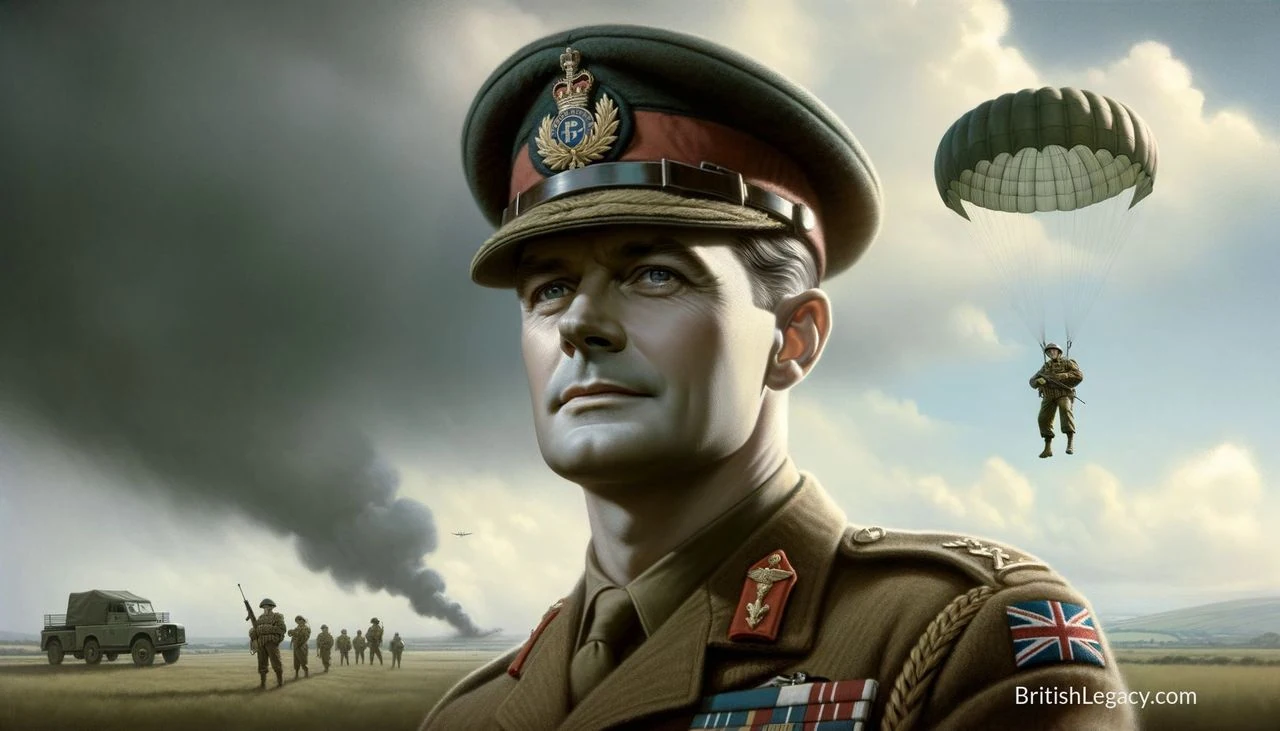
Frederick Browning’s career linked two very different chapters of British public life: the creation and command of airborne forces during the Second World War, and his later service in the royal household. Remembered as one of the founders of the British airborne forces, he commanded the 1st Airborne Division and I Airborne Corps. In September 1944, as deputy commander of the First Allied Airborne Army, he took part in Operation Market Garden. The operation failed to secure all its objectives, and Browning’s decisions and responsibilities remain part of its complicated history.
From Eton and Sandhurst to the Western Front
Frederick Arthur Montague Browning was born in London on 20 December 1896. The son of wine merchant Frederick Henry Browning and Anne Alt, he was educated at West Downs School and Eton College, where he joined the Officer Training Corps. He entered the Royal Military College, Sandhurst, in December 1914 and graduated the following June. Commissioned as a second lieutenant in the Grenadier Guards, he joined the Western Front in October 1915.
Browning served in the First World War’s major campaigns, including the battles of Pilckem Ridge, Poelcappelle and Cambrai. At Cambrai in November 1917, after other officers had become casualties, he took command of three companies, reorganised them and helped establish a defensible position under heavy fire. He received the Distinguished Service Order for his conduct. He was also awarded the French Croix de Guerre and mentioned in despatches. In 1918 he briefly served as aide de camp to General Sir Henry Rawlinson, then returned to his regiment and became an adjutant.
Between the wars, his service included appointments at Sandhurst and the Small Arms School, as well as command of the 2nd Battalion, Grenadier Guards. Sport was another strand of his life: he competed in athletics and, after an injury prevented him from taking part in the 1924 Winter Olympics, competed in bobsleigh at the 1928 Games, where his team finished tenth. He was also a sailor. In 1932 he married novelist Daphne du Maurier; they had three children.
Building Britain’s airborne forces
At the outbreak of the Second World War, Browning became commandant of the Small Arms School and then commanded the 128th Infantry Brigade. In 1941 he took over the 24th Guards Brigade Group. On 3 November that year, promoted to acting major-general, he became the first General Officer Commanding of the newly formed 1st Airborne Division. Its creation required more than a name and a new uniform: troops needed specialist training, equipment and aircraft capable of carrying them into action.
Browning worked through the practical and administrative barriers to developing the force. He dealt with the War Office and the Air Ministry as the division expanded and tested equipment, while the scarcity of suitable aircraft remained a serious constraint. He argued for the transport capacity the division needed; after a demonstration to Winston Churchill and the US Army Chief of Staff, George C. Marshall, Churchill directed the RAF to find more aircraft. Browning also helped establish the visual identity of the airborne troops: he was instrumental in introducing the maroon beret and assigned Major Edward Seago to design the Parachute Regiment’s Pegasus emblem. His work in organising and advocating for the force earned him the enduring description “father of the British airborne forces”.
His role extended beyond the first division. As major-general responsible for airborne forces at Allied Force Headquarters, he considered the lessons of operations in North Africa and pressed for airborne troops to be employed with adequate support and authority. He later commanded I Airborne Corps, which became part of the First Allied Airborne Army. His contribution was not simply to argue for a new way of fighting: it also involved the difficult work of organising units, securing resources and coordinating plans with British and American commanders whose priorities did not always align.
Market Garden and its limits
Operation Market Garden began in September 1944. The Allied plan was to use airborne troops to seize bridges in the Netherlands, enabling ground forces to advance towards Germany. Browning was deputy commander of the First Allied Airborne Army while retaining command of I Airborne Corps. He arrived by glider near Nijmegen with a tactical headquarters on the operation’s first day, 17 September.
The plan faced substantial constraints. Browning had concerns about the timetable for the air lifts, which limited the number of troops available at the outset, and about British landing zones he believed were too far from the Arnhem bridge. Intelligence had also raised the presence of German armoured divisions near Arnhem, although Browning did not convey the full weight of those concerns to his subordinates. His headquarters’ communications proved inadequate: it had little contact with the British division at Arnhem or the American division near Eindhoven. The 38 aircraft assigned to move his corps headquarters, including a substantial proportion carrying signals equipment, have since been criticised as a poor use of scarce lift capacity.
Market Garden did not achieve its central objective. The British airborne force at Arnhem was unable to hold the bridge, and the Allied advance fell short of the intended crossing into Germany. Browning’s part in the operation cannot be separated from the wider command structure, the decisions of other commanders, or the operation’s practical and intelligence failures. He accepted responsibility for ordering the American 82nd Airborne Division to secure the Groesbeek Ridge, a decision that took priority over an immediate attempt to capture the Nijmegen bridges. His assessment of the Polish airborne contribution also had consequences: the Polish brigade’s commander, Major-General Stanisław Sosabowski, was removed from his post.
The phrase “a bridge too far” became closely associated with the operation. Browning is said to have used it during the planning, though the exact wording is presented as reported rather than certain. The operation’s outcome, and the arguments about how responsibility should be shared, are a necessary part of his record alongside his role in building the airborne forces.
Service after the war
In December 1944 Browning became chief of staff to Admiral Lord Mountbatten at South East Asia Command, serving there until July 1946. He was appointed a Knight Commander of the Order of the British Empire in 1946 for his service. His final major Army post was Military Secretary at the War Office, from September 1946 until January 1948; he formally retired from the Army in April that year.
That January, Browning became comptroller and treasurer to Princess Elizabeth, then Duchess of Edinburgh, and head of her personal staff. When she became Queen Elizabeth II in 1952, he moved to the Office of the Duke of Edinburgh as its treasurer. The office supported the Duke’s sporting, cultural and scientific interests; Browning also became involved with the Cutty Sark Trust and the administration of the Duke of Edinburgh’s Award. He held senior honours in the royal household, becoming a Knight Commander of the Royal Victorian Order in 1953 and a Knight Grand Cross in 1959.
His health deteriorated after a severe nervous breakdown in 1957, and he resigned from his palace position in 1959. He retired to Menabilly in Cornwall, where du Maurier had lived and which had inspired her novel Rebecca. Browning was appointed a Deputy Lieutenant of Cornwall in 1960. He died at Menabilly on 14 March 1965, aged 68. His life in Cornwall and his marriage to du Maurier are part of his biography, but his lasting public reputation rests principally on his military service and the development of Britain’s airborne forces.
Why Frederick Browning deserves a place in British Legacy
Browning’s place in British Legacy rests first on his practical contribution to the establishment of British airborne forces. As the first commander of the 1st Airborne Division, he had to help turn a developing military concept into an organised force: one that required trained personnel, specialist equipment, transport aircraft and workable command arrangements. His dealings with the War Office and Air Ministry, his efforts to secure aircraft, and his part in shaping the maroon beret and Pegasus emblem show the range of that work. The history is more substantial than a claim that one officer single-handedly created a new arm of the Army. Browning’s importance lay in his command and advocacy within a larger military effort.
His record also gives the legacy a necessary measure of complexity. At Market Garden, Browning was a senior commander in an operation that failed, and his planning choices, communications arrangements and dealings with other commanders formed part of the outcome. Recording those limits makes his contribution more intelligible, not less significant. He also served Britain after the war, first in South East Asia Command and later in roles supporting Princess Elizabeth and the Duke of Edinburgh. Together, these strands explain his national connection: he helped shape a British military capability during wartime and went on to serve in both the Army and the royal household. His story offers a specific account of institution-building, command and the consequences of military decisions.
Sources
Adapted in part from Frederick Browning by Wikipedia contributors, under CC BY-SA 4.0. Text has been edited and combined with the existing article; this adapted text is shared under the same licence. Contributor history.
.jpg)