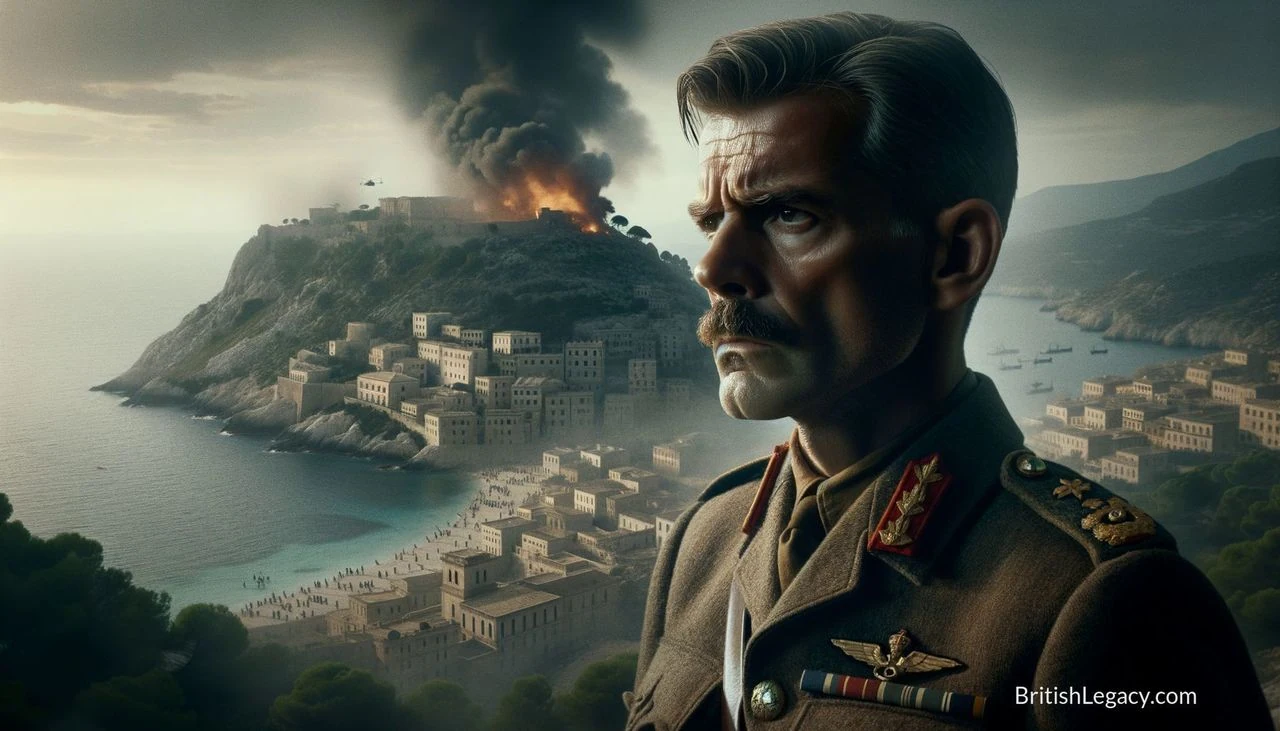
When Italy entered the Second World War in June 1940, Malta faced air attack and an uncertain military future. Lieutenant-General Sir William George Shedden Dobbie, newly appointed governor and commander-in-chief, told the garrison that difficult times might lie ahead, but that its courage and determination must not falter. His appeal joined military duty to his Protestant faith. Over the next two years, as Malta became a contested base in the Mediterranean, Dobbie’s work involved more than exhortation: he pressed for reinforcements, helped maintain morale and directed the island’s defence during sustained bombardment.
An engineer shaped by earlier wars
Dobbie was born in Madras, British India, on 12 July 1879. His father was a civil servant in the Indian Civil Service, and the family had a long military lineage. At nine months old, William was left in the care of relatives in England so that he could be educated there. He won a scholarship to Charterhouse School at 13, where he excelled in classical studies and took an interest in ancient military campaigns.
He went on to the Royal Military Academy at Woolwich and the Royal School of Military Engineering at Chatham. Commissioned as a second lieutenant in the Royal Engineers on 6 August 1899, he served in the Second Boer War, joining the conflict in 1901. He was wounded and returned to Britain after hostilities ended. In later life he described that war as unjust.
During the First World War, Dobbie served on staff and received the Distinguished Service Order. In November 1918, he was the staff officer on duty when the ceasefire telegram was sent to troops; his was its only signature. The episode became part of his own account of his service. After the war, he continued to advance through the army, holding engineering and command appointments. In 1935 he became General Officer Commanding Malaya Command, a post he held until 1939.
Preparing for a threat from the north
Dobbie’s years in Malaya also produced a warning about Singapore’s vulnerability. In 1936, he asked for an assessment of whether more forces were needed on the mainland to prevent a Japanese landing and the capture of forward bases. His chief staff officer, Arthur Percival, prepared an appreciation of likely Japanese operations. Dobbie concluded that Singapore could not be treated as a self-contained naval base: its survival depended on defending mainland Malaya.
In a 1938 report, he identified an attack from the north as the greatest potential danger to Singapore. He argued that the north-east monsoon would not necessarily prevent an invasion. Jungle was not impassable to infantry in most places, he wrote, while seasonal weather could provide cover for an attacking force. The assessment shows a commander considering how terrain and weather might shape an enemy’s choices, rather than relying on the apparent security of a fortified base.
Governor of Malta
Dobbie had expected to retire after Malaya, and efforts to return to active service after war began initially failed. In April 1940, however, he was offered the governorship and command of Malta. He arrived as doubts remained about the island’s ability to resist attack. Malta had only four aircraft, which may have escaped notice, and some questioned whether it could be defended or whether its population would remain committed to the British cause.
On the day Italy declared war, Dobbie addressed the garrison. He urged its members to rely on God and do their duty without flinching. Although he was a Protestant on a predominantly Catholic island, his broadcasts and evident calm helped him speak to the population’s religious outlook. Admiral Andrew Cunningham, commander-in-chief of the Mediterranean Fleet, later credited Dobbie’s faith and evening broadcasts with contributing substantially to morale.
Malta mattered to the wider Mediterranean campaign. Its position made it useful to British operations against Axis supply routes to North Africa, while also exposing it to attack. In early 1942, the Luftwaffe joined the assault in an exceptionally intense bombing campaign. The island endured hundreds of raids in two months; the weight of bombs dropped was reported as 27 times that of the Coventry Blitz. Requests for aircraft and reinforcements went to Winston Churchill, but two attempts to relieve Malta failed after supply ships were bombed in harbour. Spitfires delivered to the island were also destroyed on the ground soon after arrival.
Replacement and recognition
The pressure was not confined to the air raids. Dobbie faced administrative difficulties, including a blame culture in the island’s council. Exhausted and unwell, he was replaced by Viscount Gort in May 1942. Gort brought with him the George Cross, awarded by King George VI to the island of Malta in recognition of its people’s courage. Dobbie himself received the Knight Grand Cross of the Order of St Michael and St George. He retired from the army later that year, on 10 November, with the honorary rank of lieutenant-general.
Dobbie had married Sybil Orde-Browne, and they had a daughter and two sons. After his military service, he remained involved in education as a governor of Monkton Combe School in Somerset, a role he held from 1942 until 1964. He died in Kensington, London, on 3 October 1964, aged 85, and was buried at Charlton Cemetery.
Why William Dobbie deserves a place in British Legacy
Dobbie’s place in British Legacy rests on the combination of military judgement and practical leadership visible across his career. In Malaya, he challenged the assumption that Singapore’s naval defences could stand alone, identifying the mainland and the possibility of a northward attack as central to its security. In Malta, he took command when the island’s defences were in doubt and faced the demanding work of holding a garrison and population together while bombing, failed relief efforts and shortages shaped daily life. His tenure ended before the island’s ordeal was over, and the George Cross recognised Malta as a whole, not Dobbie alone. Remembering that distinction makes the account more accurate, not less significant.
His British connection is grounded in his service in the British Army, from the Royal Engineers and the Boer and First World Wars to senior commands between the wars and the governorship of Malta during the Second World War. His story also illustrates how command depended on more than battlefield orders: Dobbie’s appeals, broadcasts and faith mattered to morale, while his requests for aircraft and reinforcements linked the island’s defence to decisions made in Britain. Malta’s endurance had consequences beyond its shores because the island was a base in the Mediterranean struggle over Axis supply lines to North Africa. Dobbie’s contribution belongs within that larger, collective achievement: a record of foresight, responsibility and service under pressure, without mistaking one commander for the people and forces who defended Malta.
Sources
William Dobbie (revision 1379811145)
Adapted in part from William Dobbie by Wikipedia contributors, under CC BY-SA 4.0. Text has been edited and combined with the existing article; this adapted text is shared under the same licence. Contributor history.