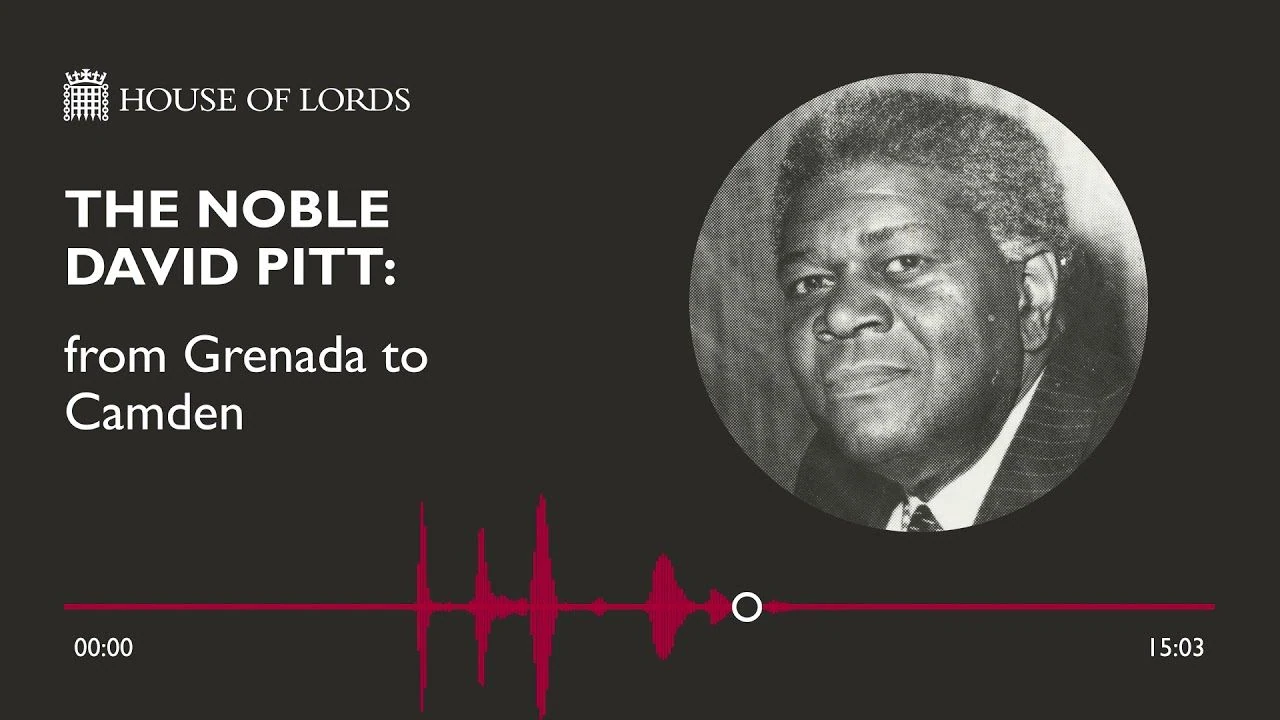
Lord David Pitt, Baron Pitt of Hampstead, stands out in modern British public life because he worked on one of the country’s hardest moral and political questions: whether Britain would meet post-war diversity with exclusion or with equal rights. A Grenadian-British politician and physician, he campaigned against racial discrimination, argued for the rights of immigrants and became a persistent public voice for fairer treatment in the United Kingdom.
What makes Pitt worth remembering is not simply that he spoke in favour of equality, but that he did so in places where argument might lead to change. He moved between medicine, activism and national politics. He brought professional authority, political experience and personal seriousness to debates that affected housing, work, public services and the everyday dignity of immigrant communities. When he entered the House of Lords in 1975, it was not a decorative honour at the end of a career. It was recognition that his campaigning had already helped shape Britain’s conversation about race and justice.
His story also matters because it joins several strands of British life that are too often told separately. Pitt was a doctor concerned with public welfare, a politician interested in reform, and a campaigner who understood that discrimination is not an abstract insult but something that can limit where people live, how they work and whether institutions treat them fairly. That combination gives his legacy its force.
From Grenada to Britain, through medicine and public service
David Thomas Pitt was born in Grenada on 3 October 1913. He came to the United Kingdom to study medicine and graduated as a physician from the University of Edinburgh in 1938. That medical training mattered. It gave him a profession, but it also seems to have reinforced a broader habit of mind: problems were to be examined, not merely lamented, and public well-being required practical remedies rather than pious language.
After Edinburgh, he returned to Grenada. There, according to the supplied account, he became involved in politics while also advocating social reform and improved medical services. Even in this early phase, the pattern of his public life is clear. He was not content to keep medicine inside the consulting room. Questions of health, poverty, administration and civic fairness belonged together.
In the years that followed, his route back to settled life in Britain included a period practising medicine in Trinidad before he settled in London in 1950. London gave him a larger stage, but the concerns remained consistent. He had seen public need at close quarters, and in Britain he entered a society where new arrivals were helping to reshape the country while also encountering prejudice and structural barriers. Pitt’s later prominence did not come from detachment. It grew from long contact with the human consequences of inequality.
Campaigning against racial discrimination
Pitt’s central public cause was the fight against racial discrimination in Britain. The supplied material describes his campaigning as tireless, and that is important because discrimination was not a single issue to be solved by one speech or one election. It appeared in different forms across public and private life, and it demanded organised, sustained pressure.
As chairman of the Campaign Against Racial Discrimination, from 1966 to 1971, Pitt occupied exactly that kind of organising role. Chairmanship in such a movement means more than attaching one’s name to a cause. It means turning grievance into argument, argument into pressure, and pressure into demands that government cannot indefinitely ignore. Pitt’s significance lies partly in this ability to help frame racial equality as a national political matter rather than a complaint to be pushed aside.
The article links that work directly to the Race Relations Act 1968. It says he played a pivotal role in influencing the legislation through campaigns that pressed the government to act against racial discrimination. The importance of that connection is easy to see from the areas named in the supplied text: employment, housing and public services. Those are not marginal concerns. They shape the practical terms on which people are allowed to live. A person denied a job, decent accommodation or fair access to services is not merely offended; that person is blocked from ordinary participation in society.
That is why Pitt’s anti-discrimination campaigning deserves to be understood as serious constitutional work as well as moral advocacy. He was helping Britain define what equal treatment should look like in daily life. The argument was not only about attitudes. It was about whether institutions would recognise and curb exclusion.
Immigrant rights and the politics of belonging
The supplied account stresses that Pitt’s work went beyond race relations in a narrow legislative sense. He was also a defender of immigrant rights and a critic of xenophobic policies. That broader role matters because immigration debates are often conducted as if newcomers exist only as a problem to be managed. Pitt insisted, instead, that immigrant communities had rights, interests and claims to dignity that had to be heard at the highest levels of government.
There is a great difference between talking about immigrants and talking with a determination to secure their rights. Pitt belonged to the second tradition. He treated immigrant communities as participants in British life, not outsiders waiting to be tolerated. That stance helped shape the tone of public debate as much as its content. It pressed against the habit of imagining Britain’s future in narrow or exclusionary terms.
His achievement here was not a single measure or slogan but something more durable: he helped establish that immigration and race were matters of justice, citizenship and fair dealing. In that sense, he contributed to the dialogue as well as the policy of race relations in Britain. He demanded that the country see people not as abstractions in a controversy, but as neighbours, workers, patients and citizens whose treatment would reveal the character of British democracy itself.
A physician’s concern for reform
Pitt’s medical career was not incidental to his public work. The supplied article notes that he advocated improvements in the National Health Service, with particular attention to ethnic minorities and underprivileged communities. That concern fits naturally with the rest of his life. A doctor sees that inequality is not only argued about in Parliament or on platforms; it is also experienced in access, provision and trust.
What gives this aspect of his legacy particular interest is the way it joins public service to reform. Pitt was not presented merely as a doctor who later took up politics, nor as a politician who happened to have medical qualifications. The two roles informed one another. His healthcare advocacy suggests a practical understanding that systems may fail people unevenly, and that reform should be judged by whether it reaches those most easily overlooked.
That concern for underprivileged communities also helps explain the consistency of his politics. Whether the issue was discrimination, immigrant rights or healthcare provision, Pitt’s attention returned to the same basic question: do the institutions of British life treat people fairly, especially when those people have the least power to insist on fair treatment themselves? His career gains coherence from that repeated test.
From campaigner to peer
In 1975, Pitt was made a life peer as Baron Pitt of Hampstead, becoming, in the wording of the supplied material, one of the first people of Afro-Caribbean descent to be elevated to the House of Lords. That fact carries symbolic weight, but the article rightly points to something more substantial. In the Lords he was an outspoken advocate for racial equality, social justice and healthcare reform.
His peerage therefore represented continuity as much as advancement. The causes did not change when the setting became more formal. He moved from campaigning outside government to arguing within one of the country’s central institutions. That matters because reform in Britain often depends on persistence across several arenas at once: public campaigning, political debate and legislative influence. Pitt’s career touched all three.
It also helps explain why his name remains associated with equality, justice and compassion in the supplied account. Those values were not left in the realm of sentiment. He tried to give them institutional form. The legal and social landscape of Britain, as described in the source material, was changed by that effort, and his example also fed a wider civil-rights conversation beyond Britain itself.
Why Lord David Pitt deserves a place in British Legacy
Lord David Pitt deserves a place in British Legacy because he represents a serious and valuable kind of British public life: one in which professional achievement, political courage and civic conscience strengthen one another. He did not contribute to Britain only by holding office or speaking nobly about fairness. He contributed by pressing the country to examine how it treated real people in work, housing, public services and healthcare. Those are the places where lofty principles either become part of ordinary life or fail altogether.
His British connection is not decorative and does not need embellishment. He studied in Edinburgh, built his public life in London, campaigned on questions central to the United Kingdom, and carried those arguments into the House of Lords. The issues he addressed were bound up with Britain’s own development as a diverse democracy. By defending immigrant rights and challenging racial discrimination, he helped widen the practical meaning of belonging in British society.
Future generations can value Pitt not simply as a symbol of representation, important though that is, but as a figure who tried to make institutions answerable to the ideals they claimed to uphold. His legacy asks a demanding and enduring question: who is British public life actually for, and how do we know? Pitt’s answer was that equality must be visible in law, in services and in political voice. That remains a legacy worth keeping close.