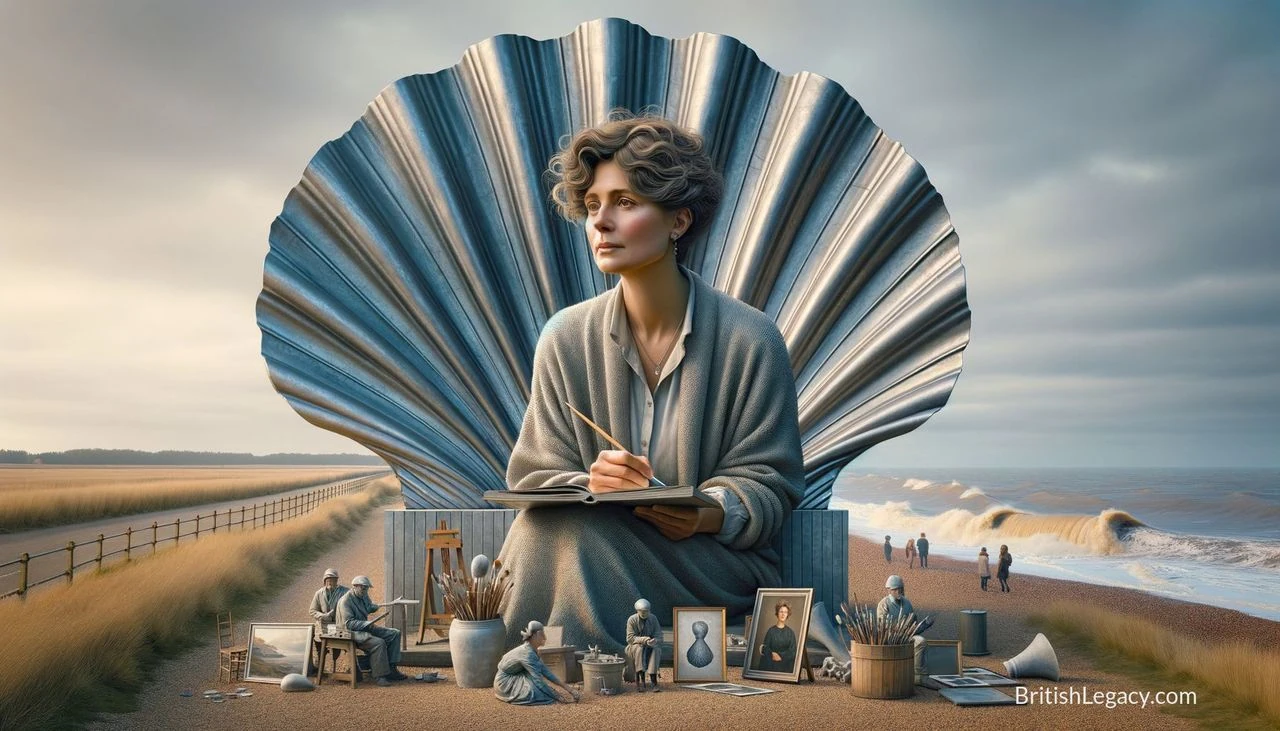
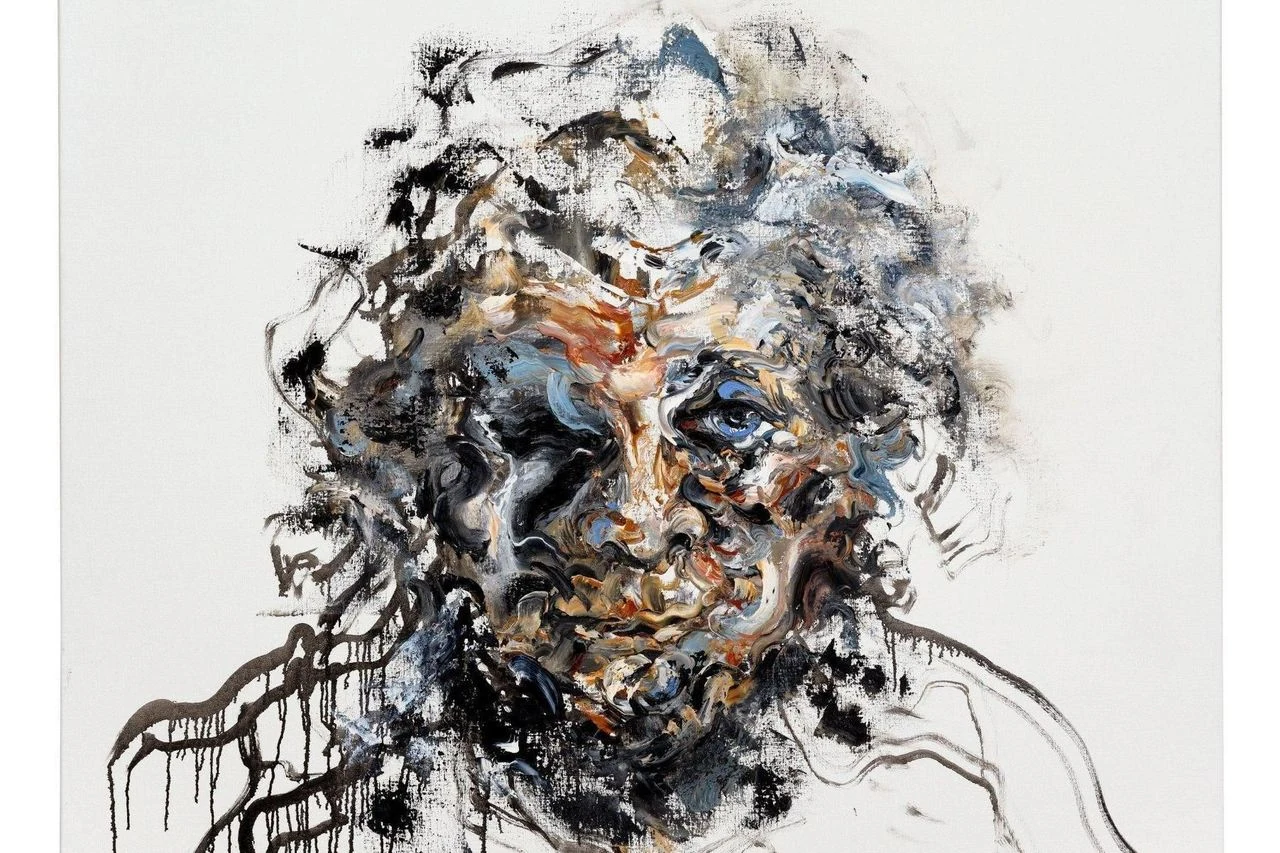
Maggi Hambling’s art does not stay quietly in the background. Her portraits give sustained attention to their subjects, while her public sculptures place striking forms and ideas in streets and landscapes where people can encounter—and argue about—them. On Aldeburgh beach, Scallop brings a quotation from Benjamin Britten’s opera Peter Grimes into conversation with the sea. In central London, A Conversation with Oscar Wilde turns a memorial into a place where visitors can sit beside the writer’s likeness. Both works show an artist willing to make public art an active encounter rather than a distant object.
Learning to look and paint
Hambling was born in Sudbury, Suffolk, on 23 October 1945. Her art education took her through several schools: she studied with Yvonne Drewry at Amberfield School in Nacton, then at the East Anglian School of Painting and Drawing from 1960. She continued at Ipswich School of Art, Camberwell College of Arts and, from 1967 to 1969, the Slade School of Art at University College London, graduating in 1969.
That training preceded a career spanning painting and sculpture, though Hambling is principally a painter. Her subjects include portraits as well as landscapes and seascapes; her North Sea paintings form a notable series. In 1980 she became the National Gallery’s first artist in residence. One result was a series of portraits of comedian Max Wall. When Hambling asked to paint him, Wall replied in a letter: “Re: painting little me, I am flattered indeed – what colour?” The exchange captures a directness that sits comfortably alongside the seriousness of the work.
Women feature prominently in her portraits. In 1985 the National Portrait Gallery commissioned her to paint the scientist Dorothy Hodgkin. Hambling represented Hodgkin at a desk with four hands, each engaged in a different task. The portrait makes its subject’s work and activity part of the image, rather than treating portraiture as a simple record of appearance. Hambling has also made portraits of Henrietta Moraes, including charcoal drawings made after Moraes’s death in 1999.
Portraits, landscapes and work made from grief
Hambling has painted people both living and dead, including her parents and Moraes in their coffins. She described continuing to paint after a subject’s death as therapeutic. A series about George Melly followed the jazz singer and writer’s approach to dying; Melly joked that Hambling would go down in history as “Maggi ‘coffin’ Hambling”. The dark humour and the sustained attention to death belong to the work’s subject matter, not to a tidy formula for interpreting it.
Her work also responds to concerns beyond individual portrait subjects. Hambling has spoken of anger about the destruction of the planet, politics and social issues, and has described making art as “making a work of love”. Her paintings are held in public collections including the National Portrait Gallery, the British Museum, Tate, the National Gallery, the Scottish National Gallery of Modern Art and the Victoria and Albert Museum. Their range places portraiture alongside a broader practice that takes in landscape, seascape and sculpture.
Public sculpture, from Wilde to Aldeburgh
In 1998 Hambling’s memorial to Oscar Wilde was installed at Charing Cross in central London. Called A Conversation with Oscar Wilde, it shows the writer emerging from a polished green granite coffin, a cigarette in hand. The coffin also serves as a bench, so a visitor can sit beside Wilde’s effigy. The title gives that ordinary act a role in the design: the memorial is not only something to view but a place to pause. It bears a line from Lady Windermere’s Fan: “We are all in the gutter but some of us are looking at the stars.”
The memorial drew severe criticism from some reviewers, while supporters said it had become well loved by the public. Its cigarette was repeatedly removed and was eventually no longer replaced. Those reactions are part of the work’s public life: the sculpture has been treated as a subject for debate and, at times, as something visitors could alter.
Scallop, Hambling’s 2003 memorial to composer Benjamin Britten, stands on the beach outside Aldeburgh in Suffolk. The four-metre-high cast stainless-steel sculpture takes the form of the two fractured halves of a shell. Etched into it are the words “I hear those voices that will not be drowned”, from Peter Grimes. Hambling described the work as a conversation with the sea, with its central space directing the sound of waves and wind and offering visitors a place to sit and contemplate.
Not everyone welcomed it. Opponents said it spoiled an unspoilt stretch of beach; a local petition attracted several hundred signatures, and the sculpture has been vandalised. The dispute is not separate from its setting: Scallop stands in a real coastal landscape, where a large modern structure inevitably changes how that place is seen. Hambling received the Marsh Award for Excellence in Public Sculpture for the work; the supplied biographical account gives differing years for the award, so no year is stated here.
A monument to Mary Wollstonecraft
Hambling’s later public sculpture for Mary Wollstonecraft was commissioned after a campaign for a permanent memorial had been under way since 2011. In 2018 she was chosen unanimously by the Mary on the Green campaign. The resulting work, A Sculpture for Mary Wollstonecraft, was unveiled in Newington Green, north London, on 10 November 2020, across from the Unitarian church associated with Wollstonecraft.
The sculpture presents a figure described as an everywoman, emerging from organic matter. Its design was inspired by Wollstonecraft’s description of herself as “the first of a new genus”, and a quotation from her appears on the plinth: “I do not wish women to have power over men but over themselves”. Hambling defended the decision to depict a naked figure, arguing that clothing would have restricted her and made the statue seem to belong to the past. The design prompted strong criticism, including from writer Caroline Criado Perez, who called it “catastrophically wrong”. Its reception continues a feature of Hambling’s public commissions: the work becomes a focus for argument about how, and by whom, history should be represented.
Recognition and a life in Suffolk
Hambling received the Jerwood Painting Prize jointly with Patrick Caulfield in 1995 and was appointed OBE in the same year for services to painting. In 2010 she was appointed CBE for services to art. She received the Suffolk Medal in 2022, having previously designed it. The honours recognise a career that has moved between studio work and commissions placed in public view.
Hambling has lived in Suffolk, and her work has maintained a strong connection with its coast and cultural life. In 2013 she exhibited at Snape during the Aldeburgh Festival, as well as holding a solo exhibition at the Hermitage in St Petersburg. She is also a patron of Paintings in Hospitals, a charity that provides art for health and social care in England, Wales and Northern Ireland. These activities extend her work beyond the making of individual paintings and monuments, linking her to institutions and audiences in different settings.
Why Maggi Hambling deserves a place in British Legacy
Hambling’s place in British Legacy rests on the breadth of a career in which painting and sculpture have remained in conversation. Her portraits include Dorothy Hodgkin, painted for the National Portrait Gallery, and her work is held across major British public collections. Her paintings of the North Sea draw on a landscape closely associated with her Suffolk life, while her portraits of people such as Max Wall and Henrietta Moraes show a sustained interest in the particular lives and faces before her. These are not isolated accomplishments: they form part of an artistic practice that has also addressed grief, death and public questions.
Her sculptures make that public dimension especially clear. Scallop connects Britten’s words and music with Aldeburgh’s shore, giving visitors a place to sit within a work designed around the sound of sea and wind. A Conversation with Oscar Wilde uses a bench to bring a memorial into everyday contact with its audience. A Sculpture for Mary Wollstonecraft, in turn, raises questions about how a historical woman should be represented in public space. The works have provoked criticism as well as support; that response is evidence of their presence in civic and cultural life, not a reason to claim universal approval. Hambling’s enduring contribution is to make art that people can meet directly, and that continues to prompt discussion about landscape, memory and representation.
Sources
Adapted in part from Maggi Hambling by Wikipedia contributors, under CC BY-SA 4.0. Text has been edited and combined with the existing article; this adapted text is shared under the same licence. Contributor history.