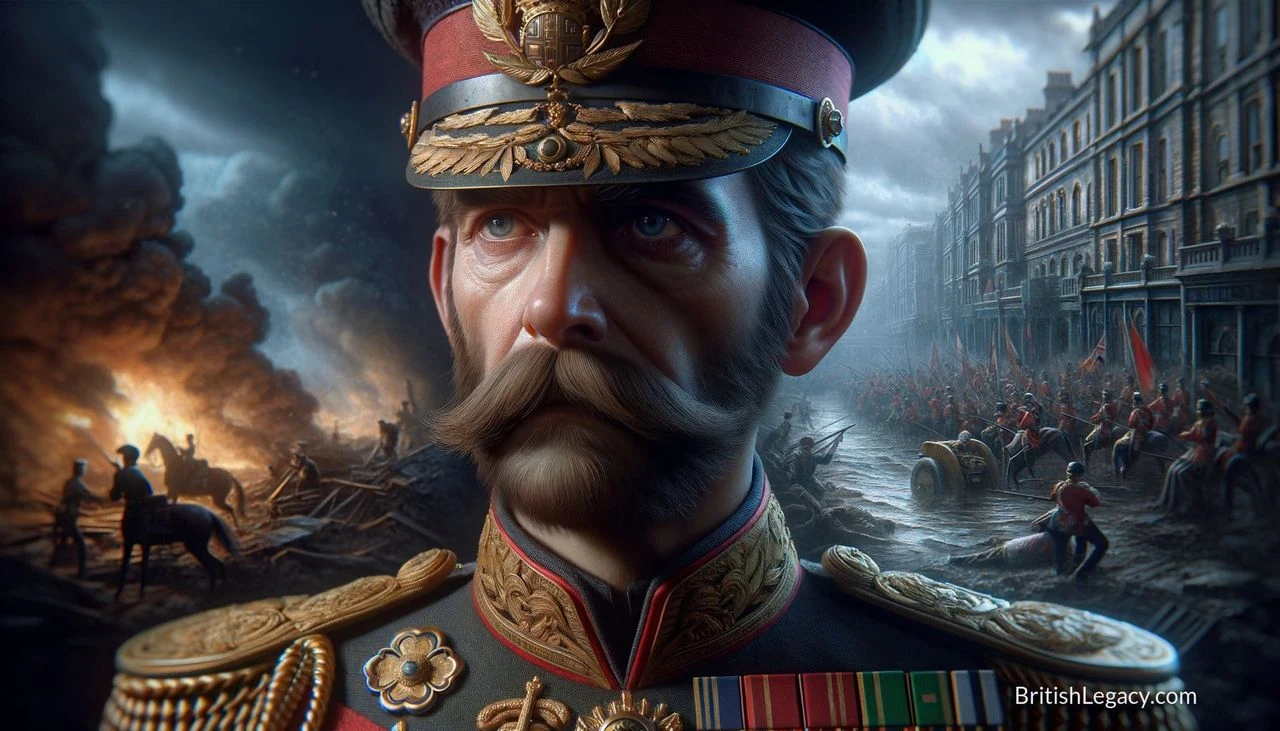
Charles George Gordon’s reputation was shaped by two very different campaigns. In China, he commanded the Ever Victorious Army against the Taiping rebellion; in Sudan, he remained in besieged Khartoum despite the British government’s plan to evacuate the city. His death in January 1885 turned him into a celebrated national figure. The story behind that fame is more complicated than the image of a solitary hero: it includes military skill, opposition to slavery, defiance of orders and a British public captivated by the crisis at Khartoum.
A Royal Engineers officer at war
Gordon was born in Woolwich, Kent, on 28 January 1833, into a military family. His father was Major General Henry William Gordon, and several generations of Gordon men had served as officers. Charles was educated at Fullands School and Taunton School before entering the Royal Military Academy at Woolwich. He received his commission as a second lieutenant in the Royal Engineers in June 1852. The engineers’ work included surveying, reconnaissance and the construction or destruction of fortifications, often under fire.
His first major experience of war came in the Crimea. Gordon arrived in January 1855 and took part in the siege of Sevastopol, mapping Russian defences and serving in dangerous forward trenches. He also joined the expedition to Kinburn. After the war, he worked on international boundary surveys, including the new frontier between the Russian and Ottoman empires, and later returned to Britain as an instructor at Chatham.
In 1860, he volunteered for service in China during the Second Opium War. By the time he arrived, the fighting involving British forces was largely over. He nevertheless saw the consequences of war and the devastation around him. The Taiping rebellion, a separate conflict against the Qing dynasty, was spreading towards Shanghai. Gordon initially viewed the Taipings with some sympathy, but accounts of their violence against local people changed his view.
Commanding the Ever Victorious Army
European and Asian militia had been organised to defend Shanghai and its surroundings. After the American commander Frederick Townsend Ward was killed, the Qing authorities sought a British officer to replace his successor. Gordon took command of the force known as the Ever Victorious Army in March 1863. It was made up of Chinese soldiers and led by foreign officers, but its loyalty and discipline could not be taken for granted. Gordon insisted that his men be paid, imposed firm rules against looting and used rivers and canals to move troops and supplies.
His approach to fighting favoured manoeuvre over costly frontal attacks. He led from the front and became known for carrying a rattan cane rather than a sword or firearm, although that familiar image should not obscure the dangers of the campaigns or the violence inflicted on civilians. Under Gordon, the army won a succession of engagements, including the capture of Quinsan and Suzhou. Its victories helped the Qing forces regain territory, but the rebellion was ultimately suppressed by a much wider campaign, not by Gordon’s force alone.
The conquest of Suzhou brought a lasting rupture between Gordon and his Chinese allies. He had guaranteed humane treatment to rebels who surrendered, but Qing troops executed prisoners after the city fell. Gordon was furious, viewing the killings as a breach of his word and as a military mistake likely to encourage further resistance. He temporarily withdrew his force from operations. He also declined substantial financial gifts from the Qing emperor and Shanghai merchants. The emperor honoured him with an imperial yellow jacket; Britain appointed him a Companion of the Order of the Bath in 1864. His successes made “Chinese Gordon” a familiar name in Britain.
Reform and failure in Sudan
In 1873, Gordon accepted employment with the Khedive of Egypt, with British government approval. He became governor of Equatoria, a southern province of the Egyptian-ruled Sudan, and worked to extend the administration’s reach. A central part of his work was suppressing the slave trade. He confronted slave traders and established stations along routes and waterways, but his efforts were obstructed by an inefficient and corrupt administration. He also had to contend with illness, distance and the demands of governing a vast region.
Gordon later became Governor-General of the Sudan. He sought to curb slavery and reform abuses, including torture and public flogging, but the officials and institutions needed to enforce those measures often resisted them. His reforms achieved limited results. After a dispute with the Egyptian authorities and a failed mission to Abyssinia, he resigned in 1879 and left Sudan. His service there was not simply a story of effective administration: he held office within an expansionist Egyptian system while attempting to restrain some of its worst practices.
In the years that followed, Gordon considered or accepted several posts. He spent time in India, returned briefly to China during concern about a possible war with Russia, and served in Mauritius. In 1880 he also urged the British prime minister, William Gladstone, to address poverty in Ireland through land reform. These episodes show a man who readily spoke his mind to governments and who was drawn to practical interventions, but they did not make him an easy subordinate.
The siege of Khartoum
By 1883, the Mahdist revolt led by Muhammad Ahmad had badly weakened Egyptian control in Sudan. The British government decided that the Sudan should be evacuated. Gordon, whose public reputation had grown through press coverage of his earlier service, was sent to Khartoum in January 1884 to report on how the withdrawal could be carried out. He arrived in February with executive authority from the Egyptian ruler, but his mission was not a British order to hold the city.
Gordon helped evacuate about 2,500 civilians, then stayed behind with a smaller force. He organised Khartoum’s defences as Mahdist forces closed in. His decision to remain ran against the British government’s intended withdrawal. It also left Egyptian soldiers and other inhabitants trapped in a city under siege. The British cabinet, divided over the response and reluctant to commit troops, eventually authorised a relief expedition under General Garnet Wolseley. Its progress up the Nile was slow.
The relief force’s advance did not reach Khartoum in time. The city fell on 26 January 1885, and Gordon was killed. A small reconnaissance party arrived two days later and found that the siege had ended. The British press had followed the crisis closely, and Gordon’s death provoked an intense wave of public mourning and criticism of Gladstone’s government. The familiar account of Gordon meeting death unarmed with only his cane is uncertain: accounts of his final moments differ, and the popular version was shaped by the heroic image built around him.
From national hero to contested imperial figure
Gordon’s death was quickly made into a national story. For many, he represented courage, Christian faith and loyalty to duty; the failed relief effort became a charge against ministers accused of abandoning him. Monuments and memorials followed. His cenotaph is in St Paul’s Cathedral, and a statue by Hamo Thornycroft, first erected in Trafalgar Square, was later placed on Victoria Embankment. In Gravesend, where Gordon had commanded Royal Engineers work on riverside fortifications, he is remembered through local sites including Gordon Promenade. His charity work there included supporting homeless boys with food, education and help finding homes or employment.
Later writers have questioned the simplicity of the heroic portrait. Lytton Strachey’s Eminent Victorians offered a sharp critique, while other biographers have examined Gordon’s volatile temperament, religious convictions and unreliable judgement. His decision to defy instructions at Khartoum remains central to that reassessment. It made the defence possible for as long as it lasted, but it also complicated the government’s withdrawal policy and exposed others to the consequences. Remembering Gordon therefore means considering both his humanitarian commitments and the imperial settings in which he worked.
Why Charles George Gordon deserves a place in British Legacy
Gordon belongs in a history of British influence because his career connects military service, overseas administration and the public politics of empire. As a Royal Engineers officer, he served in the Crimea and commanded a Chinese-led force during the Taiping rebellion. His insistence on paying his soldiers and his anger at the execution of surrendered prisoners distinguish his conduct from a simple tale of battlefield triumph. In Sudan, his attempts to suppress the slave trade and reform abusive practices mattered, even though the administration he served repeatedly frustrated those efforts.
His final stand at Khartoum also shows how an individual’s decisions could collide with government policy. Gordon chose to remain after being sent to advise on evacuation; the British state then struggled to respond as the city came under siege. The public story of his death turned that failure into a lasting British political and cultural memory, reflected in mourning, criticism of ministers, memorials and decades of debate about his character. That memory deserves attention not as uncomplicated praise, but as evidence of how British audiences understood duty, humanitarian purpose and imperial responsibility. Gordon’s legacy is powerful precisely because it holds achievement and contradiction together.
Sources
Charles George Gordon — Wikipedia revision · Charles George Gordon — Wikipedia
Adapted in part from Charles George Gordon by Wikipedia contributors, under CC BY-SA 4.0. Text has been edited and combined with the existing article; this adapted text is shared under the same licence. Contributor history.