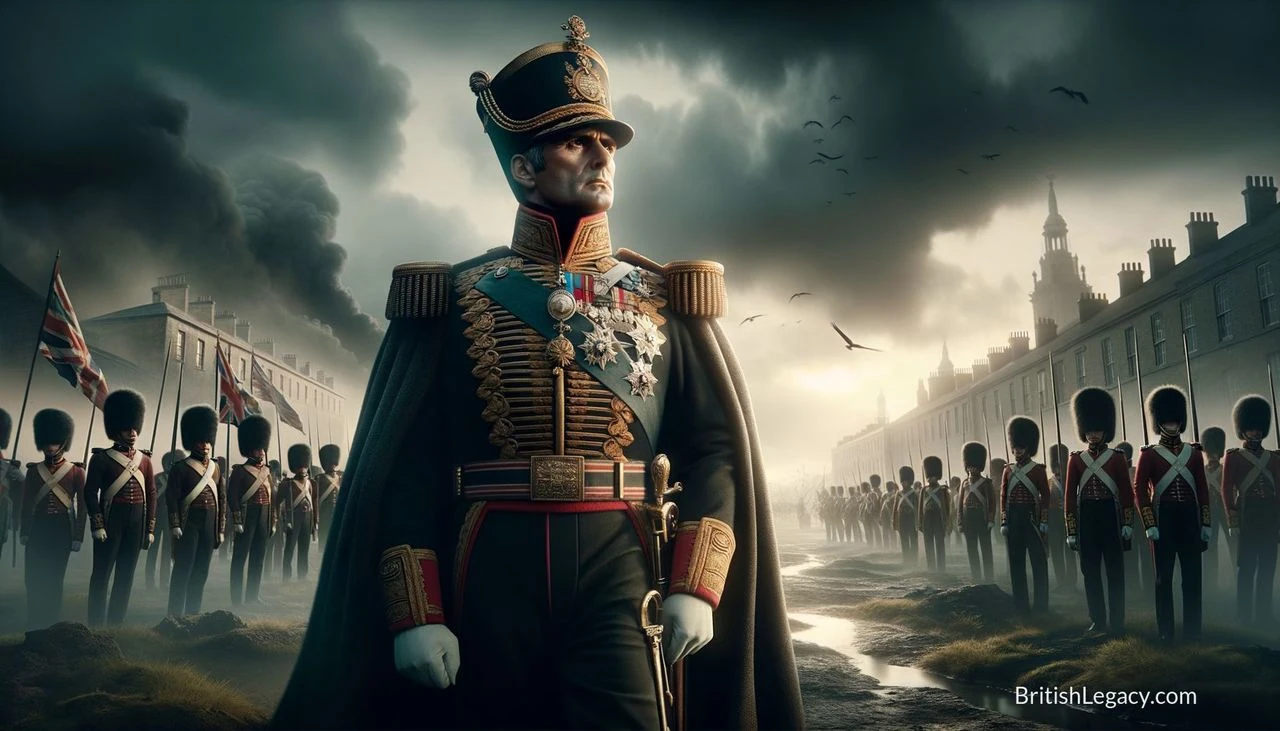
Robert Ross’s military career carried him from the battlefields of Europe to the American capital. A British Army officer born in Rostrevor, County Down, he served in the French Revolutionary and Napoleonic Wars before taking command of British forces on the east coast of the United States in 1814. On 24 August, after the victory at Bladensburg, he led troops into Washington, where public buildings including the Capitol and the White House were set on fire. Less than three weeks later, he was mortally wounded during the advance on Baltimore.
From Rostrevor to the army
Ross was born in 1766 in Rostrevor, County Down, Ireland. His father, Major David Ross, had served in the Seven Years’ War; his mother was Elizabeth Adderley. Ross studied at Trinity College Dublin, where he served as treasurer of the College Historical Society. In 1789 he joined the 25th Regiment of Foot as an ensign, beginning a military career that took him through several campaigns over the next quarter-century.
His early service included the fighting at Krabbendam in the Netherlands in 1799 and the Battle of Alexandria in Egypt in 1801. Promoted to major in 1803, he took command of the 20th Regiment of Foot. He fought at Maida in 1806 and Corunna in 1809, and was promoted to lieutenant-colonel at the end of that year. In 1810 he became a full colonel and an aide-de-camp to the King.
In 1813, Ross served under Arthur Wellesley in the Peninsular War, commanding his regiment at Vittoria, Roncesvalles and Sorauren. At Orthez in France, on 27 February 1814, he was seriously wounded in the neck. He had only recently returned to service when he was promoted to major general and appointed to lead an expeditionary force to North America.
The campaign in North America
Ross sailed to take command of British troops on the east coast of the United States. He led his soldiers ashore at Benedict, Maryland, and marched through Upper Marlboro towards the American forces. On 24 August 1814, at Bladensburg, British troops defeated hastily organised American militia. Ross’s victory opened the route to Washington.
That evening, his force entered the capital. Under Ross’s command, British troops set fire to public buildings, including the United States Capitol and the White House, then known as the President’s House. Both buildings sustained extensive damage to their interiors and contents. The current article characterised the operation as a meticulously planned assault and a calculated demonstration intended to hasten peace negotiations. The detailed account of Ross’s command instead describes the advance following Bladensburg, and reports that he had to be persuaded by Rear-Admiral George Cockburn to attack the capital. It also says Ross refused Cockburn’s recommendation to damage private property and threatened punishment for soldiers who did so. The burning of government buildings and the protection of private property are distinct parts of the campaign’s record.
Ross then led the British force north towards Baltimore. On the morning of 12 September, troops landed at North Point, south-east of the city. As the British advance encountered American skirmishers, Ross rode forward to direct his men. He was shot through the right arm and into the chest, and died while being carried back towards the fleet. His death came during the Battle of North Point, part of the wider Battle of Baltimore.
Death and remembrance
Ross’s body was taken aboard HMS Tonnant, where it was preserved in a barrel of Jamaican rum. When the ship was diverted to New Orleans, his body was transferred to HMS Royal Oak and carried to Halifax, Nova Scotia. He was buried at the Old Burying Ground there on 29 September 1814.
His memory has been marked in several places. In his home village of Rostrevor, a granite obelisk commemorates him; a smaller memorial stands in Kilbroney Parish Church, erected by soldiers who had served with him at Maida. In 1826, a granite memorial was placed on a hill within sight of his widow’s home. A National Monument to Ross also stands in St Paul’s Cathedral in London. Its inscription records his capture of Washington and his death while directing an attack near Baltimore.
Ross was not knighted and did not receive a title of nobility. His widow and descendants were granted an augmentation to the family arms, including an image of a broken American flagstaff, and the family name became Ross-of-Bladensburg. His military career is also commemorated in the United States Capitol, where a portrait of Ross is displayed in the central rotunda. The contrast between memorials in Ireland, London and the United States reflects the different places and communities touched by his campaigns.
Why Major General Robert Ross deserves a place in British Legacy
Ross’s place in British history rests on a career that joined the European wars of the late eighteenth and early nineteenth centuries to the War of 1812. His service took him through campaigns in the Netherlands, Egypt, Italy, Spain and France; after being badly wounded at Orthez, he returned to duty and was given command of an expeditionary force across the Atlantic. At Bladensburg, his troops defeated American militia, and he led the subsequent advance into Washington. These events make his career a concrete example of the reach and operations of the British Army during a period of conflict spanning Europe and North America.
That legacy should not be reduced to a celebratory account of the burning of Washington. The destruction of public buildings was consequential, but the record also distinguishes those targets from private property, which Ross ordered his troops to preserve. His death at North Point, during the next phase of the same campaign, brought his military career to an abrupt end. Memorials in Rostrevor and St Paul’s Cathedral, alongside his portrait in the United States Capitol, show how his actions have been remembered across national boundaries. For British Legacy, Ross is worth examining as a historically significant and contested figure: an Irish-born officer in British service whose campaigns and decisions remain part of both British and American history.
Sources
Robert Ross (British Army officer, born 1766) — revision 1379816299
Adapted in part from Robert Ross (British Army officer, born 1766) by Wikipedia contributors, under CC BY-SA 4.0. Text has been edited and combined with the existing article; this adapted text is shared under the same licence. Contributor history.