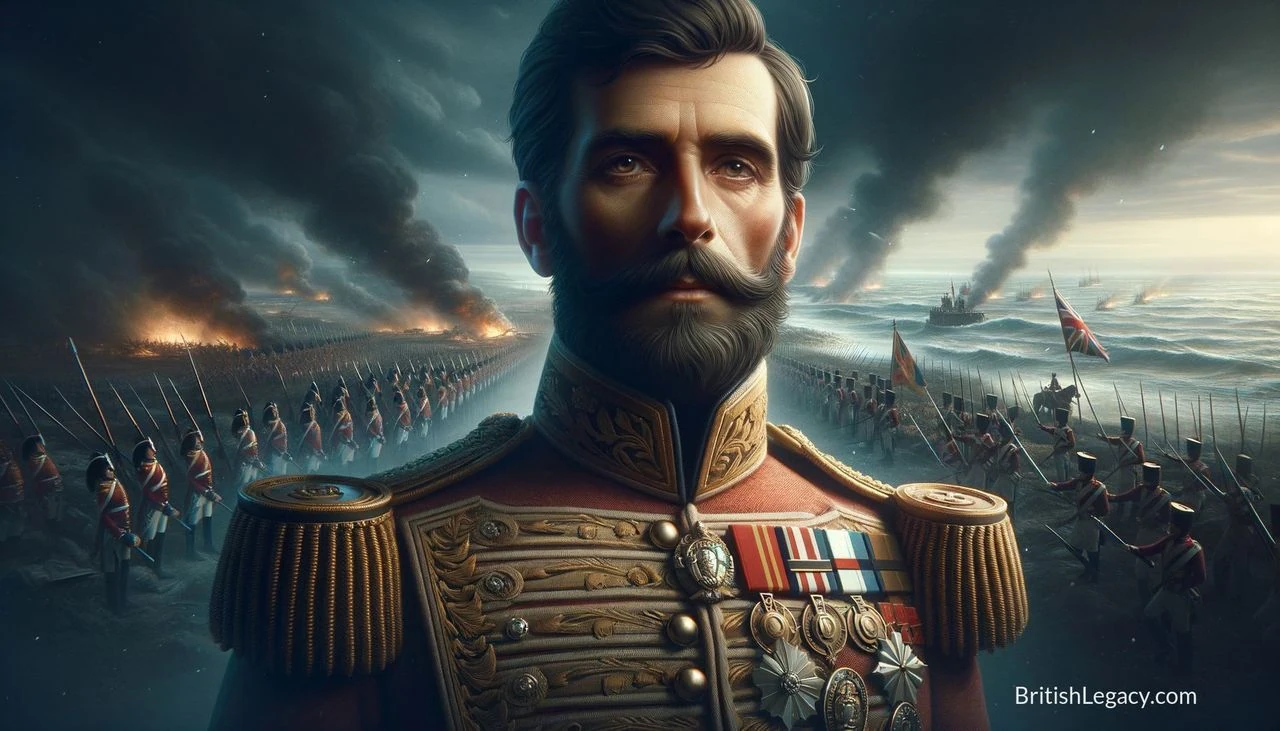
Isaac Brock’s reputation in Canada rests on two sharply different moments in the War of 1812. In August, his bold campaign forced the surrender of Detroit; two months later, he was killed leading a counterattack at Queenston Heights. The victories and the death helped make the British Army officer from Guernsey one of the best-known figures in the defence of Upper Canada. His story is also more complicated than a single heroic charge: Brock prepared the colony for war, worked with Indigenous leaders and left a legacy commemorated on both sides of the Atlantic.
From Guernsey to the British Army
Brock was born in St Peter Port, Guernsey, on 6 October 1769, the eighth son of John Brock, a former Royal Navy midshipman, and Elizabeth de Lisle. He was sent to school in Southampton at eleven and later studied in Rotterdam, where he learnt French. His formal education ended while he was still a teenager, but he continued reading widely, including military works, science and history.
In 1785, aged fifteen, Brock joined the 8th (The King’s) Regiment of Foot as an ensign. His family purchased his first commission, a common practice of the period. He transferred to the 49th Regiment of Foot in 1791 and rose through its ranks, eventually becoming its commanding officer. His early service took him to the West Indies and to Europe. The 49th served in the 1799 Anglo-Russian expedition to the Netherlands and the 1801 expedition against Copenhagen. At Alkmaar in 1799, Brock was injured by a spent musket ball but returned to duty within half an hour.
The regiment reached British North America in 1802. Brock commanded it in Upper Canada, where he dealt with desertion and a threatened mutiny, and later held senior military responsibilities in the Canadas. Promoted to colonel in 1805 and brigadier general in 1808, he became a major general in 1811. That year he was also appointed administrator of Upper Canada while its lieutenant governor, Francis Gore, was away. Brock therefore had both military and civil responsibilities as the threat of war grew.
Preparing Upper Canada for war
Many people in Britain and Canada expected that war might be avoided, while Brock considered the colony vulnerable to an American invasion. Its regular troops were few and spread across distant posts. As administrator, he pressed to strengthen the militia and fortifications, and sought support from Indigenous leaders, including the Shawnee leader Tecumseh and the Mohawk leader John Norton. He also wanted greater authority to prepare the colony, though his attempt to have the legislature partially suspend habeas corpus failed.
The United States declared war on Britain on 18 June 1812. In July, American forces under Brigadier General William Hull crossed the Detroit River and occupied Sandwich, but then withdrew towards Detroit. Brock travelled west with regulars and militia, joined on the way by other militia and Indigenous warriors. His force was smaller than Hull’s, but Brock judged that delay would give the Americans time to strengthen their position.
On 16 August, Brock’s force crossed the river and secured Hull’s surrender at Detroit. He used artillery, the presence of Tecumseh’s warriors and other measures to make his force appear stronger than it was. The victory captured supplies and firearms, removed an immediate threat to Upper Canada and encouraged Indigenous groups who had been uncertain about supporting Britain. Brock’s success brought him public acclaim and a knighthood in the Order of the Bath. It also strengthened his association with Tecumseh, although the two men had collaborated in person for only a few days.
The alliance served shared military aims, but it should not be mistaken for proof that Brock and British authorities consistently recognised Indigenous sovereignty. Brock promised Tecumseh that he would not negotiate peace with the Americans without addressing the Shawnee leader’s vision of an independent homeland. The outcome of the war and the later fate of Indigenous claims cannot be reduced to Brock’s intentions alone.
Queenston Heights and Brock’s death
American forces crossed the Niagara River at Queenston in the early hours of 13 October 1812. Brock rode to the village and found that the Americans had captured a British artillery position on the heights. He assembled regulars and militia and led an attempt to retake it. Shot in the chest by an American marksman, he died on the battlefield, aged 43. The counterattack he led did not succeed.
The fighting continued after Brock’s death. Major General Roger Hale Sheaffe arrived with reinforcements and led a later attack that forced the American troops to surrender. The distinction matters: Brock was killed before the British victory was secured, rather than living to turn the battle in Britain’s favour. His immediate successor was nevertheless remembered in the shadow of Brock’s reputation, and Brock’s death became central to the story told about the defence of Upper Canada.
Brock and his aide-de-camp, Lieutenant Colonel John Macdonell, were buried at Fort George. Their remains were later moved to a monument on Queenston Heights. After the original monument was heavily damaged by a bombing in 1840, a larger replacement was built at public expense. Brock and Macdonell were reinterred there in 1853. The monument remains a prominent memorial to the battle and to Brock’s role in it.
A legacy across Britain, Guernsey and Canada
Brock’s name became attached to the early British successes of the War of 1812, especially the capture of Detroit. In Canada, his memory extends well beyond the battlefield: the city of Brockville, Brock University, schools and other public places bear his name. Brock’s Monument at Queenston Heights and memorials elsewhere mark his importance in Canadian public memory. Such honours reflect the lasting place assigned to him in accounts of the defence of Upper Canada, not proof that every later legend about his life is accurate.
His British connections are equally concrete. Guernsey was his birthplace, and his career was spent in the British Army. A memorial to him stands in St Paul’s Cathedral in London, and his childhood home in St Peter Port bears a commemorative plaque. A depot of the 49th Regiment of Foot, later known as the Royal Berkshire Regiment, was named Brock Barracks in Reading. These links place his life in the history of a British regiment and its overseas service, while also recognising Guernsey’s distinct place in his story.
Some familiar details have become part of the legend rather than firmly established biography. Brock’s supposed last words, “Push on, brave York Volunteers”, are not supported by the account of a witness who described him falling without replying. His story is strongest when the record is allowed to retain that uncertainty: a decisive commander at Detroit, a senior officer preparing a vulnerable colony, and a soldier killed in an unsuccessful attempt to recover the heights.
Why Major-General Sir Isaac Brock deserves a place in British Legacy
Brock’s place in British Legacy rests on an evidenced connection between his origins, his service and the consequences of his command. Born in Guernsey, he entered the British Army as a teenager and served with the 49th Regiment in Europe and North America. As a senior officer and administrator in Upper Canada, he did more than hold a title: he worked to improve the colony’s defences and prepare its militia when an invasion seemed possible. At Detroit, he took a calculated risk with a smaller force and secured a surrender that temporarily checked an American advance. Those events make his career a specific part of British military history, rather than an example of Britishness by assertion.
His legacy also deserves a measured account because it reaches beyond military success. Brock’s dealings with Tecumseh mattered to the defence of Upper Canada, but the alliance had its own Indigenous aims and cannot simply be presented as a story of harmonious cooperation. At Queenston Heights, Brock died before the later British victory, a distinction that honours his actions without crediting him with a result achieved under Sheaffe. Memorials in London, Guernsey and Canada show how his reputation travelled across the places connected to his life and service. Remembering both his achievements and the limits of the heroic legend gives readers a fuller understanding of a British officer whose actions shaped the early course of the War of 1812.
Sources
Isaac Brock — supplied revision
Adapted in part from Isaac Brock by Wikipedia contributors, under CC BY-SA 4.0. Text has been edited and combined with the existing article; this adapted text is shared under the same licence. Contributor history.