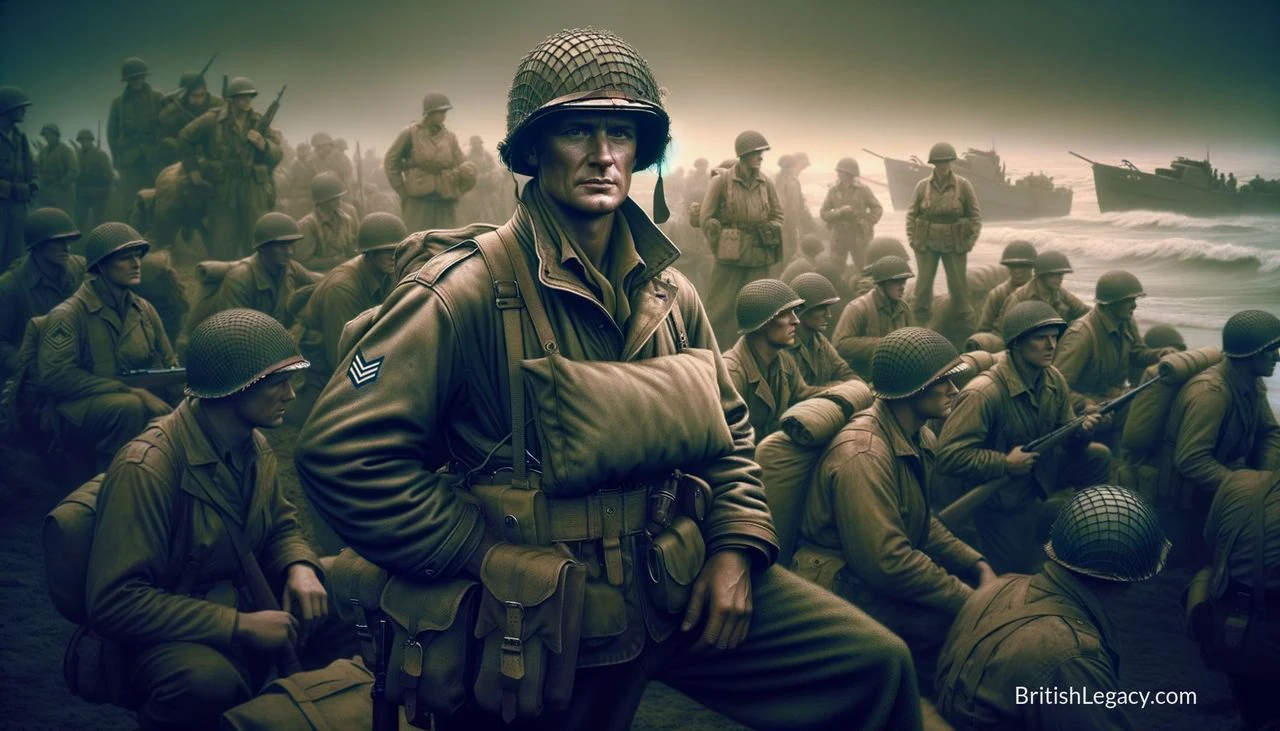
Richard Winters arrived in Britain in September 1943 as an American paratrooper preparing for the invasion of Europe. In Wiltshire, Easy Company trained for the campaign that would begin with the Normandy landings. The next summer, after his company commander was killed during the airborne assault, Winters led the attack at Brécourt Manor that won him the Distinguished Service Cross. His wartime story is American, but Britain was a staging ground for the campaign and a formative setting in the history of the unit he came to command.
From Pennsylvania to the paratroopers
Richard Davis Winters was born on 21 January 1918 in New Holland, Pennsylvania. His family soon moved to nearby Ephrata and later to Lancaster, where he attended Lancaster Boys High School. He graduated in 1937 and went on to Franklin and Marshall College, balancing his studies with part-time work. He gave up wrestling and much of his social life to concentrate on his degree in economics, which he completed in June 1941 with the highest academic standing in his college’s business programme.
Winters entered the US Army on 25 August 1941. After basic training in South Carolina, he attended Officer Candidate School at Fort Benning, Georgia, and was commissioned as a second lieutenant in July 1942. He chose the new parachute infantry and joined the 506th Parachute Infantry Regiment at Camp Toccoa. Assigned to Company E, later known as Easy Company, he became a platoon leader and then acting company executive officer.
Training shaped both the company and Winters’s relationships within it. He had serious concerns about the combat leadership of Easy Company’s commander, Herbert Sobel. Their conflict led to Winters being transferred temporarily to battalion headquarters; after Sobel was moved to a parachute training school, Winters returned to the company. Winters later recognised that Sobel’s demanding training had contributed to the unit’s preparation, despite their differences.
Training in Wiltshire, fighting in Normandy
The 506th arrived in Liverpool on 15 September 1943 and moved to Aldbourne, Wiltshire, for intensive preparation for the Allied invasion. Easy Company was still based there when disputes over Sobel’s command came to a head. In February 1944, First Lieutenant Thomas Meehan took command of the company.
On 6 June, the aircraft carrying most of Easy Company’s headquarters section was shot down, killing everyone on board. Winters landed safely near Sainte-Mère-Église. He had lost his weapon during the jump, but gathered paratroopers, including men from the 82nd Airborne Division, and moved towards the unit’s objective near Sainte-Marie-du-Mont. With Meehan’s fate unknown, Winters became Easy Company’s acting commander for the Normandy campaign.
Later that day, he led an assault on German guns at Brécourt Manor, south of Le Grand-Chemin. The battery’s howitzers were firing on the causeways used by troops leaving Utah Beach. The Americans estimated that about 50 German troops defended the position; Winters had 13 men. His force attacked the battery and withdrew for reinforcements, returning with tank support to put the remaining guns out of action. They also obtained a map showing German gun positions near the beach. The assault is taught at West Point as an example of an attack on a fixed position by a smaller force.
Winters was promoted to captain on 1 July 1944 and received the Distinguished Service Cross the next day. The award recognised his leadership in the attack, although he had been recommended for the Medal of Honor. The 506th returned to Aldbourne after the Normandy campaign for reorganisation.
Across the Netherlands, Belgium and Germany
In September 1944, the regiment parachuted into the Netherlands as part of Operation Market Garden. On 5 October, a German attack threatened the flank of the 2nd Battalion. After a patrol reported a large enemy force near a crossroads, Winters took a squad to investigate. He led an assault on a machine-gun position and, when his men came under fire from another position, called up reinforcements. A subsequent attack by his platoon and men from Fox Company succeeded; the German force was later found to have included at least 300 men.
Four days later, Winters became executive officer of the 2nd Battalion, a position normally held by a major. During the Battle of the Bulge, the 101st Airborne was sent to the Bastogne area. Winters helped defend the line north-east of the town. After the siege was relieved, the battalion attacked Foy. Winters was promoted to major in March 1945 and took over as acting commander of the battalion. In May, the 2nd Battalion reached the alpine retreat at Berchtesgaden; the war in Europe ended three days later.
After the war and the story of Easy Company
Winters left the Army after the war and worked for his wartime friend Lewis Nixon’s family business, eventually becoming its general manager. He married Ethel Estoppey in 1948. Recalled to active service during the Korean War in 1951, he was assigned to planning and training at Fort Dix. He later accepted the option to resign his commission rather than deploy to Korea.
In 1972 he started a business selling animal feed to Pennsylvania farmers. His wartime experiences reached a much wider audience through books and television. Stephen Ambrose’s 1992 history of Easy Company became the basis for the 2001 HBO miniseries Band of Brothers, in which Damian Lewis portrayed Winters. At the 2002 Emmy Awards, Winters spoke on behalf of Easy Company and remembered both the men present and those who had died. He also lectured on leadership at West Point. His memoir, Beyond Band of Brothers, written with Cole C. Kingseed, appeared in 2006.
Winters died on 2 January 2011, aged 92. A memorial to him was unveiled near Sainte-Marie-du-Mont on the 68th anniversary of D-Day. He had agreed to the statue on the condition that it honour all junior officers who served and died during the Normandy landings. A cast was later installed in Ephrata, Pennsylvania, where Winters had lived as a child.
Why Richard Winters deserves a place in British Legacy
Winters was an American officer, and his achievements should not be recast as British ones. The connection to Britain is specific: he and the 506th Parachute Infantry Regiment arrived in Liverpool in 1943, then trained in Aldbourne, Wiltshire, in preparation for the invasion of Europe. That training ground was part of the Allied effort built in Britain before D-Day. The company’s arrival, preparation and departure place Winters within a British wartime story without confusing his nationality or the command structure of the US Army.
His subsequent record gives that connection its wider significance. From the Brécourt Manor assault on D-Day to the fighting in the Netherlands, Bastogne and Germany, Winters served in operations that depended on Allied forces and preparation across national borders. His company’s history also entered public memory through Ambrose’s book and the television adaptation, while the memorial near Sainte-Marie-du-Mont commemorates junior officers beyond Winters himself. Remembering him in British Legacy is therefore a way to explain how American troops trained on British soil before taking part in the liberation of occupied Europe. It honours a documented shared history: Britain as a base for Allied action, and Winters as one of the officers whose wartime service began there.
Sources
Richard Winters · Richard Winters
Adapted in part from Richard Winters by Wikipedia contributors, under CC BY-SA 4.0. Text has been edited and combined with the existing article; this adapted text is shared under the same licence. Contributor history.