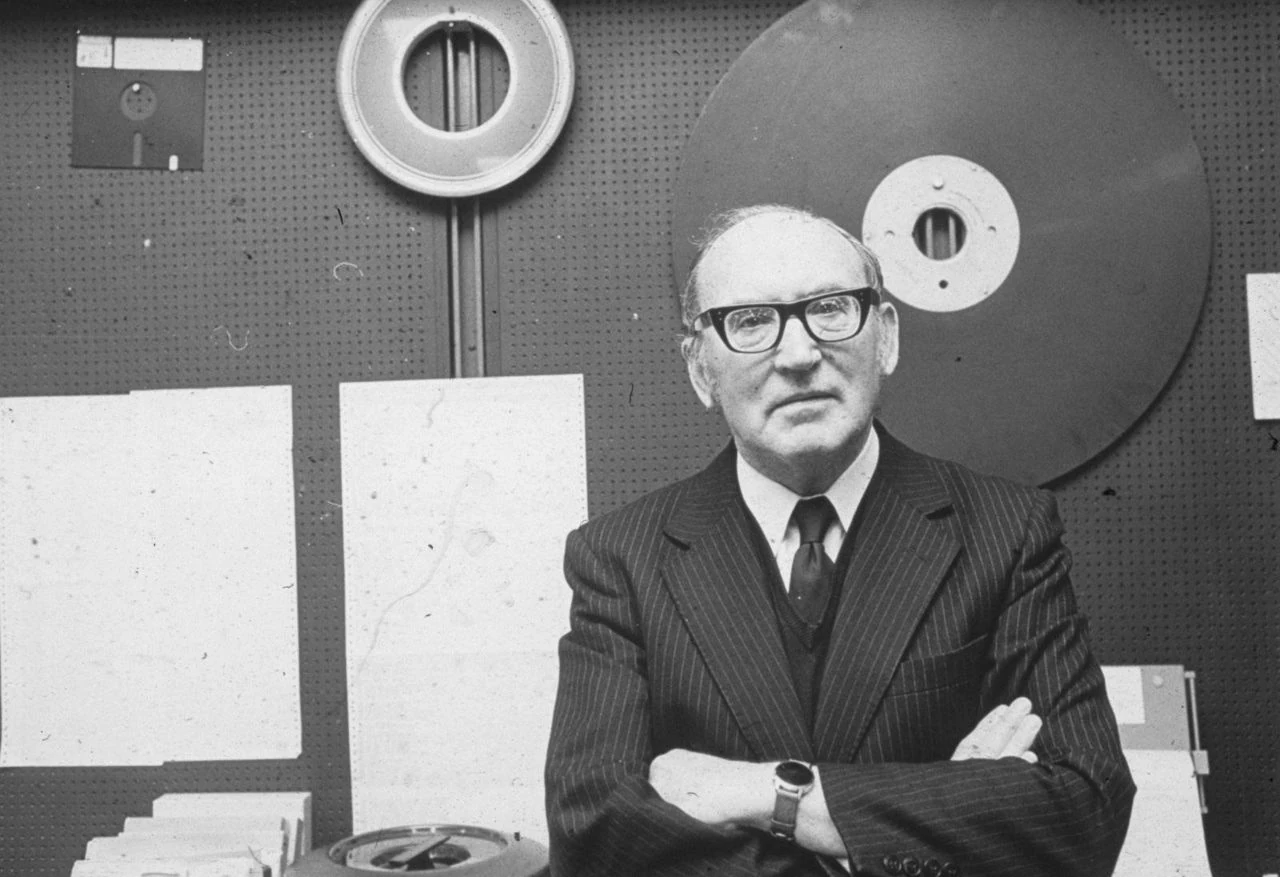
In 1946, Maurice Wilkes crossed the Atlantic to attend a course on electronic computing at the University of Pennsylvania. On the five-day voyage back to England, he sketched the logical structure of a machine he would build at Cambridge. EDSAC was designed not as a theoretical showpiece, but as a computer that the university could actually use. That practical purpose defined Wilkes’s work: he helped bring stored-program computing into operation, developed microprogramming and contributed to tools that made computers easier to programme.
From Dudley to Cambridge
John Maurice Vincent Wilkes was born in Dudley, Worcestershire, on 26 June 1913. He grew up in Stourbridge and attended King Edward VI College there. A chemistry teacher introduced him to amateur radio, an early encounter with the technology that would also inform his academic interests.
Wilkes studied mathematics at St John’s College, Cambridge, from 1931 to 1934. He completed a doctorate in physics in 1936, researching the propagation of very long radio waves in the ionosphere. He then joined the University of Cambridge, where he became involved in establishing a computing laboratory. During the Second World War, he worked on radar and operational research at the Telecommunications Research Establishment.
In 1945, Wilkes became the second director of Cambridge’s Mathematical Laboratory, later known as the Computer Laboratory. A visit from mathematician Leslie Comrie brought him a copy of John von Neumann’s description of the EDVAC computer. Wilkes had to read it overnight before returning it; without photocopying facilities, there was no way to keep a copy. The document helped persuade him that the future lay in computers whose instructions could be stored in memory.
EDSAC: a working machine for Cambridge
Wilkes travelled to the United States in 1946 to attend the Moore School Lectures on computing, but travel delays meant he could take part only in the final two weeks. On the return journey, he began to plan the machine that became the Electronic Delay Storage Automatic Calculator, or EDSAC. Back in Cambridge, the laboratory’s own funding allowed him to start building it.
His aim was to make a computer available to the university, not to produce a machine larger or faster than its rivals. He relied on methods that had already been tried, choosing a practical route over a more ambitious design. EDSAC was slower and smaller than some contemporary projects. It nevertheless became the second practical stored-program computer to be completed and operated successfully, beginning work in May 1949.
That distinction matters: describing EDSAC simply as the first practical stored-program computer overstates its place in the sequence. Its importance lies instead in bringing a working stored-program machine into regular use at Cambridge. Users could store instructions as well as data, allowing the computer to carry out different tasks by changing the programme rather than rebuilding the machine for each calculation.
In 1950, Wilkes and David Wheeler used EDSAC to solve a differential equation concerning gene frequencies in a paper by statistician Ronald Fisher. This was the first use of a computer for a problem in biology. It offered a concrete example of the machine’s purpose: making computation available to researchers tackling problems in other fields.
Microprogramming and the craft of software
Wilkes’s work extended beyond the construction of EDSAC. In 1951, he developed the concept of microprogramming: controlling a computer’s central processing unit with a small, specialised programme. The idea offered designers a way to organise and simplify the control of complex machine operations. Wilkes first described it at the University of Manchester Computer Inaugural Conference; he expanded on it in a paper published in 1955.
The approach was implemented in EDSAC 2. That computer also used repeated, identical sections called bit slices to simplify its design, with replaceable tube assemblies for each processor section. These were practical responses to the challenge of making complicated hardware manageable, rather than abstract proposals detached from engineering.
Wilkes also helped develop programming methods that made work on computers more tractable. He is credited with symbolic labels, macros and subroutine libraries: tools that let programmers refer to instructions and reusable routines without having to write every operation from scratch. In 1951, he co-authored Preparation of Programs for an Electronic Digital Computer with David Wheeler and Stanley Gill. The book introduced programme libraries in a form that could be used by other programmers.
At Cambridge, later projects carried this practical approach into new areas. The Titan computer, begun with Ferranti in 1963, supported the university’s first time-sharing system, giving more people access to computing resources. Its system controlled access partly by programme identity, and introduced password encryption later used by Unix. The laboratory also explored capability-based computing with the Cambridge CAP, and developed work on distributed computing and an early time-sharing system.
Cambridge, professional life and recognition
Wilkes led Cambridge’s computing laboratory from 1945 until his retirement from the post in 1980. He also helped build the professional community around the subject. A founder member of the British Computer Society, he served as its first president from 1957 to 1960. His career joined research, engineering and the development of a discipline that was still taking shape.
His interests continued beyond Cambridge. In 1980, he joined the central engineering staff of Digital Equipment Corporation in the United States. He returned to England in 1986, joining Olivetti’s Research Strategy Board, and later returned to Cambridge as an emeritus professor. In 1974, he encountered a Swiss data network using a ring topology to allocate network time. Cambridge tested a prototype to share peripherals; commercial partnerships followed, and related technology became widely available in the UK.
Wilkes received the ACM Turing Award in 1967 for his work on EDSAC and computing, and the Faraday Medal in 1981. His other distinctions included the Mountbatten Medal in 1997, fellowship of the Royal Society and the Royal Academy of Engineering, and a knighthood in 2000. He wrote books and memoirs on computing, including Memoirs of a Computer Pioneer, published in 1985.
Wilkes married classicist Nina Twyman in 1947; she died in 2008. He died in Cambridge on 29 November 2010, aged 97. At the time of his death, he was an emeritus professor at the University of Cambridge.
Why Maurice Wilkes deserves a place in British Legacy
Maurice Wilkes’s place in British Legacy rests on a combination of invention and practical judgement. EDSAC was not the first computer of its kind, and its significance is clearer when stated precisely: it was the second practical stored-program computer completed and operated successfully, and it brought computing into everyday academic use at Cambridge from 1949. Its work on a biological problem soon after commissioning showed that a computer could serve research beyond computing itself. Wilkes’s achievement was not only to help build a machine, but to make it useful to other people.
His contribution continued in the methods that made computing more accessible to designers and programmers. Microprogramming helped simplify the development of computer control; programme libraries, symbolic labels and macros offered ways to organise and reuse work. At Cambridge, the laboratory’s projects extended into time-sharing, networked systems and other approaches to sharing computing resources. His leadership of the laboratory and the British Computer Society also helped give the emerging discipline an institutional home. These are specific, connected parts of a British technological legacy: a university-based effort that turned computing ideas into working systems, tools and professional practice, and made them available to researchers and users beyond the machine’s designers.
Sources
Maurice Wilkes — Wikipedia revision 1379795900 · Maurice Wilkes — Wikipedia
Adapted in part from Maurice Wilkes by Wikipedia contributors, under CC BY-SA 4.0. Text has been edited and combined with the existing article; this adapted text is shared under the same licence. Contributor history.