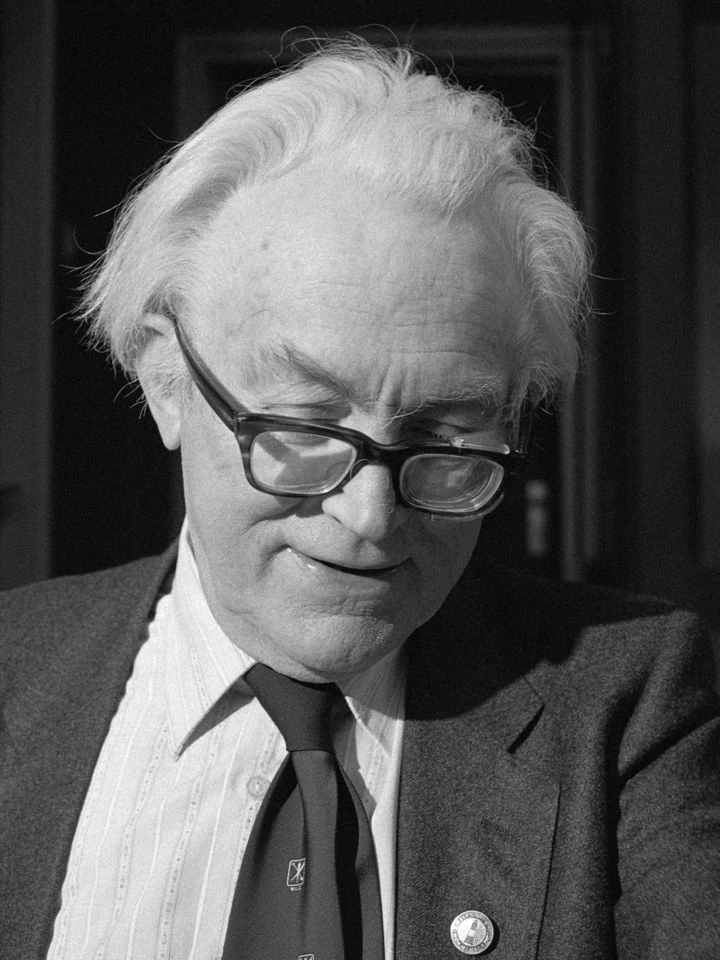
Michael Foot’s political career spanned more than four decades, from his first campaign for Parliament in 1935 to his retirement as an MP in 1992. He became known both for his journalism and as a prominent figure on Labour’s left. As party leader from 1980 to 1983, he faced a divided movement and led Labour to a decisive general-election defeat. Yet that difficult period was only one part of a career that included campaigning against appeasement, ministerial work on employment and a long record of parliamentary debate.
Plymouth, Oxford and a turn to journalism
Michael Mackintosh Foot was born in Plymouth on 23 July 1913, the fourth son of solicitor and Liberal politician Isaac Foot and Eva Mackintosh. He attended Plymouth College Preparatory School, Forres School in Swanage and Leighton Park School in Reading, before studying philosophy, politics and economics at Wadham College, Oxford. He took part in debating at the Oxford Union and graduated with a second-class degree in 1934.
After university, Foot worked as a shipping clerk in Birkenhead. The poverty and unemployment he encountered around Liverpool affected him deeply. He had been a Liberal, but at Oxford he was influenced by Labour activists, including Canadian student David Lewis, and came to identify with socialism. He joined the Labour Party and, aged 22, contested Monmouth at the 1935 general election. His campaign criticised the Government’s rearmament policy, arguing instead for an end to the European arms race.
Foot’s early journalism included a brief period at the New Statesman and work at Tribune, the left-wing weekly established in 1937. He left Tribune in 1938 after its editor, William Mellor, was dismissed amid a dispute over the paper’s political direction. On Aneurin Bevan’s recommendation, Foot joined Lord Beaverbrook’s Evening Standard. He was appointed its editor in 1942, aged 28, and later worked as a columnist for the Daily Herald. He returned to edit Tribune from 1948 to 1952 and again from 1955 to 1960, using its pages to criticise growing corporate influence over the press.
Guilty Men and a parliamentary beginning
In 1940, Foot joined fellow Beaverbrook journalists Frank Owen and Peter Howard in writing Guilty Men under the shared pen-name Cato. The polemic attacked the appeasement policies of successive National Governments and their slow rearmament in the face of Nazi Germany. It became a bestseller. The book’s argument marked a change from Foot’s 1935 campaign, when he had criticised Conservative rearmament and called for disarmament.
Foot entered the House of Commons in 1945, winning Plymouth Devonport for Labour. He lost the seat to Joan Vickers in 1955, then returned to Parliament at a 1960 by-election for Ebbw Vale, the constituency left vacant by Bevan’s death. He represented that seat, later renamed Blaenau Gwent, until 1992. His parliamentary career was interrupted by a 1961 rebellion over Royal Air Force estimates, which led to the withdrawal of the Labour whip; he rejoined the Parliamentary Labour Group in 1963.
Foot was closely associated with Bevan and the Labour left, though the two men later disagreed over unilateral nuclear disarmament. Foot opposed Britain’s involvement in the Vietnam War and the Government’s plans to join the European Communities. He also opposed the unilateral declaration of independence by Rhodesia and condemned the Soviet suppression of the 1968 Prague Spring. His positions did not fit neatly into a single political camp: he criticised Western policy in Korea, opposed West German rearmament and, as the Cold War developed, came to support NATO.
He was a founder member of the Campaign for Nuclear Disarmament in 1957 and a prominent opponent of the Suez campaign. He also took an active interest in Indian independence through the India League, later becoming its chair. These causes sat alongside his work in Parliament and journalism, where he repeatedly challenged political decisions and the institutions that shaped public debate.
Minister, deputy leader and Labour’s divisions
When Labour returned to office under Harold Wilson in 1974, Foot became Secretary of State for Employment. In that role he helped maintain the Government’s relationship with the trade unions and was responsible for significant employment legislation. The Health and Safety at Work etc. Act 1974 established a broad framework for workplace safety. The Trade Union and Labour Relations Act 1974 repealed the previous Government’s trade-union reforms, while the Employment Protection Act 1975 introduced protections against dismissal for pregnancy and provided for maternity pay.
Foot also opposed continued British membership of the European Communities in the 1975 referendum. After Wilson’s retirement in 1976, he contested the Labour leadership, initially leading the first ballot but ultimately losing to James Callaghan. He became deputy leader later that year and served in Callaghan’s Cabinet as Leader of the House of Commons and Lord President of the Council from 1976 to 1979.
The task of leading the Commons became increasingly difficult as Labour’s parliamentary majority dwindled. Foot helped steer government measures through narrow votes, including proposals on pensions and benefits, comprehensive schools, housing for homeless people and child benefit. The Government also nationalised shipbuilding and ended pay beds in NHS hospitals. It fell after losing a confidence vote by a single vote in March 1979.
After Labour lost the 1979 general election, Foot was elected party leader on 10 November 1980, defeating Denis Healey in the second ballot. He was presented as a candidate who might bridge divisions between the party’s factions. But the political environment changed rapidly: four senior Labour politicians left to establish the Social Democratic Party in 1981, while arguments over the party’s direction continued. Foot’s opposition to nuclear weapons and Britain’s membership of the European Communities, together with his support for extensive public ownership, placed him on the left of the party.
The 1983 election and a longer parliamentary life
Labour’s 1983 manifesto proposed unilateral nuclear disarmament, higher personal taxes, a more interventionist industrial policy, nationalisation of the banks and withdrawal from the European Communities. It also proposed abolishing the House of Lords. The party conference’s resolutions were incorporated into the manifesto, an approach that gave internal party decisions a direct role in setting its election programme. Gerald Kaufman, a Labour MP on the party’s right, called it “the longest suicide note in history”.
Labour lost the election to Margaret Thatcher’s Conservatives in a landslide. The Social Democratic Party–Liberal Alliance came close to Labour in votes but won far fewer seats. Foot resigned as Labour leader days after the result; Neil Kinnock succeeded him on 2 October 1983. The result was a severe setback, but Foot remained an MP for Blaenau Gwent for a further nine years, retiring from Parliament at the 1992 general election.
Outside the party leadership, Foot continued to write and take public positions. He defended Salman Rushdie after the Iranian leader Ayatollah Khomeini called for the novelist’s death. During the Yugoslav Wars, Foot supported intervention to defend civilians in Croatia and Bosnia. He remained a high-profile member of CND and wrote biographies of Aneurin Bevan and H. G. Wells. In 1988, he was elected a Fellow of the Royal Society of Literature.
Foot was also known for his longstanding support of Plymouth Argyle. He served as a director of the club and, for his 90th birthday, was registered with the Football League as an honorary player wearing the number 90. He was married to film-maker, author and feminist historian Jill Craigie from 1949 until her death in 1999; they had no children. A republican, he declined honours including a knighthood and a peerage.
Foot died at his home in Hampstead, London, on 3 March 2010, aged 96. His funeral was a non-religious service at Golders Green Crematorium. His long life included political setbacks as well as office and influence; his public record is best understood through the arguments he pursued and the work he did in Parliament, government and print.
Why Michael Foot deserves a place in British Legacy
Michael Foot’s place in British Legacy rests on the reach of his work across journalism, Parliament and government. As a co-author of Guilty Men, he helped make a forceful public case against appeasement at a crucial moment in the history of European fascism. As a journalist and editor at the Evening Standard, the Daily Herald and Tribune, he spent decades arguing that the press should not be dominated by corporate interests. These were not separate from his political life: both writing and parliamentary debate were means of challenging decisions that he believed had consequences for ordinary people.
His ministerial record also left practical marks. As Employment Secretary, Foot was responsible for legislation on workplace safety, trade-union relations and protections for workers facing dismissal during pregnancy, including maternity pay. Later, as Leader of the House, he helped carry measures on benefits, education and housing through a precarious Parliament. His time as Labour leader ended in defeat, and his policies remain part of a contested political history. But the longer record is more than that election: Foot was an MP for roughly 42 years, a campaigner for nuclear disarmament, and a persistent participant in debates over work, public ownership and Britain’s relationship with Europe. His British legacy is therefore one of argument and public service, as much as party leadership.
Sources
Michael Foot — revision 1379643075
Adapted in part from Michael Foot by Wikipedia contributors, under CC BY-SA 4.0. Text has been edited and combined with the existing article; this adapted text is shared under the same licence. Contributor history.