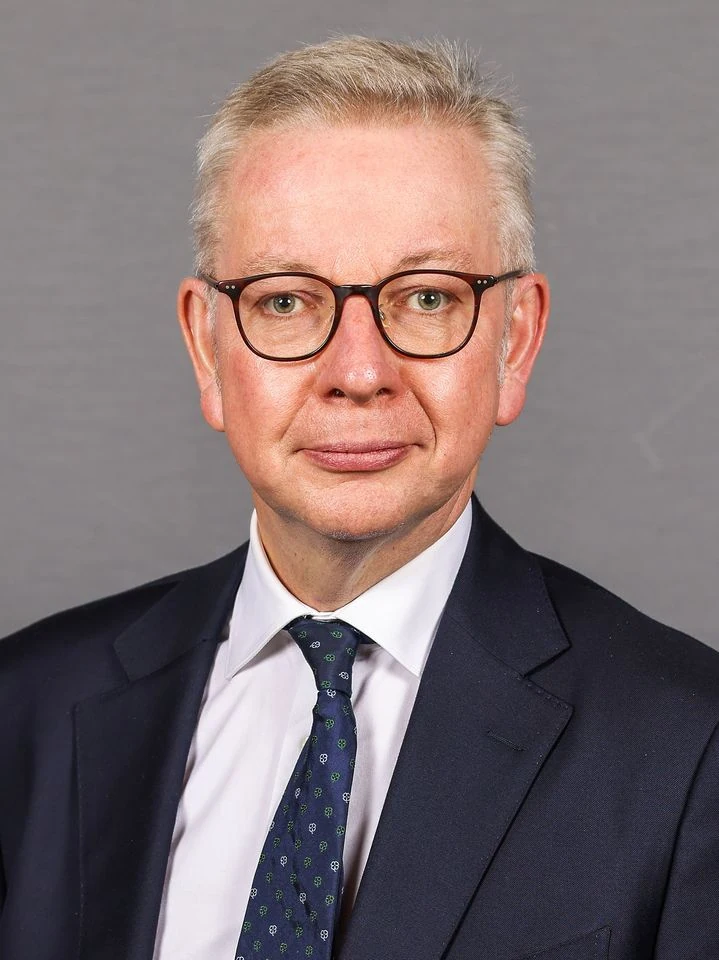
Michael Gove’s political career has been defined by two arguments: what schools should teach, and what Britain’s relationship with Europe should be. As education secretary, he changed the structure and content of schooling in England, provoking sustained opposition from teachers and academics. As a leading figure in the campaign to leave the European Union, he helped shape the 2016 referendum debate. His route into government ran through journalism, where he spent years writing and editing before entering Parliament in 2005.
From Aberdeen to journalism
Gove was born Graeme Andrew Logan in Aberdeen on 26 August 1967. Adopted at four months old by Ernest and Christine Gove, he was raised in the Kittybrewster area of the city and took their surname and the name Michael Andrew. His father ran a fish-processing business at Aberdeen Harbour; his mother worked as a laboratory assistant before later working at the Aberdeen School for the Deaf. Gove attended state primary schools before winning a scholarship to the independent Robert Gordon’s College.
In 1985 he went to Lady Margaret Hall, Oxford, to study English. He joined the Conservative Party at university and was elected president of the Oxford Union for Hilary term in 1987. His route to politics was not immediate. After university he turned to journalism, working first in Scotland, including for The Press and Journal and Scottish Television, then for the BBC and Channel 4. In 1996 he joined The Times as a leader writer. He later held editorial roles there and wrote a weekly political column.
Journalism gave Gove a public platform and a close view of Conservative politics. He co-founded the conservative think tank Policy Exchange in 2002 and chaired it for three years. In 2004 he was selected as the Conservative candidate for Surrey Heath. He won the seat at the 2005 general election, beginning a parliamentary career that lasted until 2024.
Education reform and its opponents
When the Conservative–Liberal Democrat coalition took office in 2010, Gove became Secretary of State for Education. He promoted the expansion of academies and free schools, institutions with greater autonomy from local authorities, and announced changes to the national curriculum in England. His programme placed emphasis on subject knowledge, traditional academic subjects and examination-based assessment. He also pursued reforms to GCSE and A-level qualifications and ended the previous government’s Building Schools for the Future programme, apologising after an initial list of cancelled projects proved inaccurate.
Education policy under Gove was contested from the outset. His plans for an English Baccalaureate to replace GCSEs were dropped in 2013 after a parliamentary committee warned that the changes were too much, too quickly. Proposed history-curriculum changes also drew criticism from historians and teachers, who argued that the draft gave insufficient attention to subjects including slavery, empire, migration and multicultural Britain. A revised version restored broader references, though the final curriculum left some topics to schools’ discretion.
Teacher unions passed motions of no confidence in Gove’s policies in 2013, and disputes over the pace and direction of reform contributed to strikes. The objections were not simply about individual examinations: they concerned who should set educational priorities, how much autonomy schools should have, and whether a more demanding, knowledge-rich curriculum would improve outcomes or impose an overly narrow model. Gove’s tenure therefore left a record of structural change as well as an enduring dispute about the purpose and governance of state education.
From ministerial office to the Brexit campaign
After leaving the Education Department in 2014, Gove became Government Chief Whip. Following the 2015 general election, he was appointed Justice Secretary and Lord Chancellor. In that role he removed restrictions on the number of books prisoners could receive and scrapped criminal court charges introduced by his predecessor. His time in the post ended when Theresa May became prime minister in July 2016.
Gove had already become one of the most prominent advocates of leaving the European Union. He was appointed co-convenor of Vote Leave in March 2016 and chaired its campaign committee. He argued that Britain would be freer and better off outside the EU, and said voters should not defer to experts from organisations that, in his view, had repeatedly got matters wrong. The referendum result transformed the country’s political direction, but the claims and assurances made during the campaign remained disputed.
After David Cameron resigned, Gove surprised Westminster by withdrawing his support for Boris Johnson’s leadership bid and announcing his own candidacy. He was eliminated in the second ballot. The episode made visible the personal and strategic rivalries within the Conservative Party, while also showing how closely Brexit and the contest for party leadership had become entwined.
Environment, government and housing
In 2017 Gove returned to the Cabinet as Secretary of State for Environment, Food and Rural Affairs. His policies included restrictions on microbeads in cosmetics and personal-care products, a ban on bee-harming pesticides and a ban on wild animals in travelling circuses in England. He also announced a target to end sales of new petrol and diesel cars by 2040. These measures placed environmental and animal-welfare issues prominently in his ministerial record, though they were part of wider government policy debates rather than the work of one minister alone.
When Boris Johnson became prime minister in 2019, Gove was appointed Chancellor of the Duchy of Lancaster, with responsibilities that included preparing for Brexit and overseeing Cabinet Office policy. He later took on the Cabinet Office ministerial role and was involved in coordinating the government’s response to the COVID-19 pandemic. In December 2020 he helped reach an agreement with the European Union on arrangements for the Irish border; the government then abandoned parts of a bill that could have put the United Kingdom in breach of international law.
In 2021 Gove became Secretary of State for Levelling Up, Housing and Communities and Minister for Intergovernmental Relations. He published a levelling-up white paper in 2022, setting out plans for public investment across the UK and expanded devolution in England. His department also announced Awaab’s Law, intended to require social housing providers to remedy reported damp and mould within specified time limits. Gove was dismissed by Johnson in July 2022 after advising the prime minister to resign. Rishi Sunak later returned him to the housing and intergovernmental roles, which he held until the 2024 general election.
Beyond the Commons
Gove did not stand for re-election in 2024, ending nearly two decades as Surrey Heath’s MP. He became editor of The Spectator that year. In 2025 he was created Baron Gove, of Torry in the City of Aberdeen, and joined the House of Lords. The title’s reference to Torry connects his later public life to the Aberdeen district associated with his adoptive family.
His political record has never been confined to a single department. Alongside education, justice, the environment, Brexit preparations and housing, he twice stood for the Conservative leadership. He served under successive prime ministers, moving between major policy briefs and periods outside government. That range makes a simple verdict difficult: his reforms generated strong opposition as well as lasting changes, and his arguments on Europe were part of a campaign whose consequences continue to shape British politics.
Why Michael Gove deserves a place in British Legacy
Michael Gove merits a place in British Legacy because his career illuminates how policy disagreements become part of the country’s institutions and public life. As education secretary, he changed the organisation of schools in England and pursued a more knowledge-led curriculum, while his examination reforms, history proposals and approach to school autonomy met organised resistance. The importance of that record lies not in assuming that his programme succeeded on every measure, but in recognising how forcefully it reopened questions about standards, accountability and who should shape what children learn.
His role in the 2016 referendum gives the career a second, distinct significance. As a senior Vote Leave campaigner, he argued for a change in Britain’s relationship with the European Union; after the vote, he held Cabinet responsibilities connected with preparing for and implementing Brexit. Later work on environmental measures, intergovernmental relations and housing extended his influence across policy areas that affect everyday life and the distribution of power within the UK. The British connection is direct: Gove served in Parliament and government, represented an English constituency, and became a life peer with a title tied to Aberdeen, Scotland. His record also deserves scrutiny rather than easy celebration: the disputes surrounding his reforms and political choices are integral to understanding their impact.
Sources
Michael Gove — Wikipedia revision 1379736213 · Michael Gove — Wikipedia
Adapted in part from Michael Gove by Wikipedia contributors, under CC BY-SA 4.0. Text has been edited and combined with the existing article; this adapted text is shared under the same licence. Contributor history.