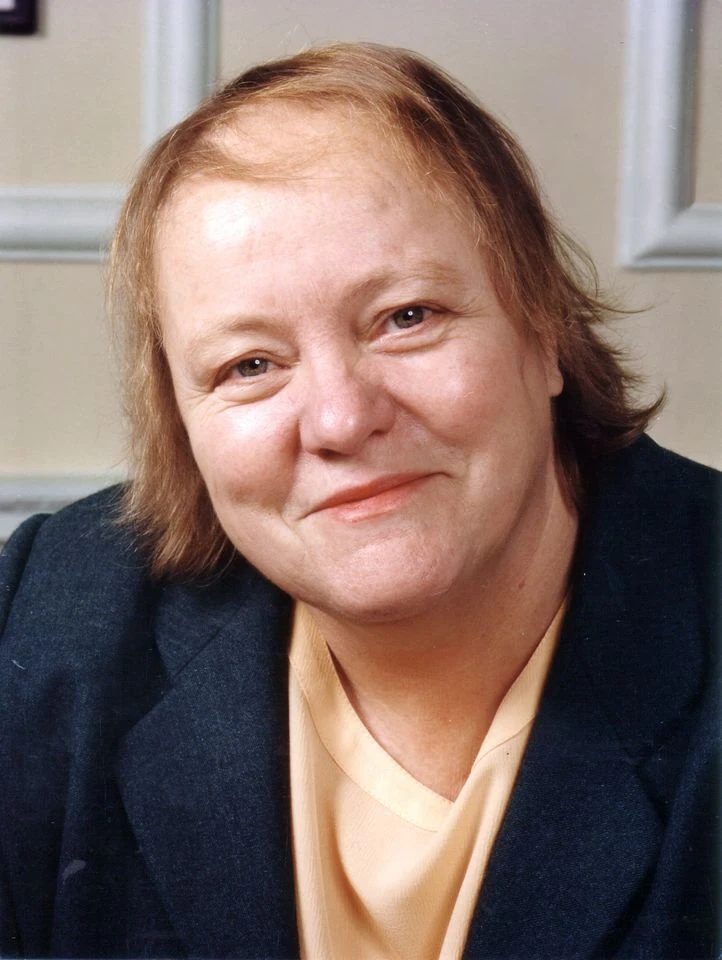
Mo Mowlam’s work in Northern Ireland was not confined to negotiating rooms. As Secretary of State, she met political leaders and prisoners, including loyalists and republicans held in the Maze, at a moment when the peace process was fragile. The Good Friday Agreement was reached in April 1998. Mowlam did not make peace alone, but her direct engagement and political judgement helped keep talks moving towards an agreement that reshaped Northern Ireland’s institutions.
From Coventry to Westminster
Marjorie “Mo” Mowlam was born in Watford on 18 September 1949 and grew up in Coventry, where her father worked as an assistant postmaster. She attended Chiswick Girls’ grammar school before moving to Coundon Court School, one of the early comprehensive schools. At school she became head girl, joined the Labour Party and took part in anti-apartheid protests and the Campaign for Nuclear Disarmament.
At Trevelyan College, Durham University, she studied sociology and anthropology and became active in student politics. After graduating, she worked for Labour MP Tony Benn in London and for American writer Alvin Toffler in New York. She then moved to the United States to complete a PhD in political science at the University of Iowa, researching the effects of the Swiss referendum system. She taught at universities in Wisconsin and Florida before returning to England in 1979 for a post at the University of Newcastle upon Tyne. She also taught adult education at Northern College in Barnsley.
Her political career included work behind the scenes as well as parliamentary campaigning. After failing to win selection for the 1983 general election, she served as treasurer on Neil Kinnock’s Labour leadership campaign. Selected for Redcar after its sitting MP, James Tinn, stood down, she won the seat in 1987 and made her maiden speech in the Commons that July. She became Labour’s spokesperson on Northern Ireland later that year.
Mowlam joined the shadow cabinet in 1992, holding posts including Shadow Secretary of State for National Heritage. After John Smith’s death, she helped organise Tony Blair’s leadership campaign. Blair appointed her shadow Northern Ireland secretary; although she had initially preferred an economic brief, she took on the role and made the issue her central political responsibility.
Opening channels in Northern Ireland
Labour’s 1997 election victory brought Mowlam into government as the first woman to serve as Secretary of State for Northern Ireland. She took office on 3 May. The Northern Ireland conflict, commonly known as the Troubles, involved years of violence and political division. The challenge was not simply to convene talks, but to keep a process inclusive enough to hold when trust was scarce and ceasefires were uncertain.
In August 1997, Mowlam met Sinn Féin leader Gerry Adams, the first face-to-face meeting of its kind since the Provisional IRA ceasefire had broken down in February 1996. Her role in helping restore a second IRA ceasefire helped create conditions for Sinn Féin to join multi-party talks. Her approach also took her outside the usual political settings. She organised a walkabout in Belfast city centre, saying that “it’s the real life of people that needs changing”.
In January 1998, loyalist representatives asked her to meet prisoners in the Maze after prisoners associated with the Ulster Defence Association and Ulster Freedom Fighters had voted against continuing to support the peace process. After consulting Tony Blair and her advisers, Mowlam visited them. She also went to the prison’s republican and Ulster Volunteer Force wings. The visit was an unusual and risky intervention for a Northern Ireland secretary: she spoke directly with prisoners, some convicted of murder, in an effort to encourage support for political progress.
The negotiations culminated in the Good Friday Agreement, signed on 10 April 1998. The agreement provided for a devolved, power-sharing Northern Ireland Assembly and included an agreement by the Republic of Ireland to change two constitutional articles concerning Irish unity. Mowlam oversaw the process that led to the agreement, but she was one participant in a wider political effort involving parties and governments on both sides of the Irish border.
Government beyond the peace talks
Mowlam’s time as Northern Ireland secretary ended in October 1999, when Peter Mandelson succeeded her. Her relationship with unionist parties had become difficult; other factors may also have influenced the change. She moved to the Cabinet Office, serving as Minister for the Cabinet Office and Chancellor of the Duchy of Lancaster until 2001. The transition marked a change in her public role, though it did not end her involvement in politics.
As head of the government’s anti-drugs campaign, she called in 2002 for the international legalisation of drugs. She had also acknowledged trying cannabis as a student. These positions attracted attention, but they were part of a broader political career in which she was willing to speak plainly on contentious issues.
In September 2000, Mowlam announced that she would leave Parliament. She stood down as Redcar’s MP at the 2001 general election. After leaving the Commons, she criticised government policy, particularly the 2003 invasion of Iraq, and joined anti-war protests. She also worked as an agony aunt for the magazine Zoo, saying she missed constituency work. Her charity, MoMo Helps, supported people completing drug rehabilitation and parents or carers of disabled children.
Her writing included Momentum: The Struggle for Peace, Politics and the People, published in 2002. She was featured on This Is Your Life in 2003. In 2004, ill health prevented her from taking part in the first series of Strictly Come Dancing.
Illness, death and remembrance
Five months before Labour’s 1997 election victory, Mowlam was diagnosed with a brain tumour. She initially kept the diagnosis private, but discussed her treatment and appearance more openly after tabloid coverage. She said she had made a full recovery, although treatment had caused her to lose much of her hair. She sometimes removed her wig in public, treating it as a practical inconvenience rather than a reason to withdraw from view.
In August 2005, after a fall and head injuries, she was admitted to hospital and did not regain consciousness. She died at a hospice in Canterbury on 19 August, aged 55. Her husband, Jon Norton, and two stepchildren survived her. A 2010 account by her former doctor said the tumour had been malignant and had caused her death. Mowlam’s ashes were divided between Hillsborough Castle, the official residence of the Northern Ireland secretary, and her former constituency of Redcar.
Memorials have marked both parts of her public life. Redcar and Cleveland commissioned a mosaic unveiled in 2009 at Redcar’s boating lake. Its images include the town’s beach, racecourse and steelworks, the lifeboat, Parliament and symbols of peace. Her personal papers are held by Teesside Archives, and Trevelyan College named its postgraduate common room the Mowlam Room. A children’s play park on the Stormont Estate in Belfast also bears her name.
Channel 4’s 2010 drama Mo, starring Julie Walters, portrayed the period from Labour’s 1997 election victory to Mowlam’s death. It attracted more than 3.5 million viewers and received critical and award attention. The drama brought her political work and public manner to a later audience, while the memorials in Redcar, Durham and Belfast locate her remembrance in the communities and institutions connected to her life.
Why Mo Mowlam deserves a place in British Legacy
Mo Mowlam’s place in British Legacy rests on specific work at a decisive point in the history of the United Kingdom. As Northern Ireland secretary, she helped sustain a political process that culminated in the Good Friday Agreement. Her contribution was not a solitary achievement: the agreement depended on negotiation among many parties and on action by the British and Irish governments. Mowlam’s part was to help bring participants into the process and maintain momentum, including through direct contact with Sinn Féin and visits to prisoners whose support for the peace process was in doubt.
The consequences were institutional as well as symbolic. The agreement provided for power-sharing and devolved government in Northern Ireland and set out changes concerning Irish unity. Mowlam’s career also connects that work to public service closer to home: she represented Redcar for 14 years, later established MoMo Helps, and is commemorated in places including Redcar, Durham and Belfast. Her example matters not because every difficulty was solved or because one politician can claim sole credit for peace, but because it shows how political responsibility can involve listening across deep divisions, taking a public risk and working towards arrangements that others must sustain. That combination of negotiation, constituency service and practical support gives her British legacy its substance.
Sources
Adapted in part from Mo Mowlam by Wikipedia contributors, under CC BY-SA 4.0. Text has been edited and combined with the existing article; this adapted text is shared under the same licence. Contributor history.