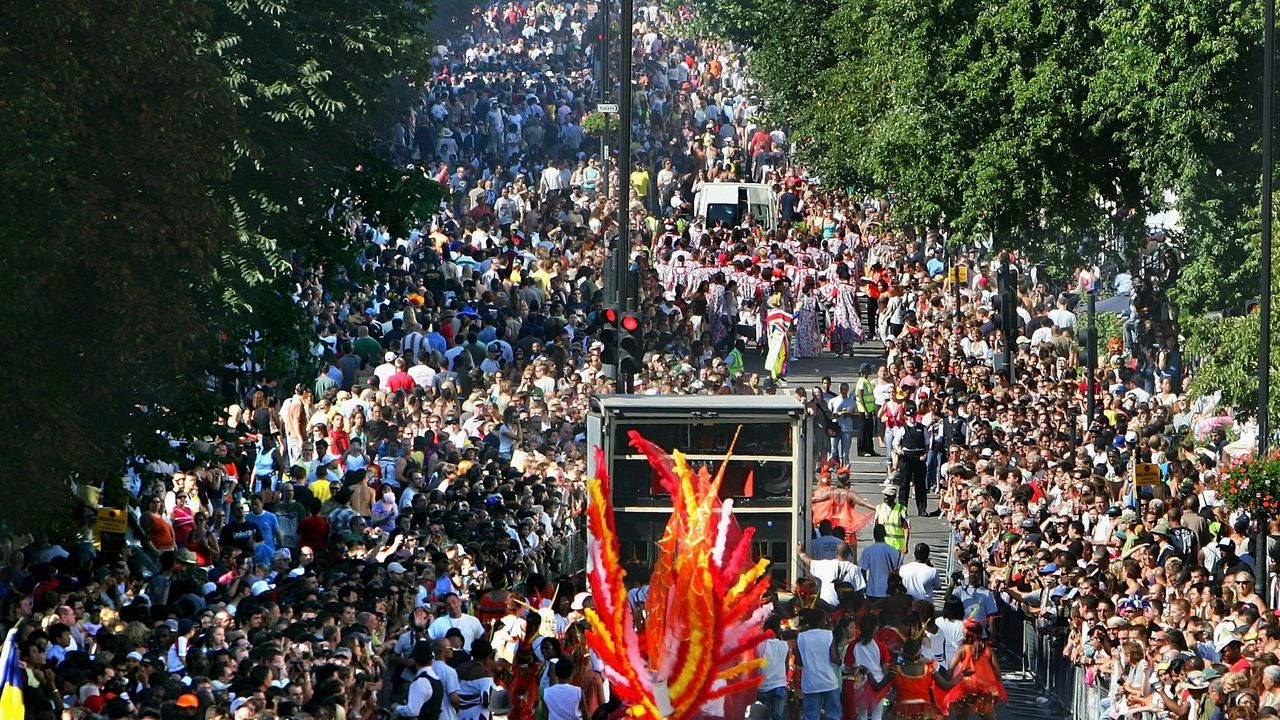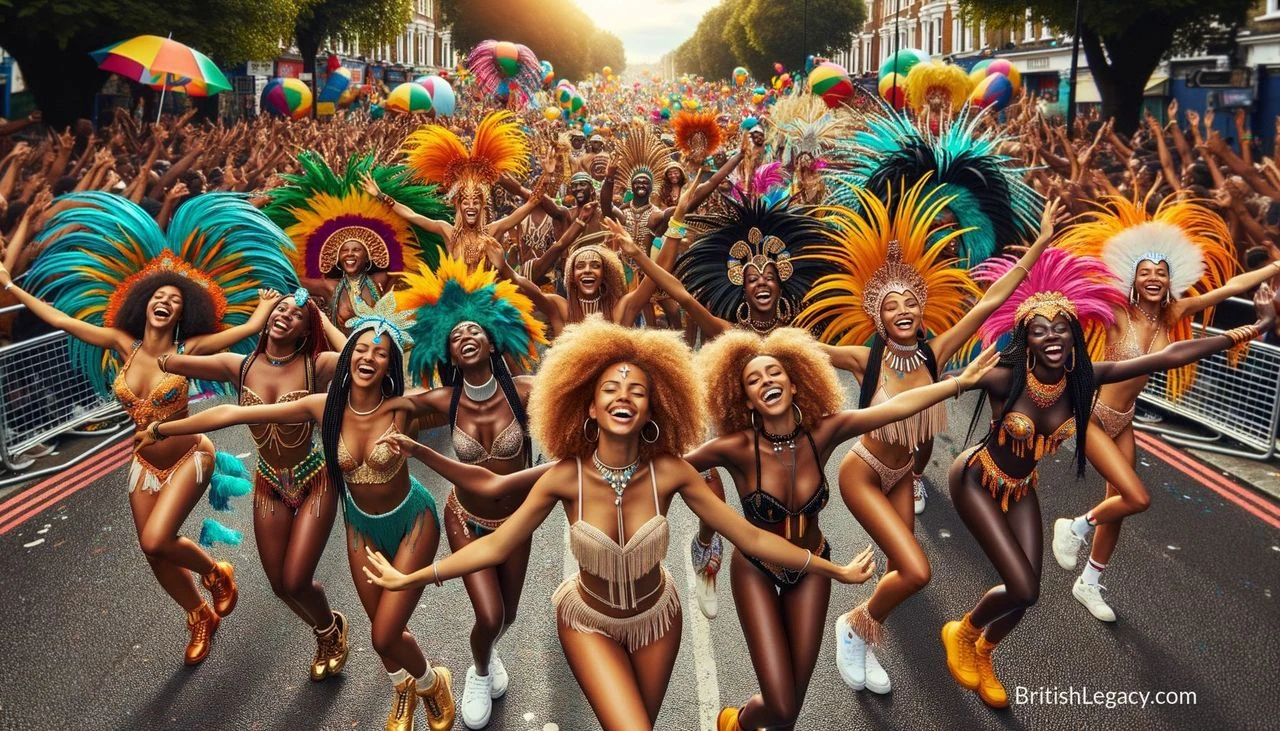
Each August Bank Holiday weekend, the streets of Notting Hill become a stage for steelpan, sound systems, masquerade and dance. Led by members of the British Caribbean community, the carnival draws around two million people and is among the largest street festivals in Europe. Its history is not a single origin story: an indoor Caribbean carnival organised by Claudia Jones in 1959 preceded the outdoor Notting Hill event that Rhaune Laslett helped launch in 1966. Together, these beginnings connect the festival to both Caribbean cultural life and the changing neighbourhoods of post-war London.
Two beginnings, and a street procession
In January 1959, Trinidadian journalist and activist Claudia Jones organised a Caribbean Carnival at St Pancras Town Hall. It came after the Notting Hill race riots of the previous year, when 108 people were charged, and took place against troubled race relations. Directed by Edric Connor, the indoor event presented Caribbean culture through cabaret: its programme included calypso singer the Mighty Terror, the Southlanders, Cleo Laine, Trinidad All Stars and a steel-band dance troupe. A carnival queen contest and a final jump-up brought the evening to a close. Jones, editor of The West Indian Gazette, is often described as the mother of the Notting Hill Carnival.
The first outdoor event in Notting Hill followed in August 1966. Organised by local social worker Rhaune Laslett, it grew from a neighbourhood street party into a procession when Russell Henderson’s steel band set off along the streets. Laslett had been inspired by the London Free School and aimed to promote cultural unity; she was not aware of the earlier indoor events when she first proposed the festival. Henderson, whose band had played at Jones’s carnival, became one of the event’s founding figures. These distinct beginnings matter: the present carnival developed through overlapping efforts rather than being simply a continuation of one event.
In its early years the street carnival was small. By 1970 it had two music bands and about 500 dancing spectators. Leslie “Teacher” Palmer, director from 1973 to 1975, helped expand it by recruiting steel bands, reggae groups and sound systems, seeking sponsorship, introducing generators and extending the route. In 1973, costume bands and steel bands representing different islands joined the parade, while stationary sound systems added another way to experience the music. BBC Radio London broadcasts by Alex Pascall helped bring the carnival to a wider audience.
Mas, pan and sound systems
The carnival’s traditions are often described through five disciplines: masquerade, calypso, soca, steelpan and sound systems. These work together rather than forming separate attractions. The parade’s masquerade bands, or “mas”, develop costumes and themes that bring performers on to the route; steel bands carry a live musical tradition through the streets; and sound systems establish their own gathering points with recorded music. The result is a moving festival whose music, dancing and visual display are made by participants as well as watched by visitors.
Sound systems became a defining presence as the event grew. Jamaican-born Duke Vin is credited with bringing a sound system to the UK in 1955 and with bringing one to Notting Hill Carnival in 1973. His system, Duke Vin the Tickler’s, played at the carnival until his death in 2012. During the 1980s and 1990s sound systems expanded, including Channel One, Saxon Sound, Mastermind Roadshow, RapAttack and Good Times. The carnival’s musical range widened too: the London School of Samba appeared in 1984, followed by other samba schools in the 1990s. Aswad’s performance at Meanwhile Gardens in 1983 was later released as the album Live and Direct.
Costume makers and designers have also shaped the event. Among those associated with its bands and samba schools are Allyson Williams, administrator and seamstress for the mas band Genesis; Clary Salandy of Mahogany Carnival; Carl Gabriel; and Ray Mahabir. The work involved in making costumes and floats is part of the carnival’s creative practice, alongside performance and music. Across the weekend, the programme traditionally includes Panorama, a steelpan competition on Saturday; a family and children’s day on Sunday, with a shorter parade route for young people; and the main adult parade on Monday.
A festival shaped by its city
Notting Hill Carnival draws on Caribbean traditions and on other festivals, while developing in the particular setting of London. Its influences include Trinidad Carnival, Crop Over, Toronto’s Caribana and the Labour Day Festival in Brooklyn. The streets and residential setting are not incidental: the parade circulates through the neighbourhood, while floats and sound systems give music a physical presence across the route. Food stalls, including those selling jerk chicken, rice and peas, and roti, add another part of the Caribbean cultural experience.
Its growth has brought questions about crowd management, policing and the event’s place in a residential area. The 1976 carnival was marked by disorder and confrontations between police and crowds; calls to ban or move the event followed. In 1987, after another confrontation, police adopted a more conciliatory approach. Later reviews considered how to manage the crowds and route. A 2000 review group led to a route change in 2002; its full 2004 report recommended Hyde Park as an additional open space to draw crowds away from residential streets. That proposal was resisted amid concern that a separate Hyde Park event might overshadow the original street carnival. The parades subsequently took a circular rather than linear route.
The festival has also had to adapt to wider circumstances. In 2020 and 2021, the carnival was cancelled because of the COVID-19 pandemic; online events were streamed in 2020. When it returned in 2022, the programme began with a run and included a 72-second silence for the 72 people who died in the Grenfell Tower fire. In 2017, carnival-goers had also observed a minute’s silence and worn green in tribute to the fire’s victims. Such moments sit alongside the celebration, marking the connection between a large public event and the city around it.
Work, audiences and public debate
The carnival’s scale makes it culturally prominent and an economic presence in London. A London Development Agency report estimated that the 2002 event contributed about £93 million to the London and UK economy. That figure is an estimate for a particular year, not a measure of every edition. Visitors and local businesses form part of its economic life, while the event also gives performers, musicians and designers a public platform. Those opportunities are tied to the creative work that sustains the festival: organising bands, making costumes, building floats and running sound systems.
Its public profile has not always matched its size. For many years, live coverage was largely associated with local media, including BBC London radio, with BBC Radio 1Xtra also broadcasting in more recent years. In 2016, for the carnival’s fiftieth anniversary, Boiler Room streamed 42 hours of live video from a range of sound systems. Media discussion has also often centred on policing, public costs and safety. Those issues form part of the practical challenge of holding a very large event in a compact residential area, but they do not account for the carnival’s cultural purpose or the work of its participants.
In 2003, the event was run by the Notting Hill Carnival Trust Ltd. Organisational arrangements and public debate have continued to develop as the festival has grown. The combination of a major parade, multiple sound systems and large crowds requires careful planning; at the same time, decisions about routes, coverage and management affect a community-led event whose distinctive character depends on its presence in Notting Hill. Its history is therefore also a history of negotiation over how a local celebration can remain accessible and workable at city-wide scale.
Why Notting Hill Carnival deserves a place in British Legacy
Notting Hill Carnival deserves a place in British Legacy because it makes the history and continuing contribution of Britain’s Caribbean communities visible in public space. Its development reaches from Claudia Jones’s 1959 indoor carnival, organised amid poor race relations, to Rhaune Laslett’s 1966 neighbourhood event and the later growth shaped by performers, organisers and musicians. The story belongs neither to one founder nor to a single moment: it reflects how community initiative and cultural practice built an enduring London festival. Steelpan, calypso, soca, masquerade and sound systems are not decorative additions to that history; they are the forms through which the carnival is made and experienced.
The festival’s significance also lies in the skills and opportunities it brings together. Costume makers, bands, designers, performers and sound-system crews contribute creative work to an event that attracts a vast audience. Its route places those traditions in the streets of west London, making Caribbean culture part of the city’s shared civic life rather than confining it to a private or occasional setting. Its evolution has required debate about safety, public space, management and the pressures of scale, as well as repeated adaptation. That combination of cultural expression, community organisation and London history is a specific British legacy: one shaped by Caribbean heritage and by the people who have made the carnival in Britain across generations.
Sources
Notting Hill Carnival (revision 1377980418)
Adapted in part from Notting Hill Carnival by Wikipedia contributors, under CC BY-SA 4.0. Text has been edited and combined with the existing article; this adapted text is shared under the same licence. Contributor history.