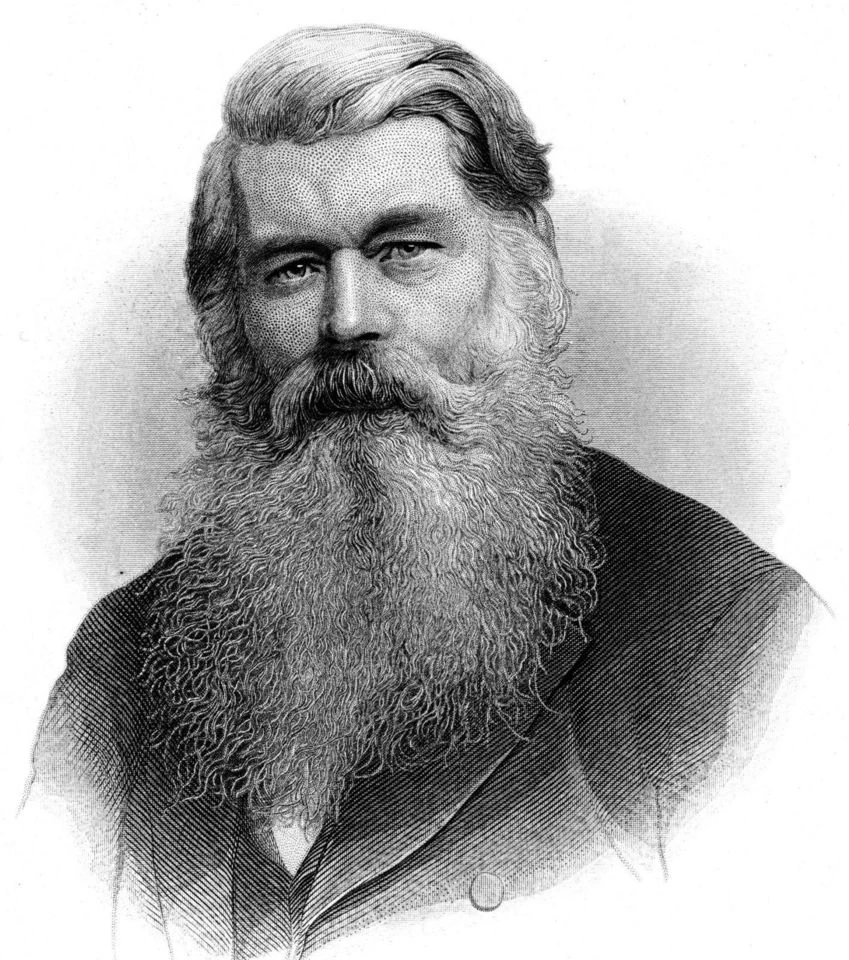
Joseph Swan’s work on incandescent lighting began decades before electric lamps became a feature of homes and public buildings. He started experimenting with carbon filaments in 1850 and demonstrated an early working lamp in 1860, but poor vacuum technology and an inadequate power source limited its performance. His later improvements helped make electric lighting practicable, and his lamps illuminated the Savoy Theatre in London in 1881. Swan’s story is not one of a single dramatic invention: it is a record of persistent experimentation, manufacturing and the gradual adoption of a new technology.
A Sunderland upbringing and a life in chemistry
Swan was born Joseph Wilson Swan on 31 October 1828 at Pallion Hall, in Bishopwearmouth, Sunderland. His parents were John Swan and Isabella Cameron. As a young man, he was apprenticed to the Sunderland pharmacists and druggists Hudson and Osbaldiston. The available account does not establish whether he completed the six-year apprenticeship: both partners died during that period.
He supplemented his education by reading at Sunderland Library and attending lectures at the Sunderland Atheneum. He later joined Mawson’s, a manufacturing-chemists’ business in Newcastle upon Tyne, founded by John Mawson, his brother-in-law. Swan became a partner in 1846. The firm went on to trade as Mawson, Swan, and Morgan, linking his working life to Newcastle’s commercial and scientific community.
Swan’s scientific interests ranged across chemistry, physics and photography. He lived at Underhill in Low Fell, Gateshead, where a large conservatory provided space for many of his experiments. It was there that his work on electric light developed from early trials into a practical, if still imperfect, lamp.
From an early lamp to a working demonstration
In 1850, Swan began investigating incandescent light using carbonised paper filaments inside evacuated glass bulbs. He could demonstrate a working device by 1860, but it gave inefficient light and lasted only briefly. The available vacuum pumps could not remove enough air, while the electric supply also constrained the lamp. The problem was not simply finding a material that would glow: the surrounding conditions and the way the lamp was powered mattered too.
Swan turned to the vacuum problem directly. In 1863, he presented a design for a pump to the British Association for the Advancement of Science. It used mercury falling through a tube to trap air in the system being evacuated. More than a decade later, he returned to the lamp with a better vacuum and a carbonised thread filament. With less residual oxygen inside the bulb, the filament could glow without immediately catching fire. The improved lamp still had low resistance, however, and required thick copper wiring.
Swan first demonstrated a carbon incandescent lamp publicly at a Newcastle upon Tyne Chemical Society lecture on 18 December 1878. That demonstration was not yet a successful display of a dependable working lamp: after shining brightly for several minutes in his laboratory, it failed because of excessive current. On 17 January 1879, he repeated the lecture successfully, showing the lamp in operation. On 3 February he demonstrated a working lamp to an audience of more than 700 at the Literary and Philosophical Society of Newcastle upon Tyne, with William Armstrong presiding.
He continued to improve the filament and its connections. A process for treating cotton to make what he called “parchmentised thread” led to British Patent 4933, granted on 27 November 1880. The date matters: Swan’s early experiments and public demonstrations were important steps, but they did not all amount to the same finished, commercially useful device.
Lighting homes, ships and the Savoy
Swan’s house at Underhill was the first house to have working electric light bulbs installed. In October 1880, a lecture at Newcastle’s Literary and Philosophical Society made its library the first public room lit by electric light. Swan founded the Swan Electric Light Company in 1881, with a factory at Benwell, Newcastle; commercial production of his incandescent lamps had begun by then.
One early installation outside the inventor’s home was at Cragside, the Northumberland residence of his friend William Armstrong. Swan personally supervised the work in December 1880. The technology also moved beyond houses. The City of Richmond, an Inman Line ship, was fitted with incandescent lamps in June 1881, and the Royal Navy began installing them on ships that year. During construction of the Severn Tunnel, lamps were used in temporary pilot tunnels.
The most prominent public installation was at the Savoy Theatre in Westminster. It opened in 1881 as the first public building in the world lit entirely by electricity, using about 1,200 Swan incandescent lamps. An 88.3-kilowatt generator on nearby open land supplied them. The first generator could not power the entire building, so the front-of-house areas were electrically lit while the stage remained lit by gas. At a performance on 28 December, theatre-builder Richard D’Oyly Carte broke a glowing bulb on stage to demonstrate its safety. The Times described the lighting the following day as visually superior to gaslight.
These installations show both the reach and the limits of Swan’s achievement. Electric lighting was not adopted through the lamp alone: generators, wiring and practical arrangements for particular buildings and users were also needed. Swan’s work helped establish that the technology could be used beyond an experiment, while the early installations exposed the engineering demands of doing so.
Filaments, patents and Edison
Swan’s original carbon-rod and carbon-filament lamps were functional, but their low resistance and short operating life made them difficult to use economically. While looking for a better filament, he developed a process for forcing nitrocellulose through small holes to form conducting fibres. Patented in 1881, these cellulose filaments were used in lamps made by the company that eventually combined Swan’s and Edison’s interests.
Thomas Edison was working on incandescent lighting independently. The two inventors’ approaches were not identical: Edison sought a high-resistance, long-life lamp suited to a larger electric-lighting system, while Swan’s original lamp had low resistance and was more suited to series operation. Their competing British companies merged in 1883 to form the Edison & Swan United Electric Light Company, commonly known as Ediswan. The merged business sold lamps using Swan’s cellulose filament in Britain, while Edison’s company continued using bamboo filaments outside the country.
The merger was a commercial response to the patents and technologies held by both sides, rather than a simple joint invention. It brought Swan’s work into a larger manufacturing enterprise and connected the development of the lamp with the growth of the electrical industry. Ediswan later moved production to Ponders End, north London, and became part of British Thomson-Houston and Associated Electrical Industries in the late 1920s.
Photography and scientific recognition
Photography was another sustained strand of Swan’s work. In 1864 he patented a transfer process for making carbon prints using carbon tissue. By adding a transfer step, he could produce prints with a full tonal range, and he sold the patents to the Autotype Company of London in 1868. His experiments with wet photographic plates also led him to observe that heat increased the sensitivity of silver bromide emulsion. By 1871, he had devised a dry-plate method, replacing glass plates with nitrocellulose plastic. In 1879, he patented bromide paper, a development used in black-and-white photographic printing.
Recognition followed across scientific and professional institutions. Swan was elected a Fellow of the Royal Society in 1894 and became president of the Institution of Electrical Engineers in 1898. He also served as president of the Society of Chemical Industry from 1900 to 1901 and became the first president of the Faraday Society in 1903. In 1904 he was knighted, received the Royal Society’s Hughes Medal and was made an honorary member of the Pharmaceutical Society. His honours also included France’s Legion of Honour, awarded after his electric-lighting display at the 1881 International Exposition of Electricity in Paris, and the Royal Society of Arts’ Albert Medal in 1906.
Why Joseph Swan deserves a place in British Legacy
Joseph Swan deserves a place in British Legacy because his contribution to electric lighting was both inventive and practical. He pursued the problem over many years, from carbonised paper in an early evacuated bulb to improved vacuum conditions and a better filament. His sequence of demonstrations in Newcastle makes the development tangible: an early lamp failed after a short time, a later lecture succeeded, and a public audience saw a working example. Patent, manufacturing and installation work then carried the technology into houses, public rooms, ships and one of London’s most visible theatres.
His British connection is rooted in the places and institutions where that work took shape. Born in Sunderland, he developed his career in Newcastle and Gateshead, established lamp production in Benwell and helped light the Savoy in Westminster. The story also shows that technological change depends on more than an inventor’s idea. Better vacuums, suitable filaments, power generation, wiring and commercial production all formed part of the move from experiment to use. Swan’s work on photographic processes adds a second substantial field of achievement, while his leadership in scientific and engineering societies reflects the breadth of his contribution. Remembering him means recognising not a lone “father” of electric light, but an English inventor whose sustained experiments and practical developments helped make electric illumination part of public and domestic life.
Sources
Joseph Swan — Wikipedia revision 1379790566
Adapted in part from Joseph Swan by Wikipedia contributors, under CC BY-SA 4.0. Text has been edited and combined with the existing article; this adapted text is shared under the same licence. Contributor history.