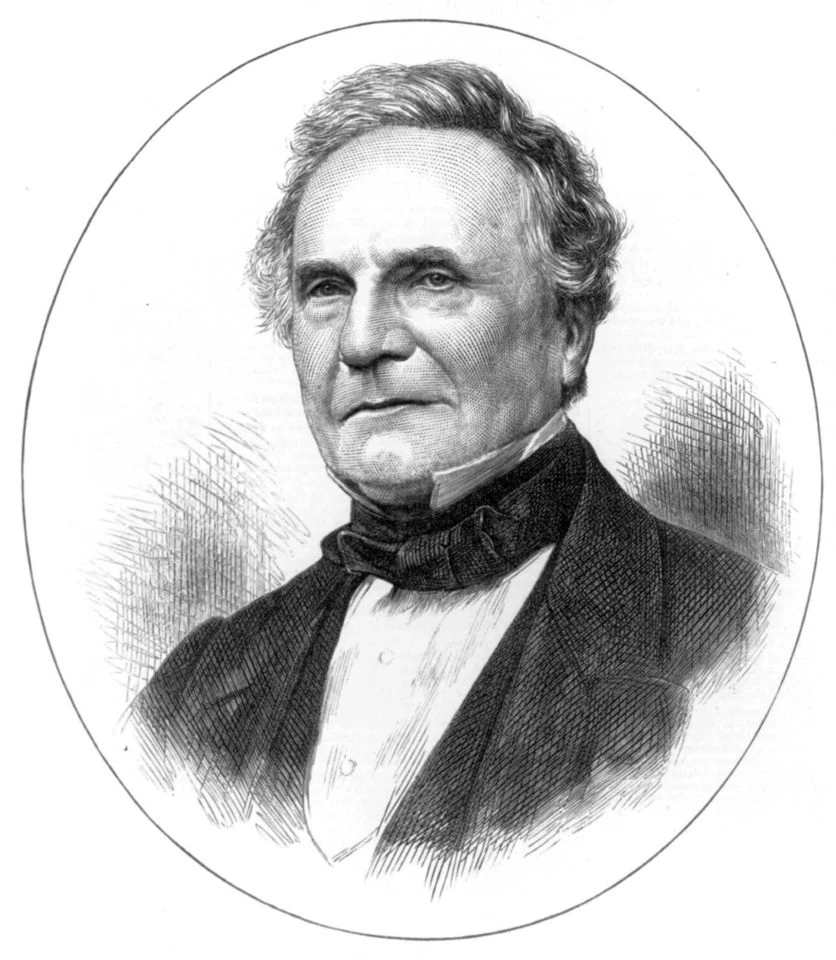
Charles Babbage set out to make calculation more reliable. In the early nineteenth century, mathematical tables used in navigation, science and engineering were worked out by hand, leaving them vulnerable to mistakes in calculation and transcription. Babbage’s response was to design machines that could perform the work mechanically. His Difference Engine was intended to produce tables; his more ambitious Analytical Engine was designed as a programmable, general-purpose machine. Neither was completed in his lifetime, but the ideas in their designs helped establish his place in the history of computing.
A mathematician in a changing Britain
Babbage was born on 26 December 1791. His birthplace is disputed; the account in the Oxford Dictionary of National Biography, as reported in the supplied reference, identifies 44 Crosby Row in Walworth, London, as the likeliest location. His father, Benjamin Babbage, was a banking partner. The family moved to East Teignmouth in 1808, and Charles’s education took him through schools and private tuition in Devon and Middlesex before he entered Trinity College, Cambridge, in 1810.
Already well read in mathematics, Babbage found the university’s teaching disappointing. He and fellow students John Herschel and George Peacock formed the Analytical Society in 1812, advocating for the use of continental mathematical methods. Babbage transferred to Peterhouse in 1812 and took a degree without examination in 1814. His academic career did not follow a conventional course: he became Lucasian Professor of Mathematics at Cambridge in 1828, but never gave a lecture and resigned in 1839.
His work was not confined to mathematics. In 1820 he helped found the Astronomical Society of London, later the Royal Astronomical Society. Its interest in improving astronomical calculations helped prompt his work on mechanical computation. In 1824 the Society awarded him its Gold Medal for inventing an engine to calculate mathematical and astronomical tables. He also studied industrial production, postal systems, insurance and cryptography, and took part in public debates about the organisation of science and universities.
From the Difference Engine to a programmable machine
Babbage began developing the Difference Engine in 1822. Using the method of finite differences, it could calculate values for polynomial functions through repeated additions, avoiding the need for multiplication and division. The aim was practical: to produce accurate tables without relying on long chains of human calculation. In 1823, he engaged engineer Joseph Clement to build a prototype. Their working relationship broke down over costs, and the larger machine remained unfinished.
The distinction between a design and a working machine matters to Babbage’s story. He received government support for the Difference Engine project, but the original machine was not completed during his lifetime. In 1847–49 he drew up plans for an improved version, Difference Engine No. 2, but did not secure government funding to build it. The Science Museum in London later constructed a working machine to those plans, using manufacturing tolerances available in the nineteenth century. It performed a calculation to 31 digits in 1991. The result demonstrated that this particular design could work; it did not mean that Babbage himself had finished the machine.
As the Difference Engine project stalled, Babbage developed a more far-reaching idea: the Analytical Engine. Its design used punched cards, drawing on the system of the Jacquard loom, to direct operations in a mechanical calculator. It was intended to work through instructions in sequence, make conditional branches and repeat operations in loops. It would also store data and use results from one operation in later computations. The Analytical Engine was not a single completed object but a succession of evolving designs. Babbage wrote programmes for it from 1837 onwards, but the machine was never built in his lifetime.
Ada Lovelace corresponded with Babbage about the Engine and translated an account of his lectures in Turin, adding notes of her own. In those notes she described how the machine might be directed to calculate a sequence of Bernoulli numbers. The extent of her independent contribution has been debated, but her published account helped explain how instructions could operate on a machine that had not yet been constructed.
Machines, manufacturing and public argument
Babbage’s interest in systems extended from calculation to industrial work. In On the Economy of Machinery and Manufactures, first published in 1832, he examined the organisation of production, machinery and the division of labour. He drew on observations of factories in Britain and abroad, considering how tasks could be divided and costs assessed. The book went through several editions and became an influential early study of industrial organisation.
He also worked on cryptography, meteorology and measurement. In 1838 he invented a pilot, or cow-catcher, to clear obstacles from railway tracks, and constructed a dynamometer car. His proposed programme to catalogue physical constants reflected a broader ambition to make measurement systematic. These interests sat alongside a combative public presence. His 1830 book Reflections on the Decline of Science criticised the state of British science; the debate that followed helped spur the formation of the British Association for the Advancement of Science in 1831. He also hosted Saturday evening gatherings at his London home, bringing together scientists, writers and members of the aristocracy.
Babbage died in Marylebone, London, on 18 October 1871, aged 79, and was buried at Kensal Green Cemetery. He had spent more than 40 years living and working at 1 Dorset Street. His designs outlasted the projects and disputes of his lifetime: components of his incomplete mechanisms are held by the Science Museum, and later builders have been able to test some of his calculations and mechanical plans.
Why Charles Babbage deserves a place in British Legacy
Babbage’s place in British history rests not on a claim that he built a modern computer, but on the specific machinery he designed and the problems he set out to solve. The Difference Engine addressed the errors that could creep into printed mathematical tables used by navigators, scientists and engineers. The Analytical Engine went further: its punched-card instructions, conditional branching, loops and use of stored results described a form of general-purpose computation in mechanical terms. Though it remained a design, its architecture made computation more than a matter of automating one fixed calculation.
His significance also reaches beyond the machines. In On the Economy of Machinery and Manufactures, he applied systematic observation to factories and the division of labour, bringing questions of machinery, skill and cost into a detailed account of industrial production. His work with the Astronomical Society connected calculation with a practical need for more dependable tables, while his advocacy helped shape debate about British science. The later construction of Difference Engine No. 2 offered a concrete test of one of his designs, showing that it could operate using nineteenth-century manufacturing tolerances. Babbage’s legacy is therefore both technical and practical: he imagined a programmable machine, pursued mechanical accuracy, and applied the same habit of analysis to industry and scientific institutions.
Sources
Adapted in part from Charles Babbage by Wikipedia contributors, under CC BY-SA 4.0. Text has been edited and combined with the existing article; this adapted text is shared under the same licence. Contributor history.