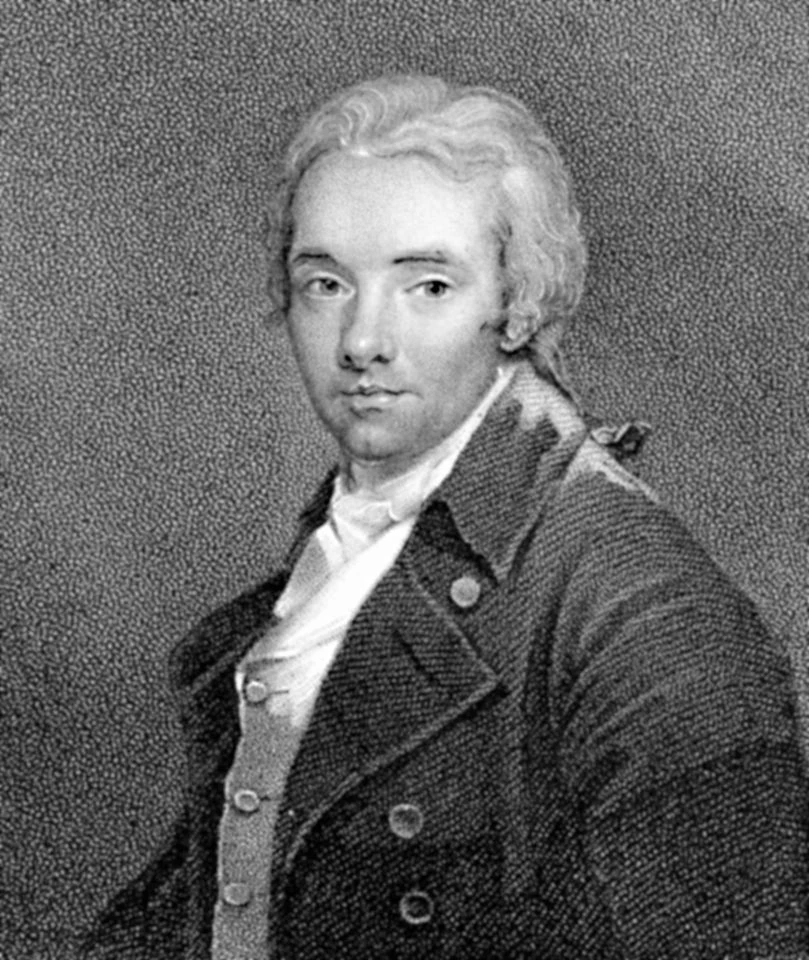
William Wilberforce is often remembered as the MP who helped abolish the slave trade. The achievement was neither his alone nor a single, sudden victory. For years, campaigners assembled evidence and pressed the public; Wilberforce brought their case repeatedly into Parliament. In 1807, that parliamentary pressure helped secure a ban on the British slave trade. The law did not free people already enslaved in the colonies, and Wilberforce continued to campaign against slavery itself. His story is one of persistence and political influence, but also of the wider movement that made reform possible and of a conservative politician whose convictions did not extend to every struggle for justice.
A Hull childhood and a political beginning
Wilberforce was born in Kingston upon Hull on 24 August 1759, the only son of merchant Robert Wilberforce and Elizabeth Bird. His grandfather, also William, had made the family’s fortune through maritime trade with the Baltic and served twice as Hull’s mayor. The younger Wilberforce attended Hull Grammar School before continuing his education at Pocklington School. In 1776, aged 17, he entered St John’s College, Cambridge.
He had inherited enough money to be independent and, at university, devoted much of his time to social life rather than study. He was known for his wit and sociability, and became friends with William Pitt, who would later be Prime Minister. Wilberforce nevertheless completed a BA in 1781 and an MA in 1788. His move into politics came while he was still a student: in 1780, aged 21, he was elected MP for Kingston upon Hull. He later represented Yorkshire from 1784 and Bramber from 1812 until his retirement.
Wilberforce sat as an independent, rather than binding himself to a party, and worked with different governments. His public manner helped him build relationships across political society, while his speaking voice and skill in debate gave him a platform in the Commons. Early in his career he supported parliamentary reform and introduced other proposals, including bills concerning the treatment of criminals. These were not all successful. His political life would be shaped, more profoundly, by a religious conversion and by the question of what duty required of him.
Faith, conscience and the abolition campaign
In 1785, during a European tour with his family and former schoolmaster’s brother Isaac Milner, Wilberforce underwent an evangelical conversion. He began to read the Bible and pray regularly, and became more self-critical about how he used his time and influence. He considered leaving politics, but the evangelical clergyman John Newton advised him to remain in public life. Wilberforce resolved to do so with greater diligence and a stronger sense of moral responsibility.
That change did not make him the originator of abolition. Quakers had organised against the slave trade and presented a petition to Parliament in 1783. Granville Sharp had pursued legal and public campaigns, while Thomas Clarkson gathered testimony and other evidence about the trade. Wilberforce’s contribution was to become a persistent advocate within the Commons, where activists needed someone able to bring their arguments before legislators and keep them there.
In 1787, Clarkson and other campaigners persuaded Wilberforce to take up the parliamentary case. His role was part of a partnership between people working outside Parliament and those who could act within it. The campaign drew on petitions, research and the accounts of people with knowledge of the trade. Its aim was not simply to evoke sympathy but to make the workings and consequences of the system difficult for Parliament to ignore.
Wilberforce’s first major Commons speech on abolition came on 12 May 1789. He argued that the trade was morally wrong and a matter of natural justice, and used evidence about the conditions endured during the Middle Passage. The work that followed was less dramatic than the speech: hearings, resolutions, bills and repeated attempts to secure a vote. Opponents delayed proceedings and defended colonial interests; political circumstances also changed the prospects for reform.
A bill introduced in 1791 was defeated. In 1792, the Commons accepted a proposal for gradual abolition rather than immediate action, a compromise that Wilberforce regarded as likely to postpone the end of the trade. The outbreak of war with France and the association of abolition with radical politics made the campaign harder. Other bills failed, including an abolition bill that passed the Commons in 1804 but did not complete its passage through Parliament. In 1805, another attempt was defeated.
The 1807 law—and what it did not do
The campaign’s eventual success depended on changing political conditions and tactics as well as persistence. After Pitt’s death in 1806, Wilberforce worked more closely with abolitionists in the new government. A bill restricting British subjects’ involvement in the slave trade to French colonies received Royal Assent in May 1806. Wilberforce then wrote a substantial restatement of the abolitionists’ case, while Lord Grenville and Charles Fox helped advance the final bill through Parliament.
On 23 February 1807, the Commons debated the measure. The bill passed by 283 votes to 16, after Wilberforce’s long campaign had been publicly acknowledged in the House. It received Royal Assent on 25 March. The Slave Trade Act abolished Britain’s participation in the trade; it did not emancipate the people already enslaved in the British colonies. Keeping that distinction clear is essential. The 1807 law was a major legislative achievement, but it was not the end of slavery.
Nor did the law, by itself, settle the fate of the trade elsewhere or end the suffering of enslaved people. Wilberforce supported efforts to enforce the ban and worked with the African Institution. He also continued to argue for emancipation. As his health worsened, Thomas Fowell Buxton increasingly led the parliamentary campaign, but Wilberforce remained involved through writing, correspondence and public meetings. In 1823, he published an appeal calling for slavery in the West Indies to be ended.
Reform, religion and political limits
Abolition was central to Wilberforce’s public reputation, but it was not his only concern. His evangelical Anglicanism shaped a broad commitment to religion, education and moral reform. In 1797 he published A Practical View, a book urging a revival of Christian practice among the middle and upper classes. He supported missionary work and was among those involved in the founding of the Church Mission Society in 1799. He also backed Hannah More’s educational work, prison reform and efforts to improve conditions for some working people.
Wilberforce was among the people present at the 1824 meeting that established the Society for the Prevention of Cruelty to Animals, later the RSPCA. The organisation’s founder was the Reverend Arthur Broome, so it would be misleading to present Wilberforce as its sole founder. His involvement nevertheless connects his reform work with the beginnings of organised animal welfare in Britain.
His record was not consistently progressive. Wilberforce was conservative, feared revolution and opposed many forms of radical political change. He supported measures that restricted public meetings and political agitation, opposed workers’ right to organise in trade unions, and resisted an inquiry into the Peterloo Massacre. He also objected to women organising publicly against slavery. These positions complicate the picture of a reformer: his opposition to the slave trade did not mean that he accepted democratic, labour or women’s campaigns on equal terms.
That tension belongs in an account of his life rather than being set aside. Wilberforce could argue with determination against the enslavement of Africans while supporting restrictions on political activity at home. His faith gave him a powerful account of moral duty, but his understanding of who should exercise political power remained limited. Recognising those limits does not erase the work he did against the trade. It makes his record more precise and avoids treating one important achievement as proof of universal moral insight.
The final campaign and a public funeral
Wilberforce retired from Parliament in 1825 as his health failed. He continued to support the campaign for emancipation, even as younger activists took on more of its parliamentary work. In 1833, Parliament passed a bill to abolish slavery throughout most of the British Empire. The legislation included an apprenticeship system and compensation for slave owners, qualifications that show how emancipation was shaped by political compromise as well as by the demands of justice.
Wilberforce heard on 26 July 1833 that government concessions had secured the bill’s passage. He died in London on 29 July, aged 73. The Act received Royal Assent on 28 August, after his death. His life therefore ended before the legislation became law, though he had lived to learn that its passage through Parliament was assured.
Wilberforce’s family had intended to bury him at St Mary’s Church in Stoke Newington. Members of both Houses of Parliament urged that he instead be honoured at Westminster Abbey. He was buried in the Abbey’s north transept on 3 August 1833, close to his friend William Pitt. The funeral was attended by MPs and members of the public, and Parliament suspended its business in tribute.
Remembering the movement as well as the MP
Wilberforce’s sons published a five-volume biography after his death that emphasised their father’s role in abolition and played down Clarkson’s contribution. Clarkson challenged that account. Later histories have restored greater attention to the relationship between Wilberforce’s parliamentary work and the research and mobilisation organised by Clarkson and others. That correction matters: a movement cannot be reduced to the person best placed to speak in Parliament.
In Hull, Wilberforce House is now a museum concerned with the history and legacies of the transatlantic slave trade. The University of Hull established the Wilberforce Institute for the study of slavery and emancipation in 2006. These institutions keep his name in view while providing settings in which the history extends beyond a biography: towards the system abolitionists opposed, the people it harmed, and the continuing study of slavery and exploitation.
Wilberforce’s legacy is therefore held in a useful tension. He was a significant parliamentary campaigner who helped turn decades of organising and argument into legislation. He was also part of a wider abolitionist movement, and his own political outlook had serious limits. Remembering both the achievement and the qualifications avoids making either a solitary hero of him or an incidental figure in a campaign he helped advance.
Why William Wilberforce deserves a place in British Legacy
William Wilberforce deserves a place in British Legacy because his parliamentary work helped make the abolition of the British slave trade a matter of law. His achievement was concrete: he repeatedly brought abolition before the Commons, presented a case built on evidence gathered by campaigners, and persisted through failed bills, political opposition and shifting public circumstances. In 1807, that long effort reached a decisive result. The law did not end slavery, and it should not be described as doing so. Its importance lies in what it did accomplish: Parliament prohibited Britain’s slave trade, challenging a system sustained by commercial and colonial interests.
His place in the story is strongest when it is shared with the people and organisations that made abolition a movement. Clarkson’s research, Quaker organising, Granville Sharp’s work and the actions of many other campaigners helped create the pressure Wilberforce carried into Parliament. His later support for emancipation connects the 1807 law to the wider campaign that led to the 1833 legislation, though that law itself included apprenticeship and compensation for slave owners. Hull’s museum and the University of Hull’s Wilberforce Institute offer local and scholarly ways to keep these histories in view. Wilberforce’s conservative positions also deserve honest attention. They show why his legacy should not be a portrait of uncomplicated virtue, but an account of sustained political effort, collective campaigning and the limits of a reformer’s vision.
Sources
William Wilberforce — Wikipedia, revision 1374397380
Adapted in part from William Wilberforce by Wikipedia contributors, under CC BY-SA 4.0. Text has been edited and combined with the existing article; this adapted text is shared under the same licence. Contributor history.