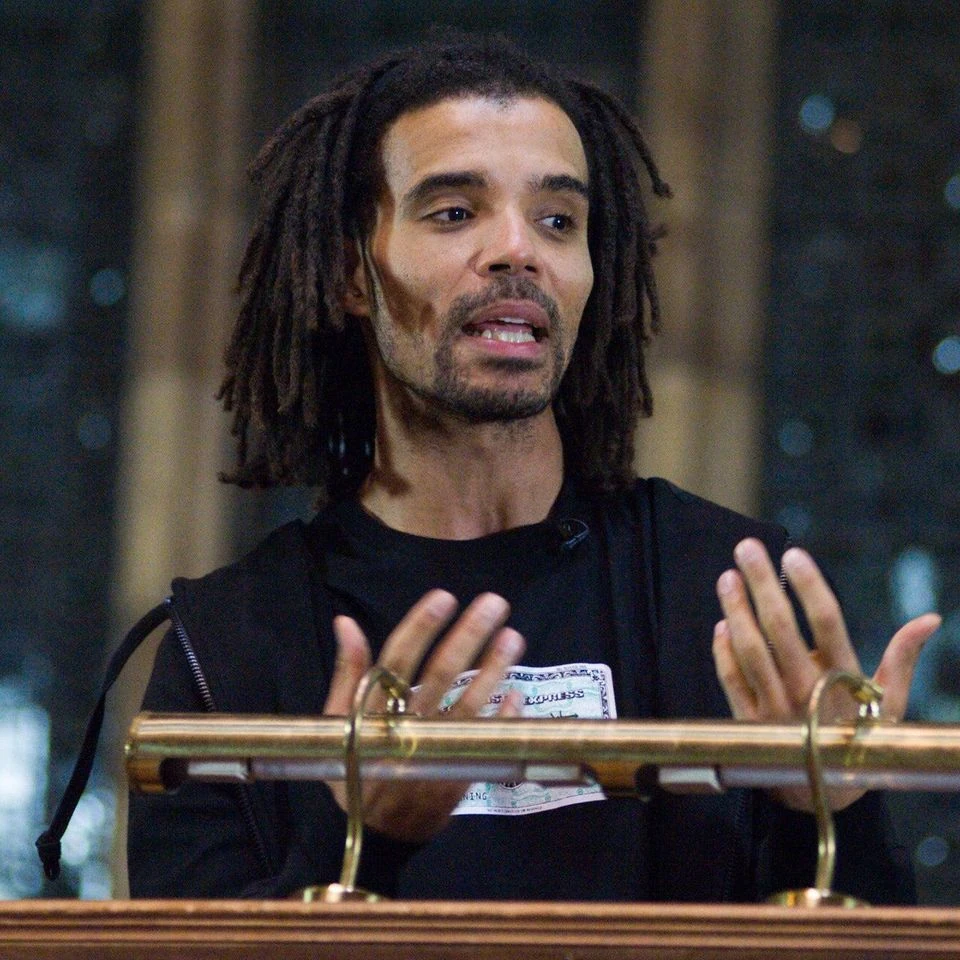
Akala has made a career of bringing difficult questions into forms that people can enter: a rap song, a book, a public talk or a classroom. His subjects include race, class and the continuing consequences of empire, but his work is not confined to commentary on any one of them. Across music, writing, education and activism, he asks how British society was shaped, how its inequalities persist and who gets to take part in explaining them.
Born in 1983 and based in London, Akala first came to prominence as a musician. His debut album, It’s Not a Rumour, appeared in 2006, the same year he received a MOBO Award for Best Hip-Hop Act. He later brought together hip-hop and Shakespeare through the Hip-Hop Shakespeare Company, founded in 2009, and wrote Natives: Race and Class in the Ruins of Empire. These are distinct achievements, but they share a purpose: to make culture a means of thinking about the country, rather than a distraction from its arguments.
Making an argument through music
It’s Not a Rumour established Akala as a musician willing to tackle complex social questions through hip-hop. His lyrics were described in the supplied account as intelligent and evocative, qualities that matter not as praise alone but as a way of understanding the work’s reach. Rap can make an argument direct and memorable while retaining the space for detail, rhythm and ambiguity. Akala’s music used that capacity to bring social criticism into a popular form.
The 2006 MOBO Award for Best Hip-Hop Act gave his work recognition beyond a narrow audience. The supplied material describes his music as resonating across generations and cultures, and its significance lies partly in that ability to carry ideas into different settings. Popular music can be a point of entry for listeners who might not begin with a book on history or social structure. In Akala’s work, that entry point did not require the questions to be softened. Music offered a way to make them audible and to invite further thought.
His career has also crossed between performance and other kinds of public engagement. The source material identifies him as a rapper, poet, journalist, author and activist. Those descriptions point to a practice that moves between forms rather than placing music in a separate compartment. The recurring subjects—race, class and historical inheritance—can be approached through a lyric, an essay or a talk. Each form has different possibilities: performance can hold an audience’s attention, while prose can develop a line of reasoning at greater length.
Personal experience and the history of Britain
Akala’s book Natives: Race and Class in the Ruins of Empire connects his experiences growing up in London with a wider analysis of systemic issues. The combination is central to its subject. Personal experience gives a reader a particular vantage point; history and social analysis help place that experience in a larger pattern. The book, as described in the supplied material, does not treat those approaches as alternatives.
Its focus on British history and on the intersection of race and class brings together topics that are often discussed separately. That connection matters because social divisions do not always operate one at a time. A discussion of race that ignores class, or one of class that leaves out the history of empire, can miss relationships that shape how people understand present-day society. Akala’s writing invites readers to consider how such histories are remembered, what is omitted and how inherited ideas continue to influence public life.
The book has been described as making complex questions accessible to a broad audience. Accessibility here need not mean reducing the subject to a simple answer. It can mean providing a route into an argument that might otherwise seem remote or confined to specialist discussion. Akala’s account joins a perspective rooted in London to questions about Britain as a whole: how the country tells its history, how it explains inequality and which experiences are treated as representative.
That method also helps explain the relationship between his writing and his music. The forms are different, but both can make room for a conversation about structures as well as individual events. A song can put an idea into circulation; a book can examine its context and implications. Together, they give Akala more than one way to reach an audience and more than one way for that audience to approach the questions he raises.
Bringing hip-hop and Shakespeare into the same room
In 2009, Akala founded the Hip-Hop Shakespeare Company. The company’s work brings hip-hop into dialogue with the plays and poetry of William Shakespeare, using that combination to engage young people with literature and the arts. It is an educational project, but its premise also makes a point about culture: forms associated with different audiences or levels of prestige need not be kept apart.
Shakespeare is often treated as a central part of established literary culture, while hip-hop can be dismissed as too contemporary or insufficiently serious. Putting them together challenges that hierarchy. It draws attention to shared possibilities in language, rhythm, performance and verbal invention, without requiring one form to replace the other. Young people can approach well-known literary works through a form they already recognise, while also seeing hip-hop as a medium capable of close attention to language.
The supplied account says the company aims to reach underprivileged communities and break down elitist barriers in education. That purpose makes the crossover more than a clever pairing. It concerns access: who feels welcome in a discussion of literature, whose cultural knowledge is recognised and how educational settings can invite participation without lowering their expectations. The project’s approach suggests that inclusion and intellectual seriousness can support one another.
Its significance is particularly clear in a British context, where Shakespeare has a prominent place in formal ideas of literary heritage. Bringing him into conversation with hip-hop makes that inheritance less like a distant possession and more like something that can be handled, questioned and performed by new audiences. The company therefore connects Akala’s interests in education and performance with his wider concern about who is able to interpret culture and take part in public life.
Speaking about race, class and empire together
Akala’s activism addresses racial discrimination, class inequality and the legacies of colonialism as connected subjects. That joined-up approach is a defining feature of his public argument. Instead of treating inequality as a collection of unrelated problems, his work asks how historical forces, social divisions and present-day assumptions may intersect. It encourages audiences to look beyond an isolated event and consider the conditions in which it takes place.
His public speaking, including TEDx talks, has addressed systemic oppression and the importance of historical awareness, according to the supplied material. The emphasis on history is not merely a backward-looking interest. It asks how inherited accounts of the past shape what people consider normal, what they notice in the present and which explanations they accept. A society’s understanding of its history can influence how it recognises—or overlooks—the persistence of inequality.
Akala’s contribution in these settings is presented as explanatory as well as critical. Denouncing unfairness can make a position clear; analysis can help an audience see how a problem is connected to other parts of public life. The material describes him as using eloquence to challenge prevailing narratives and encourage action towards social justice. His approach gives listeners a vocabulary for considering the relationship between personal experience and wider structures, rather than leaving those experiences isolated or easy to dismiss.
This concern also links the different parts of his career. Music, writing, performance and public speaking each provide a means of bringing an audience into a discussion. None removes the need for thought; each gives it a different setting. Akala’s work repeatedly returns to the question of how Britain understands itself, and of what changes when more people are able to participate in that process.
A British subject with international resonance
The supplied material identifies the UK as the primary focus of Akala’s work, while noting that his reflections on the British Empire and its consequences have resonated internationally. That wider interest follows from the subject matter: histories of empire and their effects are not confined to the borders of the country in which a particular argument is made. Audiences in other places confronting colonial histories may find points of connection in questions about memory, identity and inequality.
The international reach does not make the work less rooted in Britain. Its starting points remain British discussions of race, class, education and historical inheritance. That grounding gives the argument its specific shape, while the themes can travel beyond it. The original account also refers to collaborations with international artists and activists, presenting them as part of a wider recognition that struggles for equality are interconnected. The available material gives no further detail about those collaborations, so their significance is best understood as context rather than as a separate account of particular projects.
Different audiences may encounter Akala through different routes: music, Natives, educational work or public speaking. Together, those routes form a coherent body of work. Rather than treating culture as separate from social questions, he uses cultural forms to make those questions available to a wider public. The combination gives his British subject matter a wider audience without making it placeless.
Why Akala deserves a place in British Legacy
Akala deserves a place in British Legacy because he has used several influential parts of British cultural life to make difficult public questions easier to approach without making them less serious. His music brought social criticism into hip-hop, and the MOBO recognition in 2006 marked the reach of that work. In Natives, he connected experience growing up in London with analysis of race, class and British history. The book offers readers a way to consider how personal accounts and broader social structures can inform one another.
The Hip-Hop Shakespeare Company extends that achievement into education. By putting hip-hop and Shakespeare into conversation, it offers young people a point of entry into literature and the arts, while challenging the idea that cultural participation belongs only to those already comfortable with established institutions. Its stated aim to reach underprivileged communities makes access a practical concern, not just an argument. This work matters because educational opportunity includes the chance to see one’s own cultural knowledge treated as a resource.
Across these achievements, Akala has made space for more people to engage with questions of race, class and empire in British life. Music can attract attention; writing can give an argument room to develop; performance and educational work can invite participation. The benefit is not a single prescribed conclusion, but a wider ability to discuss how the country was shaped and how its institutions and assumptions affect people now. That combination of cultural creativity, public explanation and attention to access is the specific British legacy his work represents.