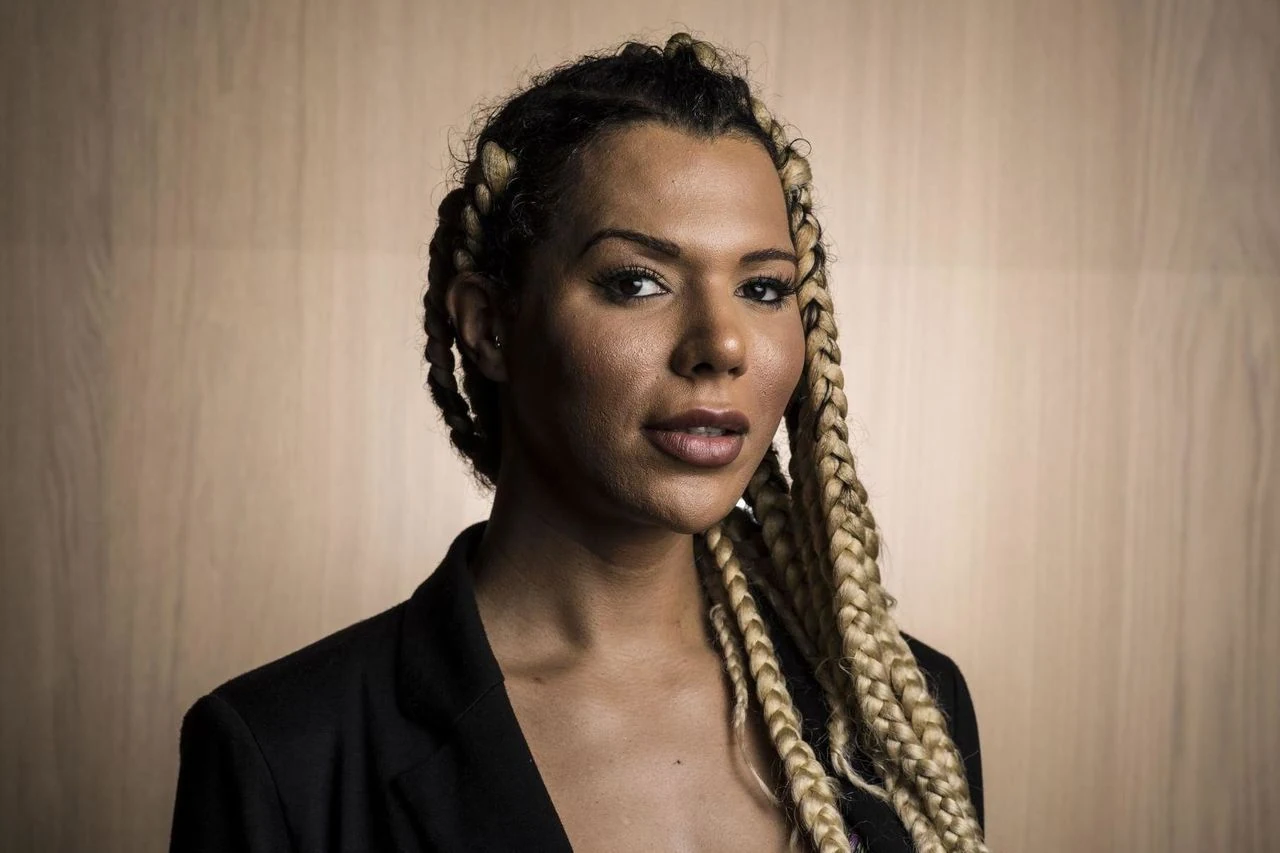
When Munroe Bergdorf appeared in L’Oréal Paris’s UK True Match campaign in 2017, she was presented as the first transgender woman to feature in a L’Oréal Paris campaign in the UK. The moment put a trans woman of mixed Black and white heritage into the imagery of a mass-market beauty brand. But Bergdorf’s significance does not rest on the campaign alone. She has used the public attention it brought to argue that representation is not enough if those represented cannot speak candidly about racism, gender and power.
Her work has ranged across modelling, broadcasting, writing, documentary film and advisory roles. She has moved between fashion, television, publishing, universities and political debate, bringing personal experience into conversations about institutions and public life. Her career has included recognition, conflict and the return to a company that had once ended its partnership with her. That history offers a view of how visibility can open doors, and of the disagreements that follow when a public figure challenges the terms on which those doors are held open.
Finding a public voice
Bergdorf was born in Stansted Mountfitchet, Essex, on 11 September 1987. Her father is Jamaican and her mother English. She studied at the University of Brighton, worked in fashion public relations and began her gender transition in her twenties. The supplied accounts describe her early life and professional background, but do not provide a detailed chronology of her route into modelling. What they do make clear is the range of experience that preceded her rise to wider public attention.
In 2019, the University of Brighton awarded Bergdorf an honorary Doctor of Letters. In an account published by the university, she described how a lecturer, Dr Jessica Moriarty, had supported her through severe depression, an eating disorder and profound confusion about herself. Bergdorf said the relationship helped her develop communication skills that she later used in activism and writing. The account connects her public voice with education and the work of finding language for difficult experience, rather than presenting public prominence as a matter of celebrity alone.
That combination of personal testimony and public argument recurs in her work. Bergdorf has spoken about transgender identity while also questioning the expectations placed on people invited into commercial campaigns and public institutions. Visibility may offer access, but it can also come with an expectation that the person being represented will remain agreeable or confined to a particular role. Bergdorf’s contributions have repeatedly returned to the tension between being shown and being heard: a campaign image can widen recognition, but it cannot substitute for an account of the structures behind it.
The original profile described her as a transgender model and activist who had used her platform to challenge transphobia and racism. That broad description is supported by the scope of her work in the supplied feature: she has modelled, written, spoken publicly and fronted documentaries, while addressing race, gender and representation. The more specific details matter, because they show the means through which she has engaged audiences rather than relying on a general label of advocacy.
A breakthrough in British beauty culture
Bergdorf entered modelling partly because she was frustrated with the fashion industry’s narrow standards. By the middle of the 2010s she was known on the London scene. In August 2017, L’Oréal Paris included her in its UK True Match campaign. She was presented as the first transgender woman to appear in a L’Oréal Paris campaign in the UK, a milestone that placed her in a mainstream commercial setting rather than a platform addressing only an already receptive audience.
Beauty advertising helps shape ideas about who is understood as feminine, aspirational and socially accepted. A trans woman with mixed Black and white heritage appearing in a widely circulated campaign widened the frame of who could be represented in that setting. For viewers who had rarely encountered someone like Bergdorf in mainstream beauty imagery, the campaign offered a different point of reference. It is not possible from the supplied material to quantify its effects, but its significance lies in the public visibility it created.
Bergdorf treated modelling as a platform rather than an endpoint. The campaign gave her reach, which she used to discuss the structures behind the images: who is included, whose experiences are treated as marketable and what companies mean when they speak about diversity. That move made her presence more than a corporate milestone. It brought into view a distinction between representation as an image and representation as a more meaningful part in institutional decisions and debate.
The question became especially sharp when the campaign was followed by a public dispute. The sequence matters: a company had selected Bergdorf for a prominent campaign, then ended its partnership after she spoke about structural racism. That contrast has informed how her career is discussed. The episode can be read as a case study in the limits of corporate inclusion, but it should not be mistaken for proof of any single organisation’s wider intentions. The documented facts are that the partnership ended and that the company later apologised for how the situation had been handled.
Controversy, politics and a return to L’Oréal
Days after the campaign appeared, Bergdorf became the focus of a public dispute over social-media comments she made about structural racism in the aftermath of white supremacist violence in Charlottesville, in the United States. L’Oréal ended its partnership with her, saying her comments conflicted with the company’s values. The episode placed her at the centre of a debate about racism, public speech and the limits of corporate support for diversity.
The supplied record says Bergdorf became the subject of intense public attention after the comments were circulated. It also states that L’Oréal’s decision was framed by the company as a values issue. These are important details to retain without making the controversy more definitive than the evidence allows. The dispute does not, by itself, settle the wider arguments about the wording of the comments or about corporate responsibility; it does show how quickly a campaign relationship can become a public argument over who is permitted to speak, and on what terms.
In February 2018, Bergdorf joined an informal LGBT+ advisory board assembled by Dawn Butler, then Labour’s shadow women and equalities secretary. She resigned the following month after older online posts were recirculated. The role was brief, but it placed her in a political context as well as a cultural one. Her involvement should be described specifically as participation in this informal board, rather than as a formal, general appointment as a Labour Party adviser. The supplied accounts do not give a fuller explanation of her reasons for resigning, so the fact of her departure is clearer than any broader claim about her motives.
The relationship with L’Oréal changed in 2020. Bergdorf criticised the company’s public support for Black Lives Matter and said she had never received an apology for the 2017 episode. L’Oréal Paris president Delphine Viguier spoke with her, apologised for the way the situation had been handled and invited her to take a consultancy role on the company’s UK diversity and inclusion advisory board. This did not erase the earlier rupture. It did, however, mark a change from being a campaign face to being invited into discussions about the company’s approach to inclusion.
That sequence captures an important feature of Bergdorf’s public work: criticism and institutional engagement have both formed part of it. She has challenged organisations from outside and, at times, accepted advisory roles within them. The positions are different, and neither guarantees change. Together, they show how a public dispute can lead to further discussion about accountability and the ways institutions respond to people whose perspectives they have previously struggled to accommodate.
From television to the page
In 2018, Bergdorf fronted Channel 4’s documentary What Makes a Woman. It appeared during a period when gender identity was being argued over loudly in British media. By placing a trans woman at the centre of the film, the programme gave viewers a chance to hear a perspective too often discussed at a distance. It also extended Bergdorf’s work beyond modelling and social-media commentary, using television to address identity with a broad audience.
Her media work has included writing for publications such as The Guardian, British Vogue, Elle and Teen Vogue, as well as speaking at university panels, including at Oxford and Princeton. Those appearances point to a career that has crossed different settings and audiences. Her public communication has not been confined to fashion coverage, nor to one form of activism. The range matters because it has allowed her to approach questions of identity and inequality in formats suited to different readers and viewers.
Bergdorf’s book Transitional develops the idea of transition beyond a narrowly defined account of gender. Its publisher describes it as a manifesto that connects transition with adolescence, love, grief, self-knowledge, racial identity and social change. The book’s argument is that transition is not a subject relevant only to a minority, but a process woven through human life. It offers readers a way to consider familiar experiences of change through a wider lens, while retaining transgender experience as an important part of the discussion.
In 2025, the documentary Love & Rage: Munroe Bergdorf continued her work on screen. It was described as an intimate portrait bringing together activism, identity, feminism, race and hope. The supplied details do not warrant claims about its reception or reach, but the film extends a clear pattern in her career: the use of popular media to bring complicated subjects into public view. Across television, writing and documentary film, Bergdorf has taken topics often reduced to slogans and approached them through personal accounts and broader questions about society.
Recognition and reach
The University of Brighton’s 2019 honorary Doctor of Letters recognised Bergdorf’s contribution to transgender rights. It was a formal acknowledgement from the institution where she had studied, and it came alongside her account of the help she had received from a lecturer. The distinction links her personal history with a body of public work that had reached well beyond her beginnings in fashion.
Her work has also included campaign and advisory roles. Her publisher’s biography identifies her as a National Advocate for UN Women UK, alongside her work as a writer, model and speaker. This is one part of a wider professional range that includes publishing, broadcasting, brands, universities and political discussion. The supplied material does not detail the practical work undertaken in every role, so the significance is best stated in terms of the breadth of settings in which she has been active, rather than ascribing unlisted outcomes to them.
In January 2022, Bergdorf became the first transgender woman to appear on the cover of Cosmopolitan UK, in the magazine’s fiftieth-anniversary issue. The cover marked another appearance in mainstream commercial publishing. Like the L’Oréal campaign, it made a trans woman visible in a familiar media setting. Such milestones do not resolve debates about equality, but they do alter the range of people audiences encounter in prominent cultural spaces.
Recognition, however, is only one measure of a public career. Bergdorf’s profile has also been shaped by disagreement: the end of the L’Oréal partnership, her short time on the informal LGBT+ advisory board and the subsequent return to L’Oréal in a consultancy capacity. These episodes make her story more complex than a steady ascent from campaign to acclaim. They show the uncertain relationship between visibility, criticism and institutional participation, and they help explain why her work has remained part of public discussion.
Why Munroe Bergdorf deserves a place in British Legacy
Munroe Bergdorf deserves a place in British Legacy because her career has made representation a more demanding subject. Her appearance in L’Oréal Paris’s UK campaign widened who could be seen in mainstream British beauty culture. When the partnership ended after her comments about structural racism, the dispute raised a difficult question: could a company celebrate diversity in its imagery while rejecting the speech of the person it had featured? The later apology and consultancy invitation did not undo the earlier conflict, but they show that public criticism can lead to a different kind of institutional engagement. This is a specific contribution to British cultural life, grounded in the relationship between advertising, public debate and corporate practice.
Her work extends beyond that episode. Through What Makes a Woman, Transitional, her writing and her later documentary, Bergdorf has brought personal experience into media and publishing forms with broad public reach. She has asked audiences to consider how gender, race and social expectations affect individuals and institutions, and has made those questions part of conversations in British television, magazines, universities and commercial culture. The available evidence does not support a claim that her work alone changed policy or public attitudes. It does support a more precise conclusion: she has helped make trans experience more visible and has challenged the idea that visibility by itself is enough.
Her British connection is not simply a matter of birthplace. Bergdorf grew up in Essex, studied at the University of Brighton and has worked in settings central to contemporary British public life, including UK advertising, Channel 4, British publishing and political debate. She has moved between those settings without limiting her contribution to a single role or medium. The combination of modelling, broadcasting, writing and advisory work has given her several ways to make arguments heard, while the controversies in her career have exposed the friction between public inclusion and institutional comfort.
That record is worth preserving because it makes a lasting cultural question visible: who is allowed to be present, and who is permitted to speak once present? Bergdorf’s career provides concrete examples rather than an abstract answer. A mainstream campaign offered a form of visibility; her public criticism tested its limits; later advisory work brought her back into institutional discussion. Her documentaries and book extended the conversation to audiences beyond fashion. British Legacy should remember her for that continuing work of representation, explanation and challenge: a contribution to how Britain sees its people, and to how its institutions are asked to respond.