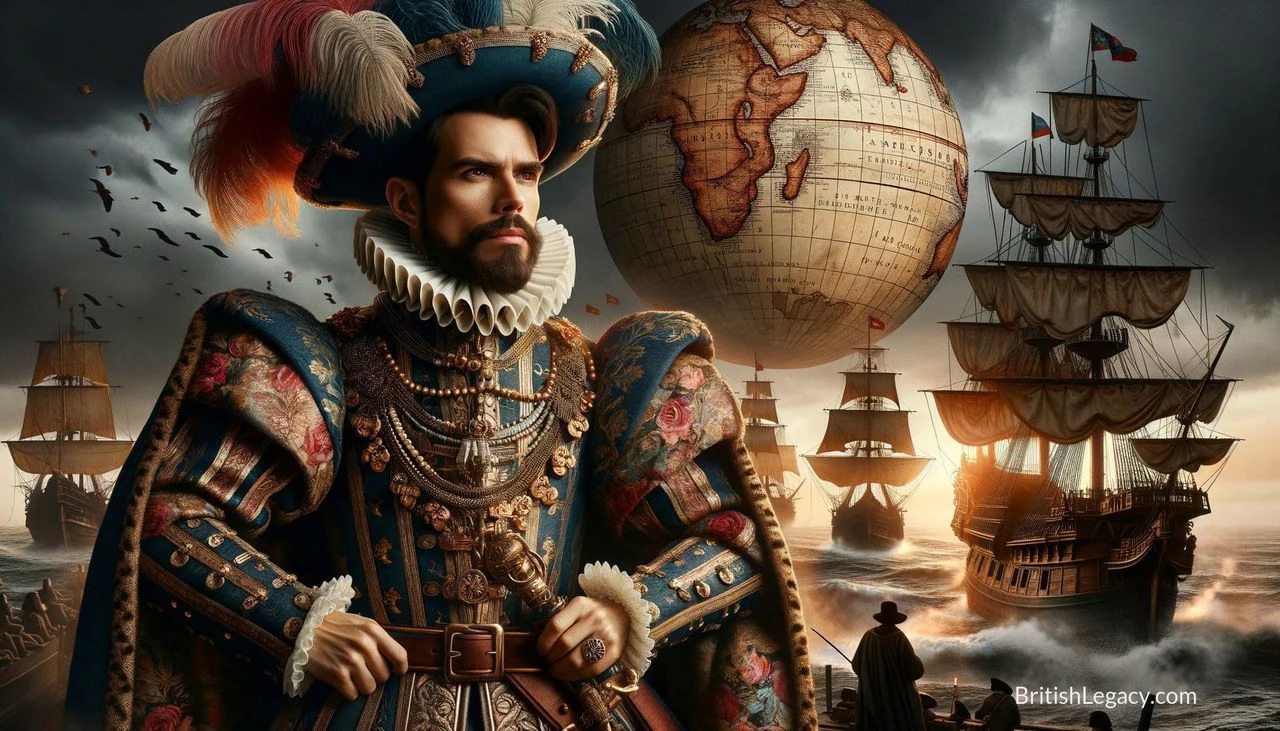
Francis Drake’s reputation rests on two defining episodes: the expedition that made him the first Englishman to circumnavigate the world, and his service as vice-admiral in the fleet that fought the Spanish Armada. Both brought him fame and wealth. Neither tells the whole story. Drake was a privateer whose attacks on Spanish ships and settlements helped shape England’s conflict with Spain, and whose earlier voyages included participation in the English slave trade.
From Devon to the Spanish Main
Drake was born at Crowndale Farm in Tavistock, Devon, probably around 1540. His precise birth date is unknown. He was the eldest of twelve children of Edmund Drake, a Protestant farmer, and Mary Mylwaye. As a boy he entered the household of his relative William Hawkins, a Plymouth sea captain, and began training as an apprentice aboard Hawkins’s vessels. He later worked on small trading ships around the English coast and the Channel.
In the 1560s Drake sailed on voyages connected to the English slave trade. He accompanied John Lovell in 1566 and John Hawkins in 1567; the latter expedition ended disastrously at San Juan de Ulúa, where Spanish forces attacked the English ships. Drake escaped aboard the Judith. Hawkins later accused him of desertion and of taking treasure, accusations Drake denied. The experience helped turn Drake towards attacking Spanish possessions, but it does not remove his involvement in the trade. The voyages enslaved Africans and formed part of the wider English effort to enter a trade dominated by Portugal and Spain.
Drake’s first major independent venture began in 1572, when he sailed from Plymouth to raid Nombre de Dios on the Isthmus of Panama. He and his men later joined French privateers and Cimarrón allies—Africans who had escaped Spanish enslavement—to attack a Spanish treasure convoy. Drake returned to England with wealth and a growing reputation. During the expedition, he and his men also climbed a tree in the mountains and saw the Pacific: Drake vowed that he would one day sail it.
A circumnavigation with a disputed commission
Drake’s expedition of 1577–80 was organised and financed by a private syndicate. Queen Elizabeth I may have invested, but the surviving account does not give Drake a formal royal commission. The fleet left Plymouth in December 1577, with Drake sailing aboard the Pelican, later renamed the Golden Hind. After crossing the Atlantic and passing through the Strait of Magellan, he continued alone along the Pacific coast of South America, attacking Spanish ports and ships and taking treasure.
In 1579, Drake claimed land on the coast of what is now Northern California for Elizabeth, naming it Nova Albion. He then crossed the Pacific, stopped in the Moluccas and rounded the Cape of Good Hope. The Golden Hind returned to Plymouth on 26 September 1580 with Drake and 59 crew members aboard. The voyage was the first English expedition to circumnavigate the globe; it was not the first circumnavigation in history. Its cargo included spices and captured Spanish treasure. Elizabeth knighted Drake aboard the ship at Deptford in 1581.
The voyage’s gains came through privateering and seizure as well as navigation. That mixture of exploration, royal interest and plunder would remain central to Drake’s reputation: celebrated in England, he was regarded by Spain as a pirate.
War with Spain and the Armada
In 1585, as war between England and Spain began, Drake led an expedition against Spanish possessions in the Caribbean. His fleet attacked Vigo, Santiago, Santo Domingo and Cartagena, then raided St Augustine in Florida. On the return voyage, Drake also reached the English settlement at Roanoke and brought its colonists back to England.
Two years later, Drake attacked the Spanish fleet at Cádiz, damaging ships and supplies being prepared for the invasion of England. The raid, later called the “singeing of the King’s beard”, delayed the Spanish preparations. When the Armada arrived in 1588, Drake served as vice-admiral under Lord Howard of Effingham, commanding the Revenge. During the pursuit through the Channel, Drake broke away to capture the disabled Spanish galleon Nuestra Señora del Rosario and its commander, Pedro de Valdés. The English fleet later used fireships at Calais, and fought the Armada off Gravelines. Drake was an important commander in the campaign, but the defeat of the Armada was a collective naval action, not his achievement alone.
The familiar tale that Drake calmly finished a game of bowls on Plymouth Hoe before going to meet the Spanish fleet is probably apocryphal. The earliest known retelling appeared decades later, rather than in an eyewitness account. Drake’s career also included serious reversals. In 1589 he and John Norris led the English Armada, whose attempt to destroy Spain’s remaining fleet and establish a revolt in Portugal failed at great cost.
Public office, final expedition and memory
Drake served as mayor of Plymouth and sat in Parliament for Camelford, Bossiney and Plymouth. As mayor, he contracted to bring water to the town from the River Meavy and to build mills. In later years he returned to sea. An expedition against Spanish America in 1595–96 suffered defeats, including failed attacks on Las Palmas and San Juan in Puerto Rico. Drake died of dysentery on 28 January 1596 while his fleet was off Portobelo, in present-day Panama. He was buried at sea in a lead-lined coffin.
His name became part of English folklore, including the legend of Drake’s Drum. In Devon, Buckland Abbey, which he bought in 1580, preserves objects associated with his life and is now cared for by the National Trust. His legacy is also contested. The sources record his participation in slave-trading voyages, the killing of Indigenous people during the voyage through the Strait of Magellan, and English violence in Ireland, including the 1575 Rathlin Island massacre, at which Drake was present. Those episodes belong in any account of the man as well as the celebrated voyages.
Why Sir Francis Drake deserves a place in British Legacy
Drake deserves a place in British Legacy because his life illuminates a decisive period in England’s maritime history. His circumnavigation was the first completed by an English expedition, linking Atlantic, Pacific and Indian Ocean routes in a single voyage and bringing the Golden Hind back to Plymouth in 1580. His later service as vice-admiral during the Armada campaign connects that experience to the defence of England against invasion. Together, the voyage and the campaign helped make Drake one of the most prominent English seamen of the Elizabethan age.
That significance is not a reason to turn him into a simple national hero. Drake’s wealth and renown were bound up with attacks on Spanish shipping and settlements, and his early career included participation in slave-trading voyages. He was also present at the Rathlin Island massacre and took part in campaigns that ended in failure as well as victory. Remembering those facts makes his British legacy more useful, not less: it shows how exploration, state interests, private profit and violence could overlap in the making of England’s maritime power. His story invites attention both to the navigational feat and to the human costs of the world it helped open to English ambition.
Sources
Francis Drake — Wikipedia, revision 1379079881
Adapted in part from Francis Drake by Wikipedia contributors, under CC BY-SA 4.0. Text has been edited and combined with the existing article; this adapted text is shared under the same licence. Contributor history.