
Barbara Hepworth made sculpture in which the space passing through a work mattered as much as the material around it. Born in Wakefield, she became a leading figure in British modernism, developing an approach to carved and modelled forms that reached from small works in wood and stone to large public commissions in bronze. Her career took her from art school in Yorkshire and London to the wartime artistic community of St Ives, where she lived and worked for the rest of her life.
Wakefield, Leeds and the move towards abstraction
Jocelyn Barbara Hepworth was born in Wakefield on 10 January 1903, the eldest child of Gertrude and Herbert Hepworth. Her father was a civil engineer who worked for the West Riding County Council. At Wakefield Girls’ High School she won music prizes, then, in 1920, a scholarship to Leeds School of Art. There she met Henry Moore. They became friends and, over time, professional rivals.
Hepworth continued her studies at the Royal College of Art in London from 1921 to 1924. The path was difficult for a woman seeking a place in sculpture, a field then dominated by men, but she won a county scholarship and completed her diploma. In 1924 she travelled to Florence on a West Riding Travel Scholarship. There she learned to carve marble from the sculptor Giovanni Ardini. She married fellow sculptor John Skeaping in Florence in 1925; they returned to London the following year and exhibited together. Their son, Paul, was born in 1929.
Her early work turned increasingly towards abstraction. In 1931 she made pierced figures, with openings that made the space within a sculpture part of its structure. That year she met the painter Ben Nicholson and filed for divorce from Skeaping; the divorce was completed in 1933. Hepworth and Nicholson became part of a circle of modern artists in Hampstead. They travelled to France, where they visited the studios of Jean Arp, Pablo Picasso and Constantin Brâncuși. Hepworth also joined the Paris-based Abstraction-Création group.
In 1933 she co-founded Unit One with Nicholson, Paul Nash, Herbert Read and Wells Coates. The group sought to bring abstraction and Surrealism together in British art. Hepworth helped introduce British audiences to developments in continental art, and designed the layout of Circle: An International Survey of Constructivist Art, published in London in 1937. She and Nicholson had triplets in 1934; they married in 1938, after Nicholson’s divorce.
St Ives: a home, a studio and a new scale
At the outbreak of the Second World War, Hepworth and Nicholson moved with their children to Cornwall. St Ives had become a refuge for artists, and it would remain Hepworth’s home for the rest of her life. In 1949 she settled at Trewyn Studios, whose yard and garden gave her space to work outdoors. That year, she and Nicholson helped establish the Penwith Society of Arts, alongside 17 other founding members, including Peter Lanyon and Bernard Leach.
Hepworth was also a skilled draughtsperson. After her daughter Sarah was hospitalised in 1944, she became friendly with surgeon Norman Capener and, at his invitation, observed operations. From 1947 to 1949 she made nearly 80 drawings of operating rooms. Her interest in the relationship between the work of artists and surgeons extended her practice beyond sculpture and shows how closely observation informed her work.
Public commissions brought her sculpture into shared spaces. For the Festival of Britain in 1951, the Arts Council commissioned Contrapuntal Forms, two figures in Irish limestone, shown on London’s South Bank. Hepworth employed assistants to help complete large-scale works; over the course of her career she worked with 16. In 1950 her work had appeared in the British Pavilion at the Venice Biennale, alongside that of Matthew Smith and John Constable.
After her divorce from Nicholson in 1951, Hepworth began working in bronze and clay as well as stone and wood. Her son Paul, serving with the Royal Air Force in Thailand, died in a plane crash in 1953. In 1954 she travelled to Greece with her friend Margaret Gardiner. A shipment of Nigerian guarea hardwood that Gardiner arranged for her inspired a group of carvings, including Corinthos and Curved Form (Delphi).
Carved openings and public monuments
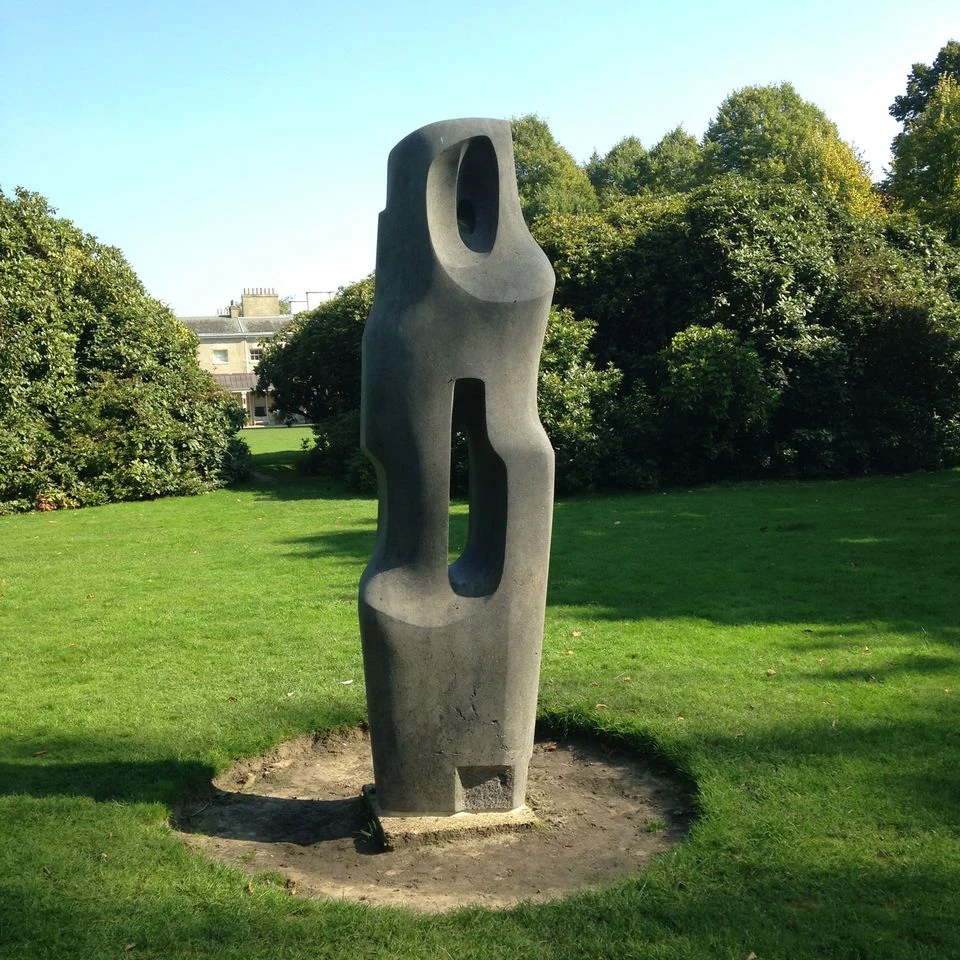
Hepworth’s pierced forms invite the eye to move through and around a sculpture rather than stop at its outer surface. Openings and recesses make surrounding space, light and the viewer’s changing position part of the experience. Works such as Oval Sculpture and Oval Form (Trezion) belong to a wider practice that explored the relationship between solid material and open space. She worked in different materials and formats, from carved wood and stone to bronze and, late in her career, lithography.
Her best-known international commission, Single Form, stands in the plaza of the United Nations headquarters in New York. Made in memory of Dag Hammarskjöld, the UN secretary-general and a collector of her work, it was commissioned in 1961 after his death in a plane crash. Hepworth completed the bronze in 1964. The work’s upright, simplified form carries that memorial purpose into a prominent public setting.
Hepworth’s standing in the United States grew through gallery relationships as well as commissions. After early negotiations and exhibitions, she established representation with Galerie Chalette in 1957. In 1960 she bought the Palais de Danse, a former cinema and dance hall across the street from Trewyn Studios, to provide space for large-scale work. Her late-career experiments included lithographic suites made in 1969 and 1971; The Aegean Suite drew on her 1954 journey to Greece.
Recognition, loss and remembrance
Hepworth received the Grand Prix at the 1959 São Paulo Art Biennial and honorary degrees from several British universities. She was appointed CBE in 1958 and DBE in 1965. In 1968 St Ives granted her freedom of the town, recognising her contribution there. She was also a founder member of Cornwall County Council’s Art in Schools programme and gave sculptures to the town. That year she was inducted into Gorsedh Kernow, the Cornish cultural organisation, with the bardic name Gravyor, meaning “Sculptor”.
Her connection to St Ives was both personal and civic. She helped found the Penwith Society, contributed to local cultural life and made her home and studio the centre of her practice. On 20 May 1975 she died, aged 72, in an accidental fire at Trewyn Studios. After her death the site became the Barbara Hepworth Museum; it came under Tate’s control in 1980. Her birthplace also honours her work: The Hepworth Wakefield, a museum named for her, opened in 2011.
Why Barbara Hepworth deserves a place in British Legacy
Hepworth deserves a place in British Legacy for the way she changed the possibilities of sculpture and made those ideas visible in public life. From her early pierced figures to large bronzes, she treated openings and surrounding space as active parts of a work, not as gaps left over after carving. Her practice crossed materials and forms, while commissions such as Contrapuntal Forms and Single Form brought modern sculpture into settings where it could be encountered beyond a gallery. The United Nations memorial joined her formal language to a specific act of remembrance; the Festival of Britain commission placed her work within a major national cultural event.
Her British significance is also rooted in the places and institutions with which she was involved. A Yorkshire education and early career in London led to a lasting home in St Ives, where she helped establish the Penwith Society and supported art education through Cornwall County Council’s programme. Her studio became a museum, and her home town later opened The Hepworth Wakefield. These links make her legacy more than a record of international acclaim: they show how an artist’s work can shape the cultural life of particular British communities. Hepworth’s career also matters as that of a woman who established herself in a male-dominated field, building a substantial body of work without confining herself to one material, scale or medium.
Sources
Barbara Hepworth — revision 1373792674 · Barbara Hepworth
Adapted in part from Barbara Hepworth by Wikipedia contributors, under CC BY-SA 4.0. Text has been edited and combined with the existing article; this adapted text is shared under the same licence. Contributor history.
_by_Erling_Mandelmann.jpg)