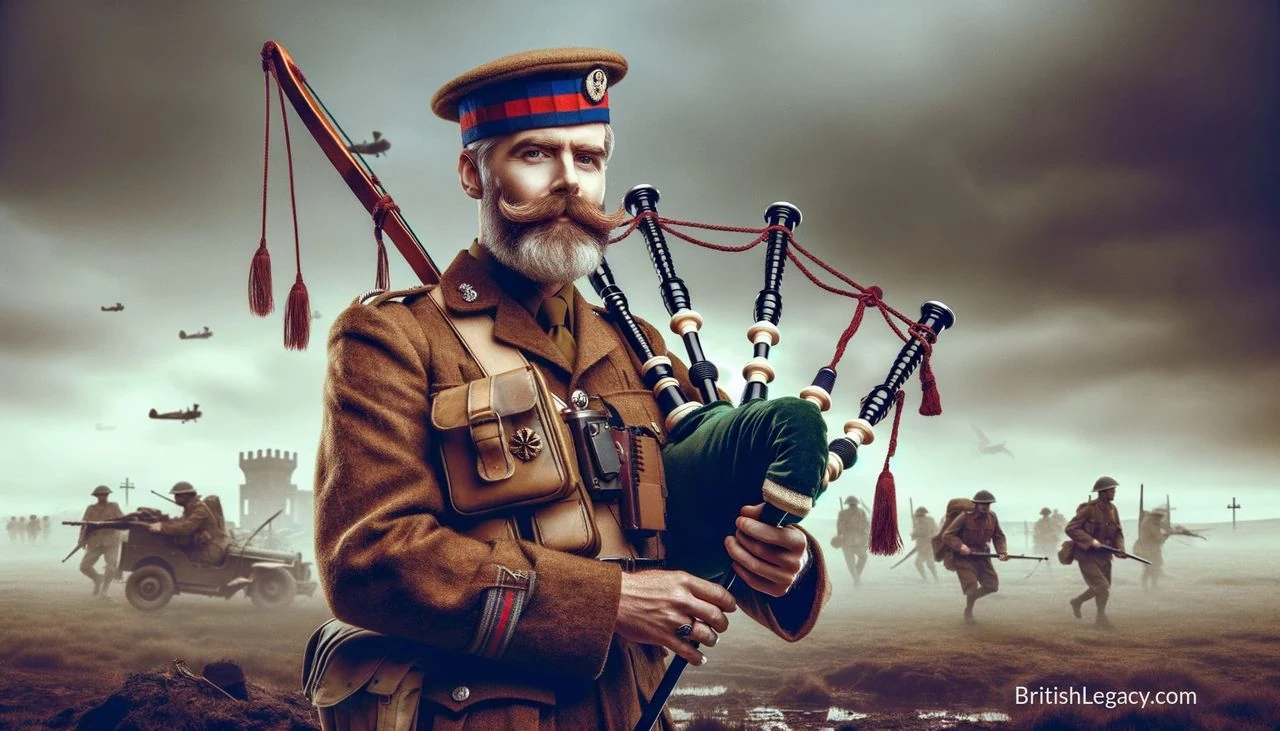
John “Mad Jack” Churchill went into action with a Scottish broadsword, a longbow and arrows, and bagpipes. The combination made him one of the most striking British officers of the Second World War, but the image can obscure the military work behind it. Churchill commanded and led commando operations in Norway, Sicily and Yugoslavia; his record includes a daring capture of a German observation post near Salerno and a final, ill-fated raid on the island of Brač. His story is unusual not because eccentricity replaced soldiering, but because it accompanied a demanding career in it.
From Colombo to the Army
Churchill was born in Colombo, British Ceylon, on 16 September 1906. His father, Alec Fleming Churchill, worked in the Ceylon Civil Service. The family returned to England shortly after Jack’s birth, later moved to British Hong Kong and came back to England in 1917. Churchill attended King William’s College on the Isle of Man and graduated from the Royal Military College, Sandhurst, in 1926. He served with the Manchester Regiment in Burma, where he enjoyed riding a motorbike.
He left the Army in 1936 and worked as a newspaper editor in Nairobi and as a model. His interests included piping and archery: he placed second in a military piping competition at the Aldershot Tattoo in 1938, and represented Great Britain at the World Archery Championships in Oslo the following year, finishing 26th. He also appeared in the 1940 film The Thief of Bagdad, using his archery skills in a small role.
When Germany invaded Poland in September 1939, Churchill resumed his commission. The Manchester Regiment went to France as part of the British Expeditionary Force. After the fighting at Dunkirk, he volunteered for the Commandos. The nickname “Fighting Jack” and the better-known “Mad Jack” suited the colourful figure he presented, but his subsequent assignments placed him in the midst of organised operations, not merely theatrical gestures.
Bagpipes in action
Churchill was second in command of No. 3 Commando during Operation Archery, the raid on the German garrison at Vågsøy, Norway, on 27 December 1941. As the landing craft’s ramps fell, he leapt forward playing “March of the Cameron Men” on his bagpipes. The commandos overran the garrison in less than ten minutes, killing or capturing the enemy soldiers they encountered. This was a real commando raid, carried out with the speed and force its objective demanded; the pipes became part of the story because Churchill carried them into the landing.
In July 1943, as commanding officer of No. 2 Commando, he led men from their landing site at Catania in Sicily. He carried his Scottish broadsword, longbow and arrows, and bagpipes. At Salerno, his unit was ordered to capture a German observation post outside Molina, which controlled a pass leading down to the beachhead. Churchill and a corporal infiltrated the town, seized the post and took 42 prisoners, including a mortar squad. They brought the prisoners back down the pass; German captives pushed carts carrying the wounded. Churchill later described the scene as “an image from the Napoleonic Wars”.
He received the Distinguished Service Order for leading the Salerno action. The popular story that he shot a German sentry with his longbow there does not match the account in his military biography: Churchill later said that his bows had been crushed by a lorry earlier in the campaign. The distinction matters. His record at Salerno is remarkable without turning a disputed tale into fact: the observation post was captured, dozens of prisoners were taken, and wounded men were brought down the pass.
Capture in Yugoslavia
In 1944, Churchill joined the Maclean Mission in Yugoslavia, supporting Josip Broz Tito’s Partisans from the Adriatic island of Vis. In May he was ordered to raid German-held Brač. He organised a force of about 1,500 Partisans, 43 Commando and a troop from 40 Commando. The landing was unopposed, but after the Partisans saw the German gun positions, they delayed the attack. Churchill’s pipes signalled the remaining commandos to advance. An RAF Spitfire strafed the area, and he decided to withdraw for the night and try again in the morning.
The next day, 43 Commando launched a flanking attack, with Churchill leading elements of 40 Commando. The Partisans stayed at the landing area; only Churchill and six others reached the objective. A mortar shell killed or wounded the others. Churchill was playing “Will Ye No Come Back Again?” as German forces advanced, and was knocked unconscious by grenades before being captured. He was taken for interrogation in Berlin because German military intelligence believed he might be related to Winston Churchill; they were not related.
Churchill did not escape from Sachsenhausen and make a 150-mile trek to safety, as a frequently repeated version of his story claims. In late April 1945, he and about 140 other prominent prisoners were transferred to Tyrol under SS guard. Fearing execution, the prisoners appealed to senior German Army officers. A German unit under Captain Wichard von Alvensleben intervened; the SS guards left, and the prisoners were protected. The episode was dangerous, but it was not one of Churchill’s escapes.
Service after the war
Churchill returned to military service after his release and was posted to British Palestine in 1948. There, he helped defend a train convoy against a force of 250 men with only 12 defenders, and later helped coordinate the evacuation from Hadassah Hospital in Jerusalem. He remained in the Army until retiring in 1959.
Outside military service, Churchill’s interests remained varied. His pre-war competition archery and piping were part of a life that also included sailing coal-fired ships on the Thames between Richmond and Oxford and making radio-controlled model warships. He died in Chertsey, Surrey, on 8 March 1996, aged 89. His wartime decorations included the Distinguished Service Order and Bar, and the Military Cross and Bar.
Why John Churchill deserves a place in British Legacy
Churchill’s place in British history rests on more than an arresting image of pipes and a broadsword. At Vågsøy, he was second in command in an operation that rapidly overran a German garrison. At Salerno, he led a small party into Molina, captured an observation post controlling a pass, and brought 42 prisoners and wounded men back down it. In Yugoslavia, his service continued through a complex raid involving commandos, Partisans and air support, ending in capture. These episodes show an officer working in varied and dangerous circumstances, with the responsibility of command as well as the distinctive personal style that made him memorable.
His British connection is grounded in his service: he was a British Army officer, served with British units from the Manchester Regiment to the Commandos, and represented Great Britain in archery. His career also resists the temptation to make legend do the work of history. The arrow story at Salerno and the supposed concentration-camp escapes are not needed to explain his achievement; the documented operations and his post-war service in Palestine provide a substantial record in their own right. Remembering Churchill in British Legacy means preserving both parts of that account: the extraordinary details that caught public attention and the military actions that give his reputation its substance.
Sources
Jack Churchill — revision 1379843335
Adapted in part from Jack Churchill by Wikipedia contributors, under CC BY-SA 4.0. Text has been edited and combined with the existing article; this adapted text is shared under the same licence. Contributor history.