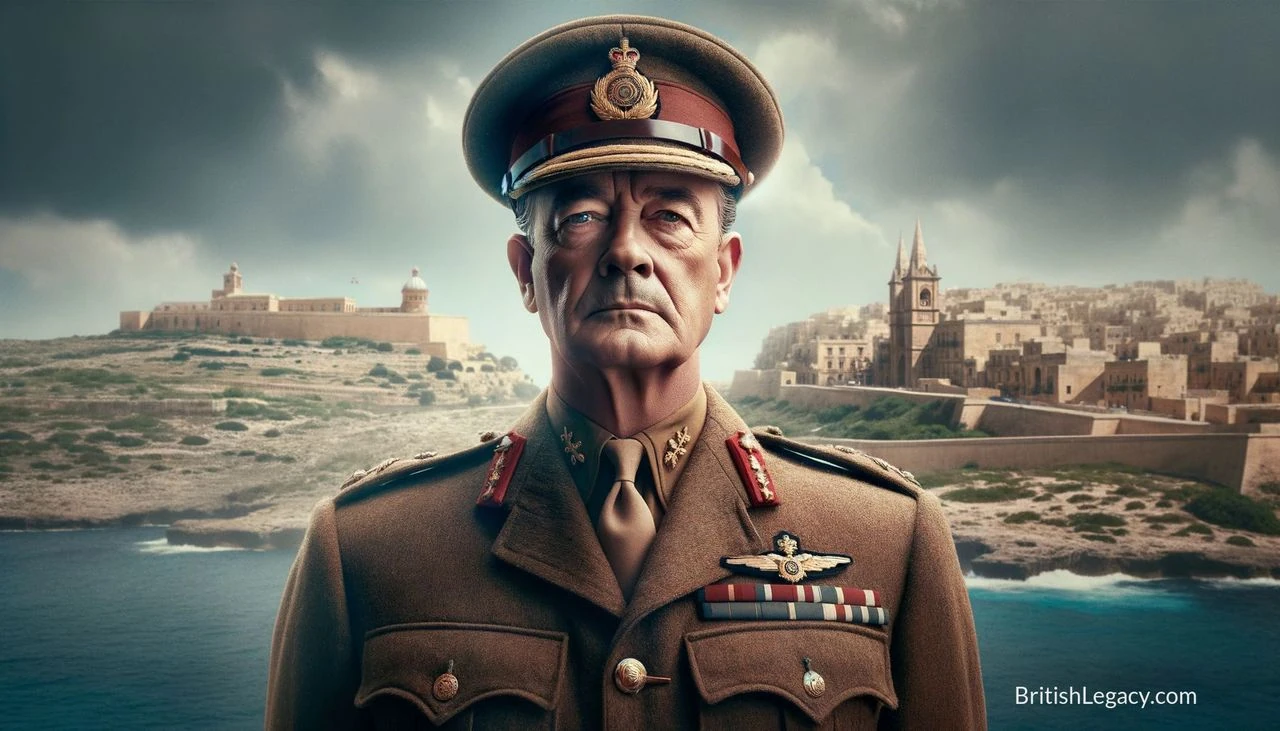
When Italy entered the Second World War in June 1940, Malta’s defence was uncertain. The island had only four aircraft, and its value as a British stronghold was not universally recognised. Lieutenant General Sir William Dobbie, appointed governor and commander-in-chief that spring, faced the task of defending it while air raids and supply difficulties tested the garrison and the people. His leadership in Malta became the defining episode of a military career that had already taken him from the Boer War through the First World War to a warning about Singapore’s vulnerability.
From Madras to the Royal Engineers
William George Shedden Dobbie was born in Madras on 12 July 1879. His father, W. H. Dobbie, was a civil servant in the Indian Civil Service. When William was nine months old, his parents left him in the care of relatives in England so that he could be educated there. At 13 he won a scholarship to Charterhouse, where he became a strong classical scholar and took an interest in ancient military campaigns.
He went on to the Royal Military Academy at Woolwich and the Royal School of Military Engineering at Chatham. Commissioned a second lieutenant in the Royal Engineers on 6 August 1899, he joined the Second Boer War in 1901. He was promoted to lieutenant while serving in South Africa, was wounded, and returned to Britain after hostilities ended. He later described the war as unjust. After his return, he served at Chatham and, following promotion to captain in 1908, attended the Staff College at Camberley.
Two world wars and the years between
During the First World War, Dobbie served on staff. He received the Distinguished Service Order in 1916 and was promoted through the wartime ranks. In November 1918, he was the staff officer on duty when the ceasefire telegram was sent to troops; his was the only signature on it. Later, when asked what he had done in the war, he was reported to have joked: “I stopped the bloody thing!” After the war, he received the Belgian Order of Leopold.
Between the wars, Dobbie held command and engineering appointments. He became commander of the Cairo Brigade in 1928, a Companion of the Order of the Bath in 1930, and, after promotion to major general, commandant of the School of Military Engineering in 1933. In 1935 he took command of Malaya Command, remaining in the post until 1939.
While in Malaya, he examined the danger of a Japanese attack on Singapore from the north. His assessment challenged the assumption that the north-east monsoon would protect the area: he warned that an invasion might be possible between November and March, with cloud cover offering concealment. His staff officer, Arthur Percival, was tasked with preparing a tactical appreciation, which also considered the vulnerability of northern Malaya. Dobbie argued that Singapore’s security depended on defending the mainland, rather than treating the naval base as self-contained.
Governor of Malta under bombardment
Dobbie expected to retire after Malaya, and was frustrated in his efforts to return to active service when war began. In April 1940, Sir Edmund Ironside offered him the governorship and command of Malta. Dobbie took up the post in May, with the acting rank of lieutenant-general, and was confirmed as governor that month. He was knighted as a Knight Commander of the Order of the Bath in 1941.
On the day Italy declared war, Dobbie addressed the garrison. He called on its members to meet the hardships ahead with courage and determination and urged them to seek God’s help in doing their duty. His Protestant faith became a source of connection on a predominantly Catholic island. Admiral Andrew Cunningham, commander-in-chief of the Mediterranean Fleet, later credited Dobbie’s calm faith and frequent broadcasts with helping sustain public morale.
Malta’s strategic importance grew as the war in the Mediterranean developed. The island served as a base from which Allied forces could disrupt German supply routes to North Africa. Churchill responded to Dobbie’s requests for aircraft and reinforcements, but Malta faced increasingly severe attacks as the Luftwaffe joined the assault in early 1942. Over two months, the island endured 500 air raids, with 27 times the tonnage of bombs dropped on Coventry during the Blitz. Attempts to bring supplies in failed, and newly delivered Spitfires were destroyed on the ground.
Dobbie also faced difficulties within the island’s administrative council. By May 1942 he was exhausted and unwell, and Winston Churchill replaced him with Viscount Gort. Gort arrived with the George Cross, awarded to Malta by King George VI in recognition of the island’s courage. Dobbie received the Knight Grand Cross of the Order of St Michael and St George. He retired from active service on 10 November 1942 with the honorary rank of lieutenant-general.
After Malta
Dobbie’s military career spanned service in the Second Boer War and both world wars, but Malta remained its most visible chapter. His book, A Very Present Help, appeared in 1944 and reflected the religious conviction evident in his wartime addresses. His wife, Sybil, and their three children were part of his family life; one of their sons, Arthur, served in the Royal Engineers and died in 1944.
After retiring, Dobbie served on the board of governors of Monkton Combe School in Somerset, a post he held from 1942 until 1964. He died in Kensington, London, on 3 October 1964, aged 85, and was buried at Charlton Cemetery.
Why Lieutenant General Sir William Dobbie deserves a place in British Legacy
Dobbie’s place in British Legacy rests on a particular combination of military judgement and responsibility under pressure. In Malta, he was charged with defending a strategically important British territory at a moment when its prospects seemed doubtful. He had to contend with air raids, threatened supply lines and limited reinforcements while maintaining the confidence of the garrison and the population. His conduct did not make the hardship disappear, but his broadcasts and personal example helped sustain morale during a period of intense danger. The George Cross awarded to Malta recognised the courage of the island’s people; Dobbie’s role belongs within that wider story of collective endurance, not in place of it.
His earlier warning about Singapore adds another dimension to his record. As commander in Malaya, he challenged the idea that the monsoon made a northern approach impracticable and argued that Singapore’s defence depended on the mainland. That assessment shows the value of questioning assumptions about geography and military security. Across his service, from the Royal Engineers and the First World War to Malta and Malaya, Dobbie held positions that required both technical understanding and clear-eyed judgement. Remembering him connects British military history with the people of Malta, whose courage was formally honoured, and with the wider strategic decisions that shaped the war in Asia and the Mediterranean.
Sources
Adapted in part from William Dobbie by Wikipedia contributors, under CC BY-SA 4.0. Text has been edited and combined with the existing article; this adapted text is shared under the same licence. Contributor history.