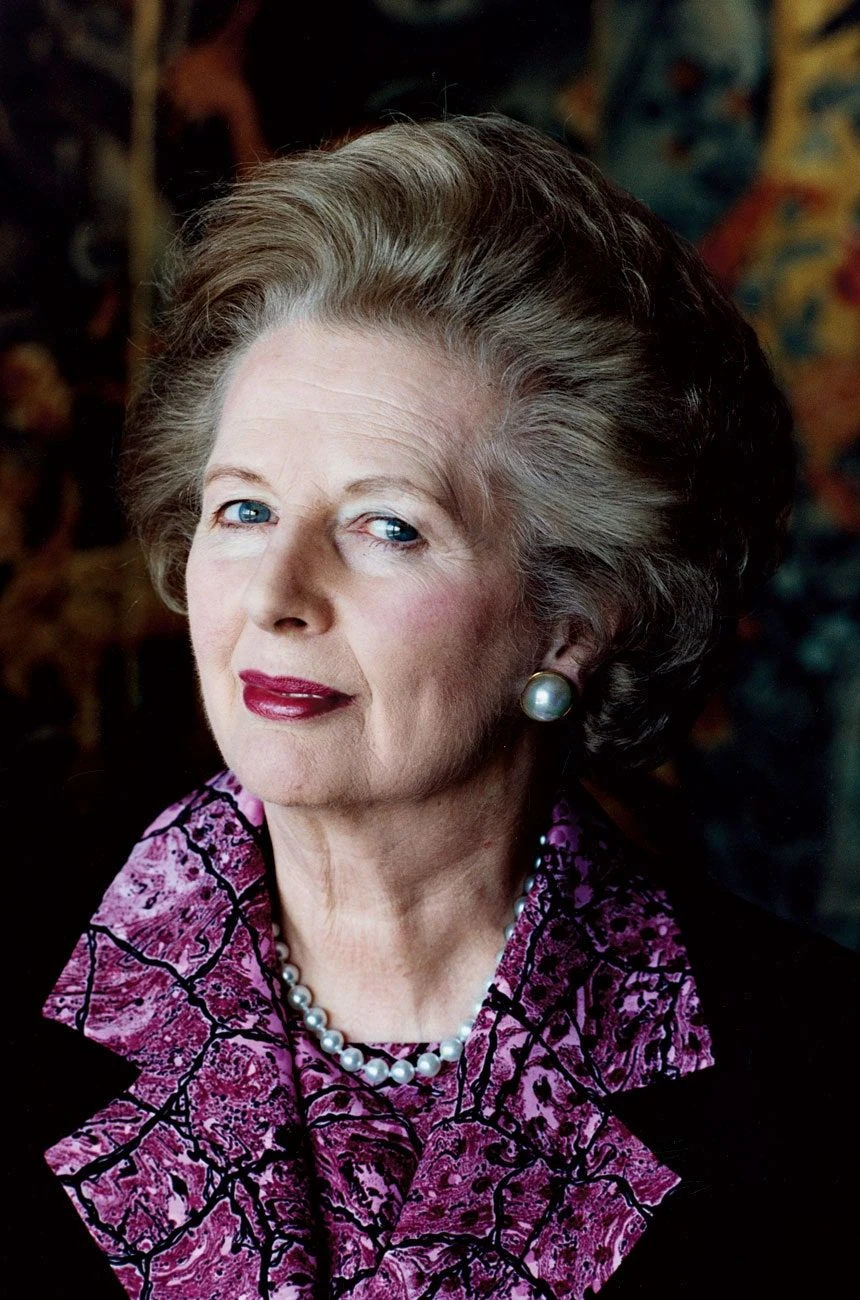
Margaret Thatcher’s premiership changed the direction of British politics. From 1979 to 1990, she pursued a smaller role for the state in the economy, reduced trade-union power and sold many public assets. Her governments also faced recession, high unemployment, industrial conflict and deep opposition to policies including the poll tax. Thatcher was Britain’s first woman prime minister and the first woman to lead a major British political party. Her career combined historic political breakthroughs with a programme whose consequences remain disputed.
From Grantham to Parliament
Margaret Hilda Roberts was born in Grantham, Lincolnshire, on 13 October 1925. Her father, Alfred Roberts, owned a grocery shop and was active in local politics as an alderman and Methodist preacher. She attended Kesteven and Grantham Girls’ School, then studied chemistry at Somerville College, Oxford, graduating in 1947. She worked as a research chemist before training as a barrister, specialising in taxation.
Roberts stood unsuccessfully for the Conservative Party in Dartford in the 1950 and 1951 general elections. She married Denis Thatcher in 1951; their twins, Carol and Mark, were born in 1953. In 1959 she was elected MP for Finchley, a seat she represented until 1992. Her early parliamentary work included a successful private member’s bill requiring local authority meetings to be open to the public. In 1970, Conservative prime minister Edward Heath appointed her Secretary of State for Education and Science.
After the Conservatives lost the 1974 general elections, Thatcher challenged Heath for the party leadership. She won in 1975, becoming the first woman to lead a major British political party and Leader of the Opposition. The Conservatives won the 1979 general election, and she became prime minister on 4 May. A Soviet journalist’s description of her as the “Iron Lady”, first used after a 1976 speech criticising the Soviet Union, became the nickname most closely associated with her.
Changing the economic settlement
Thatcher’s economic approach, later known as Thatcherism, emphasised individual responsibility, lower direct taxation, control of public spending, privatisation and limits on trade-union power. Her government raised interest rates in an effort to curb inflation and pursued spending cuts. These choices formed part of a broader shift away from the post-war approach in which the main parties had accepted extensive state involvement in the economy.
The early years brought recession and rising unemployment. Inflation fell from its early-1980s peak, but unemployment exceeded three million in 1982 and remained high into the middle of the decade. Economic recovery and the 1982 Falklands War contributed to the Conservatives’ victory in the 1983 general election. The economy grew during her time in office, but the distribution of its gains and the lasting effects on manufacturing and communities remain debated.
Privatisation became a prominent feature of the programme, particularly after the 1983 election. The government sold nationalised industries and council houses, presenting ownership and competition as ways to improve efficiency. Outcomes varied: some industries faced limited competition, and regulation expanded in areas such as gas and telecommunications. The article’s earlier account grouped coal alongside industries privatised under Thatcher. In fact, her governments closed many mines, but the remaining coal industry was privatised in 1994, after she had left office.
Industrial relations were another defining conflict. During the 1984–85 miners’ strike, the National Union of Mineworkers opposed proposed pit closures and job losses. The strike ended without a settlement, and mine closures continued. The government’s defeat of the strike and its wider restrictions on unions changed the balance between organised labour and the state. For mining communities, however, closures brought severe economic and social disruption; this legacy is central to criticism of Thatcher’s domestic record.
War, diplomacy and European division
Argentina invaded the Falkland Islands in April 1982. Thatcher’s government sent a naval task force to retake them; Argentina surrendered in June. The campaign brought deaths among British service personnel and Falkland Islanders as well as Argentine forces. Its outcome strengthened Thatcher politically, though questions about the islands’ defence and the decisions taken during the conflict continued to attract criticism.
Thatcher maintained a close relationship with US president Ronald Reagan and took a firm position against Soviet communism. Yet she was among the first Western leaders to respond warmly to Soviet leader Mikhail Gorbachev. In 1988, as reforms in the Soviet Union altered the political climate, she said that the Cold War had given way to a new relationship. Her foreign policy also encompassed difficult choices elsewhere: the British government opposed sanctions against apartheid-era South Africa, while Thatcher argued for continued engagement with its government.
Her relationship with European integration became increasingly contentious. Thatcher supported British membership of the European Economic Community and the Single European Act, but resisted greater political centralisation. In her 1988 Bruges speech she argued against a federal European structure. Her views were not shared by all in her cabinet. Disagreement over Europe, alongside opposition to her domestic policies, contributed to a leadership crisis in 1990. After Michael Heseltine challenged her, Thatcher withdrew from the contest and resigned as prime minister on 28 November. John Major succeeded her.
After Downing Street and the argument over her record
Thatcher remained an MP until the 1992 general election, then entered the House of Lords as Baroness Thatcher. She wrote two volumes of memoirs and continued to speak on political affairs until health problems led her to cancel public engagements in 2002. Her husband, Denis, died in 2003. Thatcher died in London on 8 April 2013, aged 87, after a stroke.
Her record remains polarising. Supporters point to lower inflation, privatisation, wider share ownership and her three consecutive Conservative election victories. Critics emphasise unemployment, the weakening of industrial communities, inequality and the confrontational handling of labour disputes. The Community Charge, commonly called the poll tax, proved widely unpopular; protests against it culminated in a major demonstration in London in 1990. The tax was abolished by her successor. These disagreements cannot be reduced to a simple verdict on whether she modernised Britain: they concern who benefited from change, who bore its costs and what responsibilities government should retain.
Why Margaret Thatcher deserves a place in British Legacy
Margaret Thatcher belongs in British Legacy because her career marks a major change in the country’s political and economic direction. As the first woman to become prime minister, and the first woman to lead a major British political party, she broke a barrier in national political life. She then used that office for more than eleven years, winning three general elections and advancing a distinctive programme: privatisation, restrictions on union power, reduced direct taxation and a smaller economic role for the state. These were not abstract proposals. They altered ownership, public policy and the relationship between governments, businesses, unions and workers.
That legacy must include both the changes her supporters credit and the disruption her critics emphasise. Privatisation and wider home ownership expanded private ownership, while mine closures and industrial decline brought lasting hardship to many communities. Her government’s victory in the Falklands War shaped her political standing; her approach to the poll tax helped bring her premiership to an end. Thatcher’s significance lies not in a claim that her policies were universally successful, but in the scale of their consequences and the continuing argument about them. Her story helps explain the modern British state and the political divisions that still surround its responsibilities.
Sources
Margaret Thatcher — Wikipedia revision · Margaret Thatcher — Wikipedia
Adapted in part from Margaret Thatcher by Wikipedia contributors, under CC BY-SA 4.0. Text has been edited and combined with the existing article; this adapted text is shared under the same licence. Contributor history.