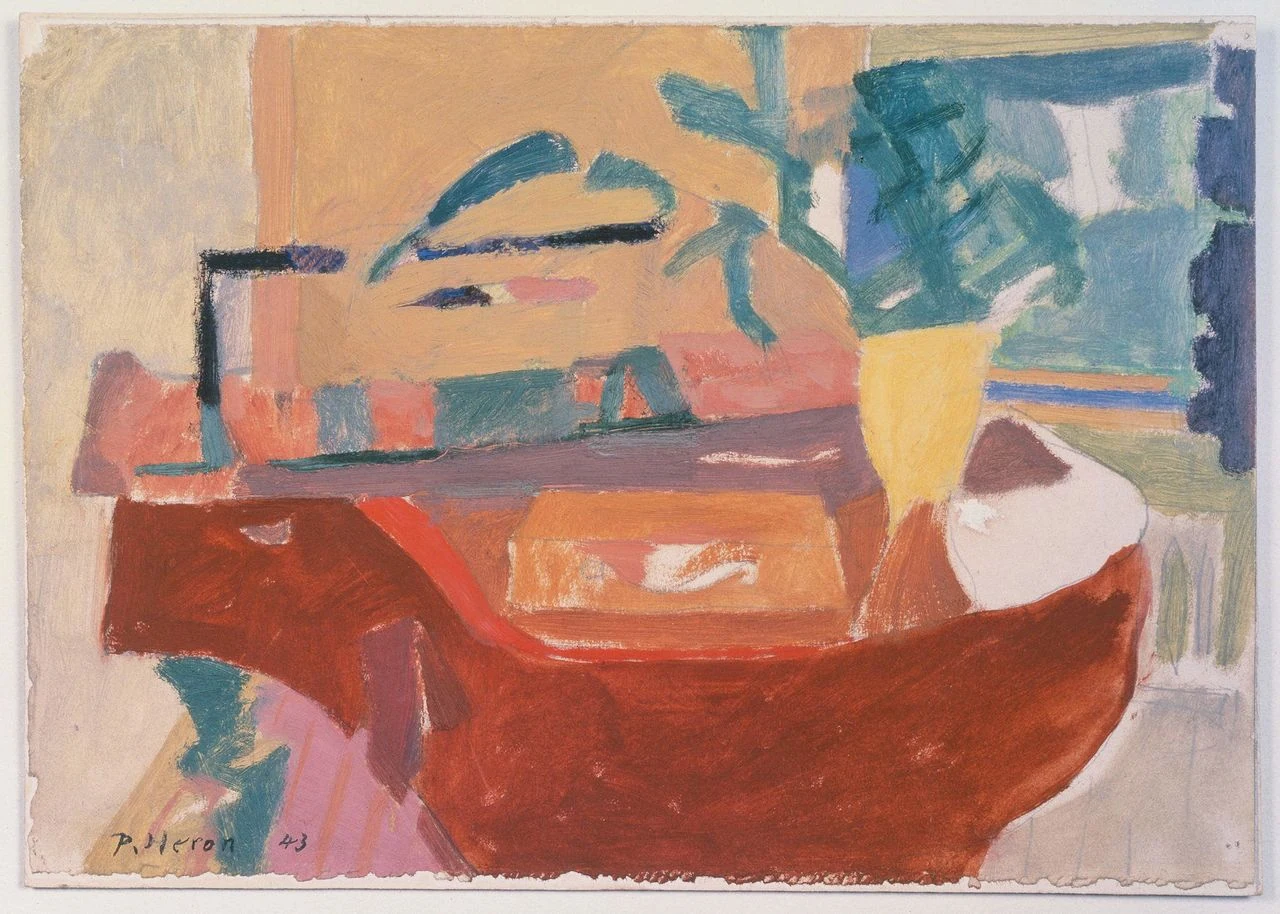
Patrick Heron’s paintings began with the visible world, but did not simply reproduce it. Across a career that moved between figurative and abstract work, he explored how colour and light could make every part of a canvas matter. His connection to Cornwall was both personal and artistic: after settling at Eagles Nest in Zennor in 1956, he drew repeatedly on its garden and landscape while developing a language of abstraction that remained rooted in specific acts of looking.
A childhood between Yorkshire, Cornwall and Welwyn
Heron was born in Headingley, Leeds, on 30 January 1920, the eldest child of Thomas Milner Heron and Eulalie Mabel Heron. When Patrick was five, the family moved to Cornwall. His father joined Alec Walker at Cryséde, the artist-designed textile business, helping it expand from printed silk into garment-making and retail. In 1929 the family moved again, to Welwyn Garden City, where Thomas established Cresta Silks. The firm worked with designers including Edward McKnight Kauffer, Wells Coates, Paul Nash and Cedric Morris. Patrick, too, designed fabrics for the company from his teenage years.
At school in Welwyn Garden City, he met Delia Reiss, whom he would marry in 1945. In 1933, a visit to a National Gallery exhibition gave him his first encounter with Cézanne’s paintings, an influence that endured. He later identified Matisse as another important touchstone: seeing The Red Studio at the Redfern Gallery in 1943 preceded his painting The Piano, which he regarded as his first mature work.
During the Second World War, Heron registered as a conscientious objector and worked as an agricultural labourer in Cambridgeshire before ill health brought that work to an end. In 1944–45 he returned to Cornwall to work at Bernard Leach’s pottery in St Ives. There he met leading figures associated with the St Ives School, including Barbara Hepworth and Ben Nicholson. Cornwall was no longer simply a childhood setting: it became the place to which he returned each summer, and eventually his permanent home.
From figurative painting to fields of colour
Heron’s early career did not begin with pure abstraction. He worked in a range of forms, including portraits, and his first solo exhibition took place at the Redfern Gallery in London in 1947. That year he began a series of portraits of T. S. Eliot; one was acquired by the National Portrait Gallery in 1966. The work would later be shown there alongside studies made from life and memory.
A key step towards abstraction came with Space in Colour, an exhibition at London’s Hanover Gallery in 1953. Heron curated the show, which presented his work alongside that of nine other British artists, and wrote its catalogue. He continued to test how a painting’s areas might relate without making one part subordinate to another. His early-1950s Tachiste paintings used vertical touches of colour; in his account, those strokes lengthened until they reached from the top to the bottom of a canvas.
In 1956 Heron made Eagles Nest, above Zennor, his permanent home. The move coincided with his commitment to non-figurative painting. The garden there became a recurring source of visual experience, not a scene to be copied literally. Azalea Garden, in the Tate collection, belongs to this engagement with colour, natural forms and the act of seeing. Heron’s abstraction did not abandon the landscape: it translated particular visual impressions into arrangements of colour and line.
From 1958, Waddington Galleries represented him in London; during the 1960s he was also represented by the Bertha Schaefer Gallery in New York. After Ben Nicholson moved to Switzerland, Heron took over his studio at Porthmeor Studios in St Ives in 1958. The larger space enabled him to work on a greater scale. His subsequent paintings included both soft-edged forms and what he called “wobbly hard-edge” work, in which the edges of colour remain distinct without becoming mechanically straight. In 1959 he won the John Moores Painting Prize for Black Painting, Red, Brown and Olive.
Painting through change
Delia Heron’s unexpected death in 1979 was a profound loss, and Patrick did little painting for a time. When he returned to work, he again looked to the garden at Eagles Nest. His method changed: instead of drawing large shapes across the canvas and filling them with a fine brush, as he had done through much of the 1970s, he used a larger brush and mixed colours as he painted. Working from the arm rather than the wrist allowed the composition to develop through the act of painting. Works including 28 January: 1983 (Mimosa) came from this renewed approach and featured in his 1985 Barbican exhibition.
In 1989 he became artist-in-residence at the Museum of New South Wales in Sydney. His walks through the city’s Botanic Gardens informed an intense period of work: in sixteen weeks he produced six large paintings and 46 gouaches. These works responded to actual visual experiences without directly depicting them; line and colour held on to what he called “specific visual realities”.
Heron continued to adapt his work to the possibilities of different spaces. For the 1994 exhibition Big Paintings at Camden Arts Centre, he created canvases of substantial dimensions, conceived with the galleries in mind. The exhibition subsequently toured Britain. In 1993, the new Tate St Ives opened with a coloured-glass window designed by Heron with his son-in-law, Julian Feary. He also painted a portrait of the author A. S. Byatt in 1997. A major Tate retrospective followed in 1998, bringing together work from across his career and making visible the persistence of its central concerns. After it closed, Heron began a series of small gouaches at Eagles Nest, stopping after 43, enough to cover the carpet in his sitting room.
The painter who wrote about art
Heron’s critical writing grew out of his practice. In 1945, while working at Leach Pottery, he wrote an article on Ben Nicholson for The New English Weekly, invited by its editor, Philip Mairet. Essays on Picasso, Klee, Cézanne and Braque followed. He broadcast talks on contemporary art for the BBC World Service and the Third Programme, and wrote regularly for New Statesman. In 1955 he became London correspondent for the New York publication Arts Digest, later known as Arts (NY). Routledge published a selection of his criticism as The Changing Forms of Art that year.
In 1958, Heron gave up his regular columns, explaining that he wanted to be “a painter who writes, not a writer who paints”. The withdrawal was not an end to his writing. He contributed to exhibition catalogues and published essays, including a series in Studio International in 1966, 1968 and 1970 that challenged the perceived ascendancy of American artists over British and Parisian artists. In 1974, The Guardian published his final essay on that subject over three days. He also argued for the independence of English art schools against their incorporation into the polytechnic system. His writing offered criticism from the perspective of someone who had spent decades making paintings himself.
Recognition and final years
Heron’s exhibitions took his work well beyond Cornwall and London. Among the venues were Wakefield City Art Gallery, Whitechapel Art Gallery, the Barbican, Camden Arts Centre and the Art Gallery of New South Wales in Sydney. Tate Gallery mounted his 1998 retrospective, while exhibitions at Tate St Ives and Turner Contemporary followed in 2018. The breadth of this record reflects a career that kept changing its scale, medium and approach while returning to colour, light and the experience of looking.
Heron was appointed CBE in 1977 and declined a knighthood. He and Delia had two daughters, Katharine, an architect and educator, and Susanna, a sculptor. He lived at Eagles Nest for the remainder of his life and died there on 20 March 1999, aged 79. His work and writing left a record not only of individual paintings, but of a sustained argument about how artists see and how painting can give form to that experience.
Why Patrick Heron deserves a place in British Legacy
Heron’s place in British art rests on more than a recognisable use of colour. He helped widen the possibilities of painting by moving from figurative work towards abstraction without severing its connection to the world around him. The garden at Eagles Nest, the changing light of Cornwall and his later walks in Sydney all supplied visual experience that he transformed rather than simply illustrated. His paintings asked viewers to attend to the whole canvas: to the weight and relation of its colours, the movement of its marks and the way light seems to operate within the composition. That approach is evident in the long development from the Tachiste paintings of the 1950s to his later large canvases and gouaches.
His contribution also reached beyond his own studio. As a critic, Heron wrote for British publications, broadcast on the BBC and made arguments about the standing of British and Parisian art and the independence of English art schools. His criticism was informed by the practical knowledge of a painter, while his exhibitions and public projects brought his work into galleries from St Ives and London to Sydney and New York. The stained-glass window made for Tate St Ives connected his practice directly with a major British art institution in Cornwall. Remembering Heron in British Legacy therefore means recognising both a distinctive body of work and a life spent making, explaining and defending the conditions in which art could be made and seen.
Sources
Patrick Heron — Wikipedia revision 1364695205
Adapted in part from Patrick Heron by Wikipedia contributors, under CC BY-SA 4.0. Text has been edited and combined with the existing article; this adapted text is shared under the same licence. Contributor history.