Paul Nash made landscapes tell stories that ordinary descriptions could not contain. In his First World War paintings, blasted trees, flooded trenches and broken ground register the destruction of the Western Front. Later, ancient stones, seawalls and familiar fields became places of mystery, while his Second World War pictures found new forms for the violence of aerial conflict. A painter, printmaker, photographer and designer, Nash helped bring modernism into English art without losing his close attention to the places around him.
A London childhood, shaped by the countryside
Nash was born in Kensington, London, on 11 May 1889. His family moved to Iver Heath in Buckinghamshire in 1902, and the countryside became a lasting source of subject and imagery. Among the places that stayed with him were the Wittenham Clumps, a pair of tree-covered hills in the Thames Valley, and the ancient monuments at Avebury. Across his career, particular locations returned in new guises: Ypres, Dymchurch, the Romney Marshes, Avebury and Swanage each became part of his developing visual language.
Art was not his first intended profession. Nash prepared for a naval career but failed the entrance examination. After studying at South-Western Polytechnic and the London County Council School of Photo-engraving and Lithography, he entered the Slade School of Art in 1910. He struggled with figure drawing and spent only a year there, concentrating instead on landscapes. His fellow students included Stanley Spencer, Dora Carrington, Ben Nicholson and C. R. W. Nevinson. Early exhibitions, sometimes shared with his younger brother John, featured drawings and watercolours influenced by William Blake, Samuel Palmer and Dante Gabriel Rossetti.
In 1914 Nash worked briefly at the Omega Workshops and helped Roger Fry restore the Mantegna cartoons at Hampton Court Palace. That year he was elected to the London Group, an artists’ association, and began to establish himself professionally. He also worked in a range of forms beyond painting: book illustration, theatre design, wood engraving, textiles and, later, photography would all become part of his practice.
The Western Front in paint
Nash enlisted in the Territorial Force in September 1914, serving as a private with the Artists’ Rifles on home service. He began officer training in 1916 and went to the Western Front in February 1917 as a second lieutenant in the Hampshire Regiment. After falling into a trench and breaking a rib, he returned to England that summer. While recovering, he used his sketches to make a series of drawings of the front. Their exhibition helped lead to his appointment as an official war artist.
He returned to Belgium in November 1917 as a uniformed observer. The landscape he found in the Ypres Salient had been transformed by shellfire, rain and flooding. Nash’s drawings from those weeks show more than military positions: they make the damaged land itself central to the experience of war. Back in England, he developed the sketches into paintings and prints, including We Are Making a New World (1918). Its empty terrain, broken tree stumps and cold sun turn the promise in the title into a bitter irony.
In April 1918 the British War Memorials Committee commissioned Nash to paint a battlefield scene for the Hall of Remembrance. He chose Tower Hamlets, an area devastated during the Battle of the Menin Road Ridge. The resulting canvas, now known as The Menin Road, was completed in February 1919. Flooded trenches and shell craters divide the ground; stripped tree trunks and smoke-filled sky make the road difficult to recognise. Two small soldiers appear caught in this broken terrain. Rather than present a clear military narrative, the painting gives destruction the scale and force of the landscape itself.
From seawalls to ancient stones
After the war, Nash continued to paint landscapes, but his work did not settle into a single style. He experienced depression and financial difficulty, and in 1921 collapsed after visiting his ill father. He and his wife, Margaret, moved to Dymchurch to aid his recovery. There, the seawall and the meeting of land and sea became recurring subjects. The stark boundary between the two also recalled the trenches and damaged ground of the Western Front.
In 1925 the couple moved to Iden, near Rye, where the surrounding Romney Marshes provided material for works such as Winter Sea. Nash also made wood engravings and illustrations, taught part-time at the Royal College of Art, and designed textiles. His students included Eric Ravilious and Edward Bawden. During the late 1920s, his paintings increasingly placed apparently unrelated objects within carefully constructed spaces. The shift towards abstraction and surrealism was part of a wider engagement with modern European art, including the work of Giorgio de Chirico.
A visit to Avebury in 1933 opened another important landscape to Nash. Its standing stones and prehistoric monuments prompted paintings including Druid Landscape and Landscape of the Megaliths, both made in 1934. In 1933 he co-founded Unit One with Henry Moore, Barbara Hepworth, Ben Nicholson and Edward Wadsworth, with the critic Herbert Read. The group was short-lived, but it brought together artists and architects committed to modern art in Britain.
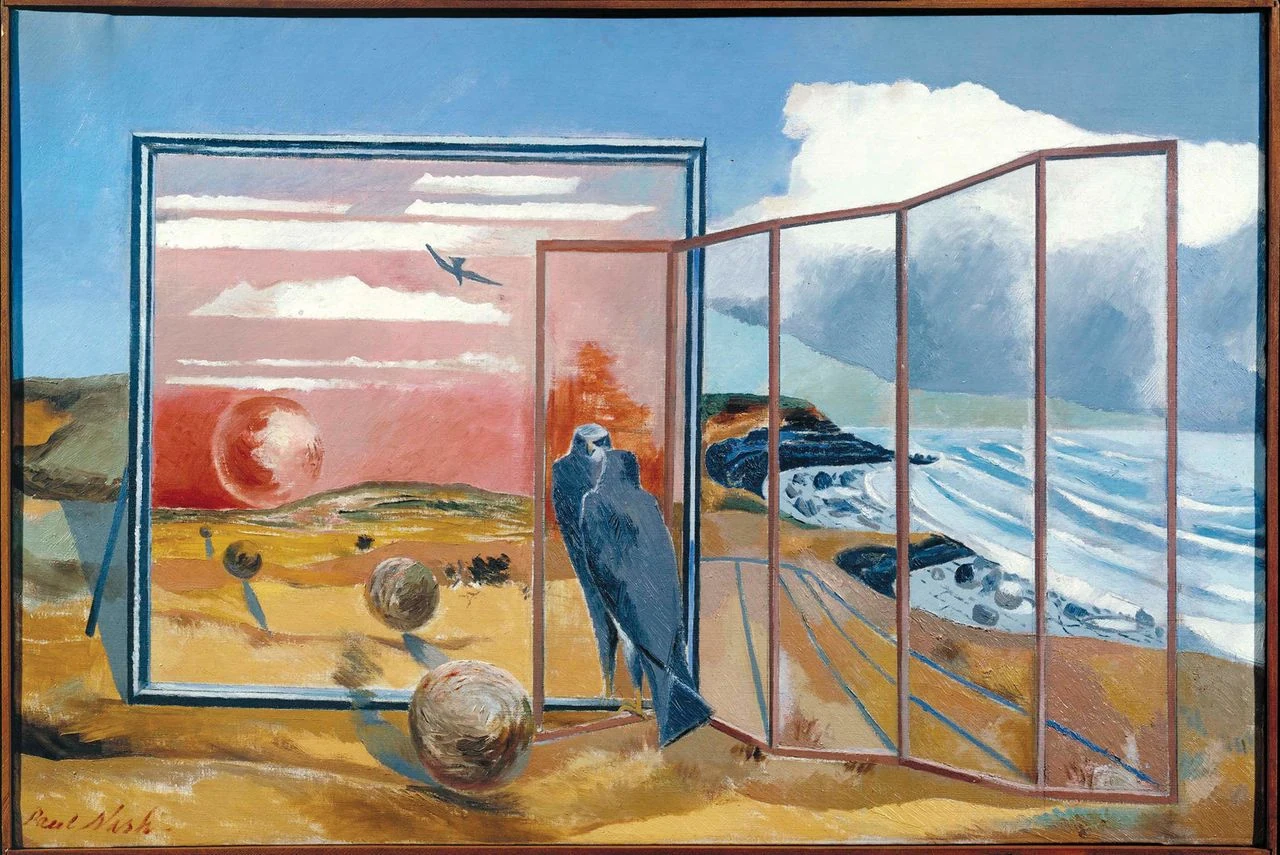
Nash’s interest in places also took him to Dorset. Living near Swanage between 1934 and 1936, he made paintings and photographs and wrote a guide to the county with Archibald Russell. He found a surreal quality in the area’s varied landscape, geology and objects. His work from this period, including Events on the Downs and Landscape from a Dream, makes the familiar strange by setting recognisable things into unexpected relationships. He also developed a practice of using his own photographs alongside preparatory sketches.
War in the air, and the last landscapes
At the beginning of the Second World War, Nash became a full-time salaried war artist attached to the Royal Air Force and Air Ministry through the War Artists’ Advisory Committee. His work did not always match the Air Ministry’s preference for portraits of aircrew. In the Raiders series, crashed German aircraft lie in English countryside; in Aerial Creatures, British aircraft take on organic, almost living forms. The latter series displeased the Air Ministry, and his full-time contract ended in December 1940. The committee nevertheless continued to commission work from him.
Totes Meer (1941) turns a collection of wrecked aircraft into a dead sea of twisted wings and fuselages. Nash based it on drawings and photographs made at an aircraft recovery site at Cowley near Oxford. In Battle of Britain (1941), vapour trails arc across a broad landscape of land and sea. Instead of depicting the battle as a conventional scene of action, he made its patterns part of the composition. These works show his continued ability to build symbols out of particular events and objects.
Asthma increasingly restricted Nash’s work. From 1942 he often convalesced at Sandlands, near Oxford, where he could see the Wittenham Clumps he had known since childhood. In his final landscapes, the hills and moon became elements in images of seasonal change and renewal. He died of heart failure, resulting from his long-term asthma, at Boscombe on 11 July 1946, aged 57. He was buried at St Mary the Virgin, Langley. The hawk carving seen in Landscape from a Dream was placed on his grave.
Why Paul Nash deserves a place in British Legacy
Nash deserves a place in British Legacy because he changed how British landscapes could be painted. His work connects identifiable places—from the Buckinghamshire hills of his childhood to the ancient stones of Avebury and the coast at Dymchurch—with history, memory and imaginative meaning. That connection was not simply picturesque. In the First World War paintings, the ruined land becomes a record of conflict; in later work, familiar settings hold the strangeness of dreams and the traces of the past. Nash helped make modernism a force in English art while maintaining a sustained engagement with the country’s actual landscapes.
His contribution also crosses disciplines and generations. He produced prints, illustrations, photographs, designs for textiles and theatre, and writing about art and place. As a co-founder of Unit One, he helped bring modern artists together at a time when abstraction and surrealism were reshaping the possibilities of British art. His war paintings, including The Menin Road and Totes Meer, remain powerful because they do not reduce conflict to spectacle: they make viewers confront its effects on land and life. Nash’s achievement lies in joining formal experiment to close observation, leaving a body of work that continues to give British places a complex, unsettled presence.
Sources
Paul Nash (artist), revision 1376023180
Adapted in part from Paul Nash (artist) by Wikipedia contributors, under CC BY-SA 4.0. Text has been edited and combined with the existing article; this adapted text is shared under the same licence. Contributor history.