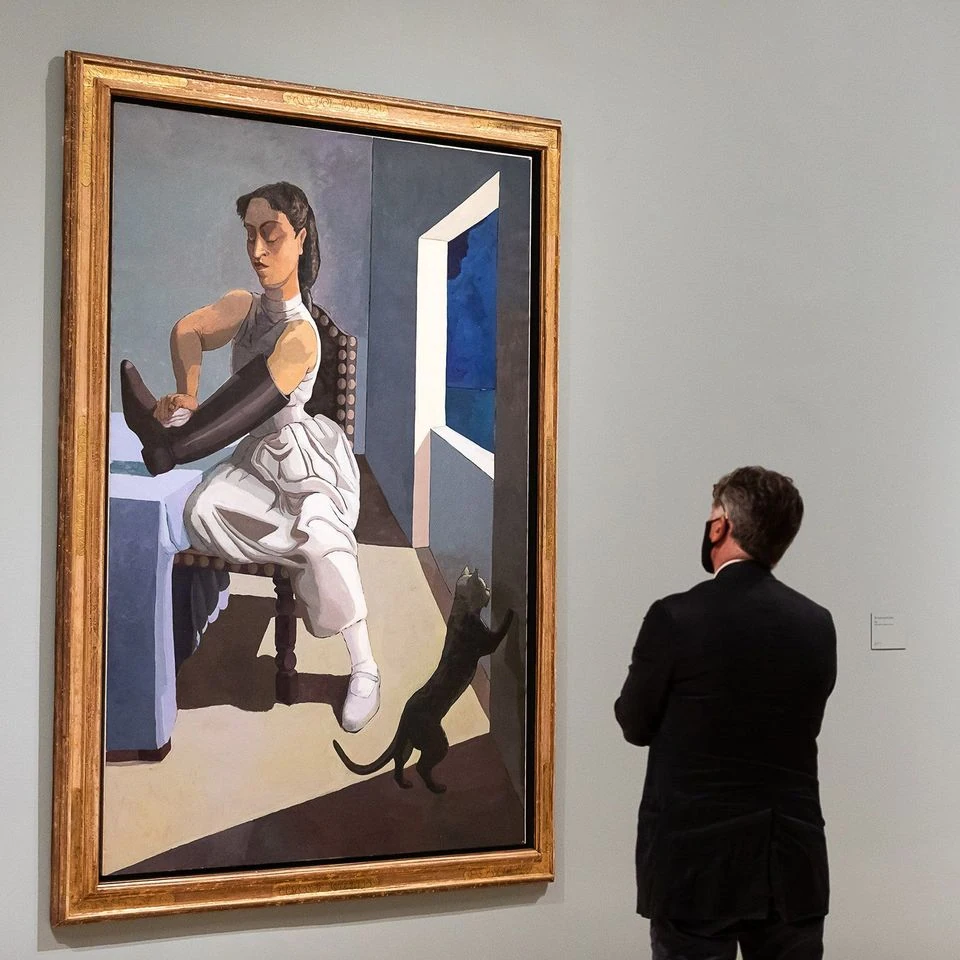
Paula Rego made pictures that draw on stories and familiar images, then unsettle the roles they seem to offer. Folktales, nursery rhymes and scenes of women’s lives became material for work that could be vividly comic, troubling or severe. Born in Lisbon, she studied at the Slade School of Fine Art, built a career between Portugal and Britain, and spent much of her life working in London. Her art’s narrative force remained constant even as its style changed from semi-abstraction to the sharply drawn figures for which she became widely known.
From Lisbon to the Slade
Maria Paula Figueiroa Rego was born in Lisbon on 26 January 1935. Her father, an electrical engineer, worked for the Marconi Company and was anti-fascist; her mother was an artist. When her father was posted to the United Kingdom in 1936, Rego remained in Portugal with her grandmother until 1939. The family’s separation did not sever her connection with Britain: she later attended an English-language school in Portugal and, in 1951, went to The Grove School in Sevenoaks, Kent.
In 1952, Rego began studying at the Slade School of Fine Art in London, where she remained until 1956, leaving without taking a diploma. There she met fellow student Victor Willing, whom she married in 1959. Rego returned to Portugal in 1957, and she and Willing lived there before settling permanently in London in 1974, after the failure of her family’s electrical business. The movements between the two countries were part of her life and work, rather than a simple story of leaving Portugal for a new home.
Rego’s artistic career began to gather public attention in 1962, when she started exhibiting with The London Group. She showed in the group exhibition Six Artists at the Institute of Contemporary Arts in London in 1965, the same year as her first solo exhibition in Lisbon. She represented Portugal at the São Paulo Art Biennial in 1969. These early exhibitions established a career with connections to both countries and a subject matter that would continue to draw on Portuguese culture.
Changing style, enduring stories
Rego’s early paintings were influenced by Surrealism, including the work of Joan Miró. Some approached abstraction, but a narrative thread remained. Salazar Vomiting the Homeland, painted in 1960 while Portugal was under the Estado Novo dictatorship, is one example of her use of unsettling imagery to engage with the politics around her. She also worked with collage and made paintings that drew on popular culture and literary sources.
A significant change followed her appointment as the National Gallery’s first Associate Artist in 1990. Working in the context of a collection dominated by Old Masters, she developed a clearer, more tightly drawn style. Her paintings and prints drew on nursery rhymes, familiar stories and the compositions of earlier European art. Crivelli’s Garden, a large-scale work inspired by paintings by Carlo Crivelli in the Gallery, brought her new work into direct conversation with its collection. A touring group of works on nursery-rhyme themes travelled in Britain and elsewhere between 1991 and 1996.
Rego increasingly used pastel from the early 1990s and continued with the medium for much of her later career. In the Dog Women works, women sit, squat and move with the unguarded physicality of dogs. The images resist idealised ideas of feminine behaviour, while leaving room for ambiguity: Rego objected to critics who read too much sexual meaning into some of her work. Her pictures often invite interpretation without settling into a single explanation.
She also reworked stories to examine women’s experiences. In the 1995 pastel Swallows the Poisoned Apple, Snow White appears after eating the poisoned fruit, older and in pain. Rego’s treatment shifts attention from the familiar fairy-tale plot to the physical experience of ageing. In 2003, she began making bonecos—Portuguese dolls or puppets—to use alongside live models. This approach informed works including War (2003) and The Cake Woman (2004).
Women’s rights and public commissions
Women’s rights and abortion became explicit subjects in Rego’s work. After Portugal’s 1998 referendum on abortion, she made Untitled: The Abortion Series, a group of ten pastels completed over about six months. The referendum did not legalise abortion. Rego’s images show women in different stages of illegal abortion, including preparation, pain and recovery. She opposed criminalising women and drew attention to the unequal risks faced by those unable to travel abroad for safer procedures. The works were published in Portuguese newspapers before a second referendum in 2007, which reversed the 1998 result; the source account says they are thought to have influenced that outcome.
Rego’s work also reached audiences through public collections, exhibitions and commissions. In 1988, retrospectives were held at the Calouste Gulbenkian Foundation in Lisbon and the Serpentine Gallery in London. After her National Gallery appointment, she made work in dialogue with its collection; later exhibitions included retrospectives at Tate Liverpool in 1997 and Tate Britain in 2005. The Royal Mail commissioned her to create a set of Jane Eyre stamps in 2004. Her work is held by institutions including the British Council, the Arts Council of England and Tate.
Her recognition included appointment as a Dame Commander of the Order of the British Empire in the 2010 Queen’s Birthday Honours. She received honorary degrees from British universities, including St Andrews and the University of East Anglia in 1999, and Oxford and Roehampton in 2005. She continued to exhibit internationally, with retrospectives and presentations in Spain, the United States, France, Mexico and Brazil.
Life, work and remembrance
Rego and Willing had three children: Caroline, known as Cas, Victoria and Nick. After living between Portugal and Britain, the family settled permanently in London in 1974. Willing, who had multiple sclerosis, died in 1988. Rego continued to live and work in London, while maintaining a strong connection with Portugal through its stories, history and cultural life.
In 2009, the Casa das Histórias Paula Rego opened in Cascais, Portugal. Designed by architect Eduardo Souto de Moura, the museum is dedicated to her work. Rego died of pneumonia at her home in Camden, London, on 8 June 2022, aged 87, and was buried with Willing in Hampstead Cemetery. Her career left a substantial body of work in public collections on both sides of the Channel, as well as a distinctive example of an artist whose biography and visual imagination crossed national borders.
Why Paula Rego deserves a place in British Legacy
Rego’s place in British Legacy rests on a sustained, specific relationship with British art and institutions. She studied at the Slade, began exhibiting with The London Group, and spent most of her working life in London. Her appointment as the National Gallery’s first Associate Artist brought a contemporary artist into direct engagement with its Old Master collection; works including Crivelli’s Garden show how that encounter could generate new art rather than simple homage. Her exhibitions at the Serpentine, Tate Liverpool and Tate Britain, her Royal Mail commission and the presence of her work in British Council, Arts Council of England and Tate collections all mark a substantial contribution to the country’s cultural life.
That contribution is not diminished by Rego’s Portuguese birth and the Portuguese sources that shaped her imagination. Folktales and cultural memory from Portugal fed pictures that British audiences encountered in galleries, public collections and popular formats such as postage stamps. Her work on abortion made the consequences of criminalisation visible through individual bodies and situations, while her treatment of fairy tales and women’s behaviour unsettled conventional ideas of femininity. Rego’s legacy is therefore both artistic and civic: she expanded what British institutions showed and collected, and made difficult subjects available for public attention through images of unusual narrative and emotional force.
Sources
Paula Rego — Wikipedia revision
Adapted in part from Paula Rego by Wikipedia contributors, under CC BY-SA 4.0. Text has been edited and combined with the existing article; this adapted text is shared under the same licence. Contributor history.