
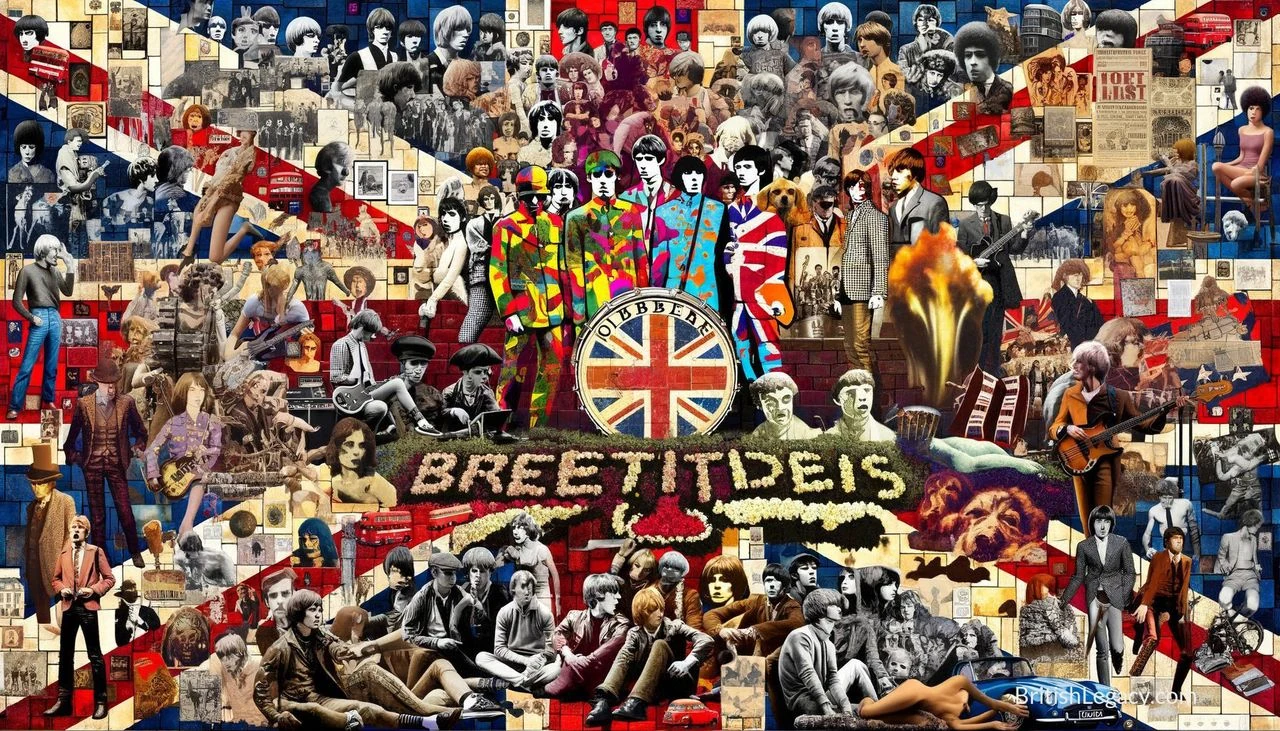
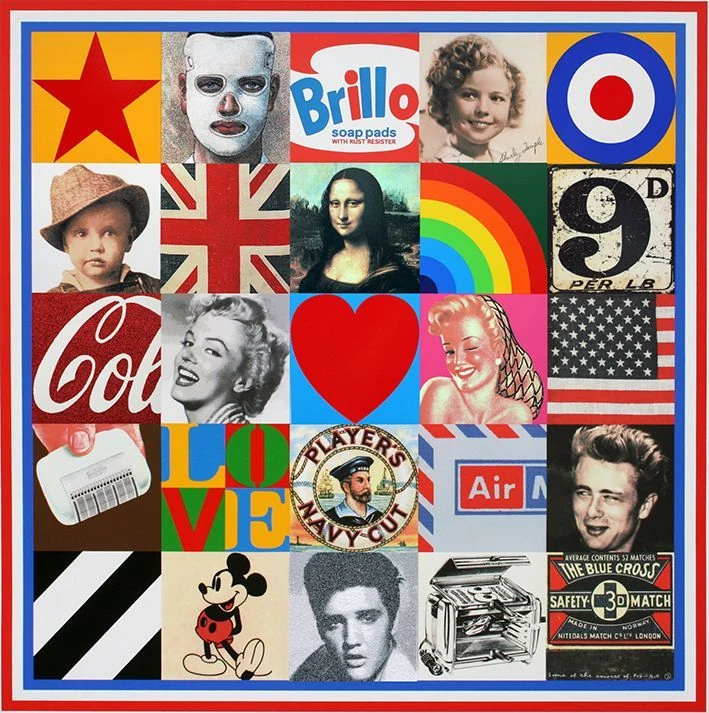
Peter Blake brought the imagery of popular culture into British art with a particular eye for the objects, entertainments and personalities people recognised. His work ranges from paintings and prints to album sleeves, posters and public commissions. The cover he co-designed with Jann Haworth for the Beatles’ 1967 album Sgt. Pepper’s Lonely Hearts Club Band became his most widely recognised work, but it belongs to a much longer practice of joining popular images to the language of fine art.
Training and the emergence of a Pop artist
Born in Dartford, Kent, on 25 June 1932, Blake studied at Gravesend Technical College’s school of art and at the Royal College of Art in London. From the late 1950s, he began bringing imagery from advertisements, music-hall entertainment and wrestling into his paintings, often incorporating collage. His interests were not confined to the glamorous or fashionable: the popular image, the familiar object and the pleasures of collecting all offered material for art.
Blake was identified with the emerging British Pop Art movement after exhibiting alongside David Hockney and R. B. Kitaj at the Young Contemporaries exhibition in 1961. That year, he won the John Moores junior award for Self-Portrait with Badges. In 1962, he appeared with Pauline Boty, Derek Boshier and Peter Phillips in Ken Russell’s BBC television film Pop Goes the Easel, which introduced the artists and their work to a wider audience. His first solo exhibition followed at London’s Portal Gallery in 1962.
On the Balcony, made between 1955 and 1957, is an important early example of Blake’s approach. It can look like a collage, but is painted throughout. A boy holds Édouard Manet’s The Balcony; badges and magazines bring other kinds of image into the composition. The painting shows Blake setting popular culture alongside the references of fine art, while making the apparent act of collecting part of the subject.
From the gallery to the album sleeve
Blake’s collaboration with Haworth on Sgt. Pepper’s Lonely Hearts Club Band carried that interest into one of the most visible formats in popular music. They designed the sleeve together, building a scene from photographic cut-outs and objects around a drum bearing the album title. The result earned them a Grammy Award for Best Album Cover, Graphic Arts, and became one of the most imitated album covers. The design’s reach brought Blake’s visual ideas to a mass audience, but it also rested on the joint work of two artists.
The fee for the design was £200, according to Blake’s later complaint, and he received no subsequent royalties. That detail complicates the familiar story of a celebrated image: the sleeve’s cultural life expanded far beyond the original commission, while the artist’s payment did not. Blake continued to design for musicians and recording projects over subsequent decades. His sleeves included Pentangle’s Sweet Child, the Who’s Face Dances and, much later, WHO; he also designed the Band Aid single Do They Know It’s Christmas?, Paul Weller’s Stanley Road and the Ian Dury tribute album Brand New Boots and Panties.
His work for music extended beyond sleeve design. He painted artwork for Eric Clapton’s 1991 live album 24 Nights, and in 2006 marked the Who’s return to Leeds University with a new Live at Leeds 2 artwork. In 2016, he created artwork for Clapton’s studio album I Still Do. The continuing commissions show how readily his art moved between the gallery, the printed image and the visual identity of popular music.
Prints, folklore and public commissions
Blake’s work was never restricted to the pop imagery of the 1960s. In 1968, he made Babe Rainbow, a screen-print on tinplate produced in an edition of 10,000 and sold for £1 each. After leaving London in 1969 to live near Bath, he turned towards English folklore and Shakespearean characters. He made watercolours for Lewis Carroll’s Through the Looking-Glass in the early 1970s and was a founder of the Brotherhood of Ruralists in 1975. When he returned to London in 1979, popular-culture references again became prominent in his work.
Blake also took on projects that brought his visual language into public spaces and shared events. For Oasis’s 2006 greatest-hits album Stop the Clocks, he assembled a still-life of cultural references, including Dorothy from The Wizard of Oz and Michael Caine. In 2008, he created an updated version of the Sgt. Pepper cover featuring figures from Liverpool’s history, as part of the city’s campaign to become European Capital of Culture. He designed the statuette for the 2012 Brit Awards and, for the Supreme Court’s building at Middlesex Guildhall, created a carpet. In 2020, his poster London Stands Together was distributed with every copy of London’s Evening Standard.
Recognition and continuing work
Blake became a Royal Academician in 1981 and was appointed a Commander of the Order of the British Empire in 1983. He was knighted in 2002 for services to art. These honours accompanied a career that continued through exhibitions, teaching connections and new commissions rather than ending with the fame of a single album sleeve. Retrospectives at the Tate in 1983 and Tate Liverpool in 2008 brought different periods of his work together. In 2005, the University of Leeds opened the Sir Peter Blake Music Art Gallery, with a permanent display of 20 examples of his album-sleeve art, including a signed print of the Sgt. Pepper design.
His relationship with popular music remained active in later projects. An exhibition at Pallant House Gallery in 2012 explored his long association with music; he also created a new Sgt. Pepper-inspired cover featuring British cultural figures for a celebration of his eightieth birthday that year. His work continued to find audiences through exhibitions, prints, commissions and objects designed for everyday use.
Why Peter Blake deserves a place in British Legacy
Peter Blake’s place in British cultural history rests not only on the fame of the Sgt. Pepper sleeve, but on the visual thinking that made such a design possible. From On the Balcony to his album covers, he treated images from popular life as serious artistic material. His paintings, prints and commissions bring together badges, magazines, music, performers and familiar cultural figures without making a hard division between high art and everyday experience. That approach helped give British Pop Art a distinctive public presence, while his work for the Beatles and later musicians carried an artist’s design into the lives of listeners around the world.
His legacy also includes a sustained practice beyond the most celebrated image: folklore-inspired painting, book illustration, public commissions and designs for music across several generations. The University of Leeds gallery devoted to his album art offers a lasting setting in which that part of his career can be seen and studied. Blake’s story is also a reminder that wide recognition does not necessarily mean lasting financial reward: he said he received only a one-off fee for the Sgt. Pepper design, without royalties. Taken together, his work and its afterlife show how an English artist could shape popular visual culture while continuing to make art across formats, audiences and decades.
Sources
Peter Blake (artist), revision 1364730583
Adapted in part from Peter Blake (artist) by Wikipedia contributors, under CC BY-SA 4.0. Text has been edited and combined with the existing article; this adapted text is shared under the same licence. Contributor history.
.jpg)