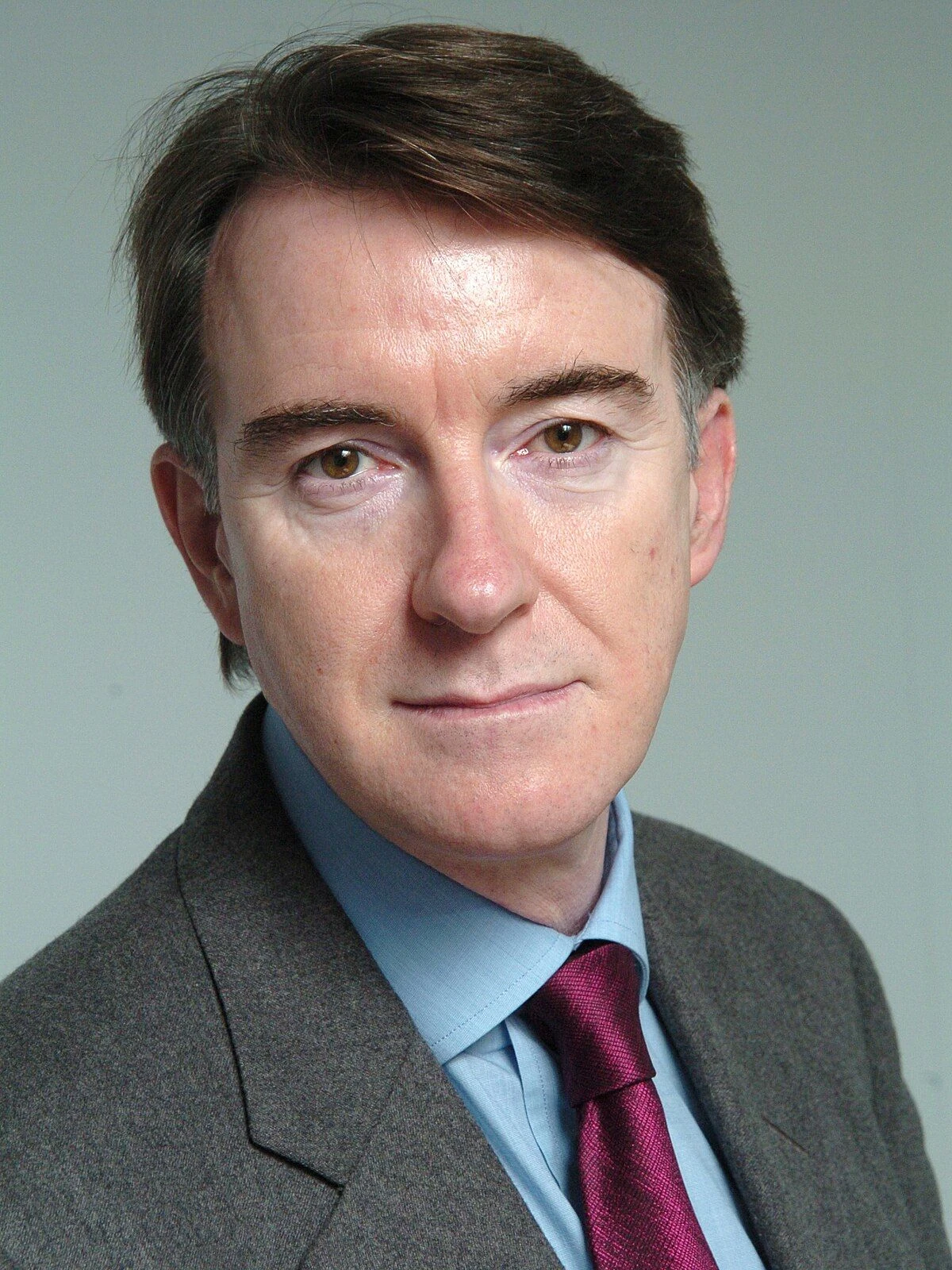
Peter Mandelson helped remake Labour’s public image, ran its winning 1997 election campaign and served in senior roles under Tony Blair and Gordon Brown. His career also included two Cabinet resignations, a European trade portfolio and a brief appointment as British ambassador to the United States. The combination of political influence and repeated controversy is essential to understanding his place in modern British public life.
From political family to party communications
Peter Benjamin Mandelson was born in Hendon, Middlesex, on 21 October 1953. His mother, Mary Joyce, was the daughter of Herbert Morrison, the Labour politician who served in the wartime coalition and the Attlee government. Mandelson grew up in Hampstead Garden Suburb and attended Garden Suburb School and Hendon County Grammar School. From 1973 to 1976 he studied philosophy, politics and economics at St Catherine’s College, Oxford.
His early career took him through trade-union and youth organisations, local government and television. He worked in the Economic Department of the Trades Union Congress, chaired the British Youth Council and was elected to Lambeth Council in 1979. After leaving the council, he became a television producer at London Weekend Television’s Weekend World.
In 1985 Labour leader Neil Kinnock appointed him the party’s director of communications. Mandelson brought the techniques of television and political marketing into election campaigning. For the 1987 general election, he commissioned filmmaker Hugh Hudson to make a party political broadcast presenting Kinnock as a potential prime minister. Labour lost the election, but the film helped raise Kinnock’s approval rating, and Mandelson became associated with the expanding role of professional communications in British politics.
Building and selling New Labour
Mandelson left his party post after being selected as Labour’s candidate for Hartlepool. He won the seat in 1992 and, after John Smith’s death in 1994, supported Tony Blair for the Labour leadership. He became one of Blair’s close advisers and directed Labour’s successful 1997 general-election campaign. He was widely regarded as one of the architects of New Labour, helping the party present itself to voters as a modernised alternative after years in opposition.
That work involved more than a new slogan or visual identity. Mandelson’s communications operation sought to make the party’s arguments coherent and accessible, while the wider New Labour project moved Labour towards the political centre. The existing account credits him with coining “New Labour, New Britain”; the detailed account of his career does not establish that attribution, so it is not included here. The 1997 victory gave Labour a large parliamentary majority, but the result belonged to a party and campaign, not to one strategist alone.
Mandelson entered government as minister without portfolio, with responsibility for co-ordinating work across government. He was also given responsibility for the Millennium Dome project. In July 1998 he became Secretary of State for Trade and Industry, where he promoted electronic commerce and a competitiveness agenda. His first period in the Cabinet ended in December that year.
Resignations, Northern Ireland and European trade
In 1996 Mandelson bought a house partly with an interest-free loan from Labour colleague Geoffrey Robinson. The loan had not been declared in the Register of Members’ Interests. When it became public in 1998, Mandelson resigned, saying that the government had to uphold high standards in public life. Robinson also left the government. This episode became an early and defining test of the new administration’s claims about propriety.
Mandelson returned to the Cabinet in October 1999 as Secretary of State for Northern Ireland. During his tenure, the devolved legislative assembly and power-sharing executive were established, and the Police Service of Northern Ireland was reformed. He resigned again in January 2001 after controversy over his contact with a Home Office minister about a passport application for businessman Srichand Hinduja, whose family firm was to sponsor the Millennium Dome’s Faith Zone. Mandelson denied seeking to influence the decision; an independent inquiry concluded that he and others had not acted improperly.
He was re-elected in Hartlepool in 2001 and remained an MP until 2004. That year he became the European Commissioner for Trade, a post he held until 2008. His work included involvement in international trade negotiations, and he publicly opposed protectionism. In October 2008, as the financial crisis deepened, he returned to British government as Business Secretary and President of the Board of Trade. He was created Baron Mandelson and entered the House of Lords.
In Gordon Brown’s government, Mandelson also became First Secretary of State and Lord President of the Council. The breadth of his responsibilities reflected his position near the centre of government, but his decisions and relationships with business figures attracted continuing scrutiny. The available account records disputes over potential conflicts of interest; it also records Mandelson’s denials and the government’s statements that particular dealings had been above board. Those competing positions should not be collapsed into a blanket assertion of wrongdoing.
After government and a return to public office
After Labour lost the 2010 general election, Mandelson published The Third Man: Life at the Heart of New Labour and co-founded Global Counsel, a London-based advisory firm. He remained active in Labour politics, arguing for a second referendum after the 2016 vote to leave the European Union and later advising Keir Starmer as Labour sought to broaden its electoral appeal. He also sought the leadership of the World Trade Organization in 2020, but the UK government nominated Liam Fox instead.
In December 2024 Starmer appointed Mandelson ambassador to the United States. He took up the post in February 2025, as Donald Trump returned to the presidency, and was expected to work on trade and the relationship between the two countries. His tenure ended on 11 September 2025. The detailed account says his dismissal followed renewed scrutiny of his association with Jeffrey Epstein, including published material indicating that their relationship continued after Epstein’s 2008 conviction. Mandelson expressed regret for the association and sympathy for Epstein’s victims.
In 2026, further reported material prompted new allegations concerning payments and the sharing of sensitive government information. Mandelson resigned from the Labour Party and the House of Lords. The Metropolitan Police opened an investigation into suspected misconduct in public office, and Mandelson was arrested on suspicion of that offence and later released on bail pending further investigation. These are allegations and investigative developments, not findings of guilt.
Why Peter Mandelson deserves a place in British Legacy
Mandelson’s place in British political history rests first on his role in Labour’s transformation during the 1990s. As director of communications, adviser to Blair and campaign director in 1997, he helped shape how a major British party presented itself and sought support beyond its traditional base. The techniques he used—from political broadcasting to disciplined message-making—became part of the landscape of modern campaigning. His contribution is best understood as that of an influential strategist within a larger political movement, rather than as the sole author of New Labour or its electoral success.
His public career also shows how political influence brings obligations as well as opportunity. His ministerial work ranged from co-ordinating government and overseeing the Millennium Dome to Northern Ireland’s devolved institutions and European trade policy. Yet his two Cabinet resignations, and the later controversies that ended his ambassadorship, are part of the same record. Remembering Mandelson in British Legacy means preserving both sides: the lasting effect of his role in changing Labour’s electoral politics and the importance of scrutiny, declared interests and accountability in public life. That fuller account is more useful than either unqualified praise or a story reduced to scandal.
Sources
Peter Mandelson — revision 1376263899
Adapted in part from Peter Mandelson by Wikipedia contributors, under CC BY-SA 4.0. Text has been edited and combined with the existing article; this adapted text is shared under the same licence. Contributor history.