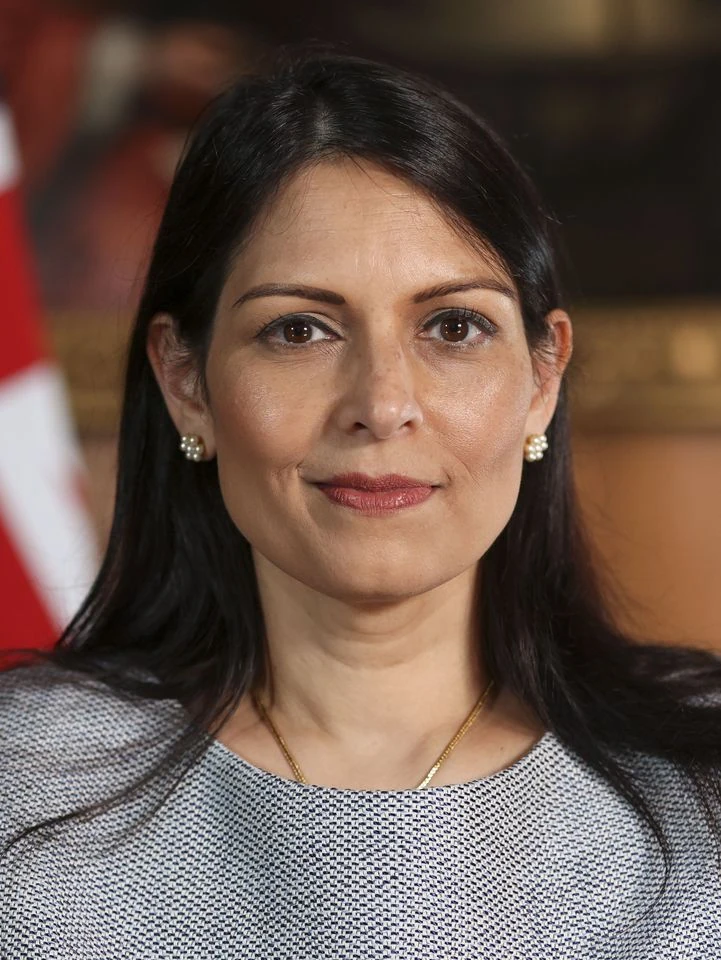
Priti Patel’s career has moved between campaigning, government and opposition, with questions of immigration and ministerial responsibility recurring throughout. She has represented Witham in Parliament since 2010 and held senior posts under three Conservative prime ministers. As Home Secretary, she launched a points-based immigration system and signed an asylum agreement with Rwanda; her time in office also included a formal finding that she had breached the ministerial code in her treatment of civil servants. These policies and disputes made her a prominent, contested figure in recent British politics.
Family, education and early politics
Patel was born in Harrow, London, on 29 March 1972. Her paternal grandparents were born in Gujarat, India, and emigrated to Uganda, where they ran a convenience store in Kampala. Her parents moved to the UK in the 1960s, settled in Hertfordshire and established a chain of newsagents in London and the South East. Patel was raised in a Hindu household and attended a comprehensive school in Watford.
She studied economics at Keele University and went on to postgraduate study in British government and politics at the University of Essex. Margaret Thatcher became her political heroine, and Patel joined the Conservative Party in 1991. After graduating, she worked at Conservative Central Office, then headed the press office of the Referendum Party from 1995 to 1997. She returned to the Conservatives in 1997, working in William Hague’s press office. Later, she spent three years at public-relations firm Weber Shandwick, worked in corporate relations at Diageo, and returned to Weber Shandwick in 2007.
Patel first contested a parliamentary seat at the 2005 general election, standing for the Conservatives in Nottingham North and finishing second to the incumbent Labour MP, Graham Allen. David Cameron subsequently recommended her for the party’s A-list of prospective parliamentary candidates. In 2006 she was selected for Witham, a new constituency in Essex, and won it at the 2010 election with 52.2 per cent of the vote.
From backbencher to minister
In Parliament, Patel was associated with a group of Conservative MPs described as the party’s “new right”. She co-wrote Britannia Unchained (2012), which criticised UK workplace productivity and argued for a smaller welfare state. Its description of British workers as “among the worst idlers in the world” attracted particular attention. Patel was elected to the executive of the 1922 Committee in the same year.
Her first junior government role came in 2014, when she became Exchequer Secretary to the Treasury. After the 2015 general election, David Cameron appointed her Minister of State for Employment, a role in which she attended Cabinet. She was also sworn of the Privy Council. At the 2015 election she had increased her majority in Witham, winning 57.5 per cent of the vote.
Patel was a prominent campaigner for Vote Leave in the 2016 EU referendum. A longstanding Eurosceptic, she argued that the EU interfered too much in daily life and said immigration from elsewhere in the EU placed pressure on schools. She supported Theresa May in the Conservative leadership contest that followed the referendum. When May became Prime Minister, she appointed Patel Secretary of State for International Development in July 2016.
International development and resignation
Patel said that British aid should be spent appropriately and emphasised trade as a route to international development. In September 2016, she announced a UK contribution of £1.1 billion to a global fund addressing malaria, tuberculosis and HIV/AIDS. She also proposed performance agreements for future aid, under which funding could be reduced if recipients failed to meet specified criteria.
She ordered a review of British funding to the Palestinian territories, temporarily freezing about a third of the aid during the review. In December 2016, the Department for International Development announced changes to future funding, saying it would be directed to vital health and education services. Patel’s period in office ended after it emerged that she had held meetings with Israeli officials in August 2017 without informing the Foreign Office. More undisclosed meetings came to light after she apologised to May and met the Prime Minister. Patel resigned on 8 November 2017, after 16 months in the post.
Home Secretary: immigration, asylum and conduct
Boris Johnson appointed Patel Home Secretary in July 2019. She launched a points-based immigration system in February 2020, which took effect on 1 January 2021. It replaced EU freedom of movement and changed the rules for skilled-worker visas: among other measures, it lowered the skills threshold, expanded the occupations eligible for visas, reduced the general salary threshold and removed the cap on skilled-worker visas. Patel described it as a firmer and fairer system that would enable the UK to attract skilled workers and control its borders. Its provisions were broader than a simple restriction on less-skilled migration.
Asylum policy and small-boat crossings of the English Channel were central to her tenure. In March 2021, Patel published a New Plan for Immigration, which included proposals to reform the system and the possibility of offshore processing for undocumented migrants. In April 2022, she travelled to Kigali and signed the Rwanda asylum plan. It envisaged transferring some people who crossed the Channel to Rwanda on chartered flights, a proposal criticised by charities and opposition politicians. Patel also sought returns agreements with countries of origin, including agreements with Albania in 2021 and Serbia in 2022.
Her approach to the Home Office and its workforce drew scrutiny as well as her policy proposals. In 2020, a Cabinet Office inquiry found that Patel had not met the ministerial code’s requirement to treat civil servants with consideration and respect. Prime Minister Johnson rejected the inquiry’s findings and said he had full confidence in her. Patel said she had never set out to upset anyone and was sorry for anyone she had upset. The FDA union sought a judicial review of Johnson’s decision; the application was rejected in December 2021. A separate dispute followed the resignation of Home Office permanent secretary Sir Philip Rutnam in 2020. Rutnam announced a claim under whistleblowing laws, and the matter was settled in 2021 without the Home Office accepting liability.
Patel also asked police forces to review security arrangements for MPs after the murder of Sir David Amess in 2021. Her public statements brought other disputes: she described migrant removals as being frustrated by “activist lawyers”, a phrase criticised by legal organisations, and criticised the England football team’s decision to take the knee against racism. After racist abuse was directed at England players following the Euro 2020 final, she condemned the abuse and called for police action; player Tyrone Mings criticised her earlier remarks about the team’s gesture.
Patel tendered her resignation on 5 September 2022, ahead of Liz Truss becoming Prime Minister, and left the Home Office the following day. She returned to the backbenches. She retained Witham at the 2024 general election and stood in that year’s Conservative leadership contest, but was eliminated in the first ballot of MPs. Kemi Badenoch appointed her Shadow Foreign Secretary in November 2024. In August 2026, Patel left the role to take up an international role with the Conservative Party, while remaining an MP.
A record shaped by policy and scrutiny
Patel’s political record spans domestic policy, international development and the conduct of ministers. Her campaign for Brexit and her subsequent immigration policies made border control a defining feature of her public role. The points-based system changed the terms of migration after the end of EU freedom of movement, while the Rwanda plan brought the question of offshore asylum processing into the centre of national debate. Those measures were presented as ways to control migration, but their design and consequences remained contested.
Her career also illustrates how decisions about public office can become inseparable from policy. The circumstances of her resignation from International Development raised questions about disclosure of meetings; the Home Office inquiry later made ministerial conduct and workplace standards part of the debate over her leadership. Together, these episodes form a record of influence and controversy rather than an uncomplicated account of achievement.
Why Priti Patel deserves a place in British Legacy
Priti Patel deserves a place in British Legacy because her career records a consequential period in the country’s politics: the years in which the Brexit vote led to changes in immigration policy and renewed argument over the management of borders and asylum. As MP for Witham since 2010, she moved from junior roles at the Treasury and Department for Work and Pensions to lead the Department for International Development and the Home Office. In those posts she made decisions affecting aid priorities and the rules governing entry to the UK. The points-based immigration system and the Rwanda asylum plan became prominent tests of the government’s stated aim of controlling migration, and of the practical and ethical limits of that approach.
Her legacy also involves the standards expected of ministers. Her resignation after undisclosed meetings with Israeli officials and the later finding that she had breached the ministerial code in her treatment of civil servants brought disclosure, workplace conduct and accountability into the story of her political leadership. The Prime Minister’s rejection of the inquiry’s finding sharpened debate about how the code should be applied. Remembering Patel in British Legacy means keeping both strands in view: the policies she advanced and the scrutiny her conduct attracted. Her career offers a specific account of how immigration, international development and ministerial responsibility became contentious questions in British public life.
Sources
Priti Patel — revision 1378362150
Adapted in part from Priti Patel by Wikipedia contributors, under CC BY-SA 4.0. Text has been edited and combined with the existing article; this adapted text is shared under the same licence. Contributor history.