Rachel Whiteread makes solid forms from spaces that are usually overlooked: the interior of a room, the gap beneath a chair, the space inside a shed. Her casts turn absence into something that can be seen and encountered. In 1993, House, a concrete cast of the inside of a Victorian terraced house in east London, brought that approach to public attention. Whiteread became the first woman to win the Turner Prize; the sculpture itself was demolished the following January.
Learning to cast ordinary spaces
Whiteread was born in Ilford, Essex, on 20 April 1963. She studied at Brighton Polytechnic, briefly attended Cyprus College of Art and then trained in sculpture at the Slade School of Fine Art at University College London, where she completed an MA in 1987. A workshop in casting with sculptor Richard Wilson helped her recognise the possibilities of the process. Rather than treating an object simply as a solid form, she began to consider the space inside it and what a cast might make visible.
While at the Slade, she made Closet, a plaster cast of the inside of a wooden wardrobe, covered with black felt. The work drew on childhood memories of hiding in a dark cupboard. After graduating, she rented studio space through the Enterprise Allowance Scheme. Shallow Breath, made in 1988, was a cast of the underside of a bed, created not long after her father died. Both works appeared in her first solo exhibition, in 1988. Their sale helped her seek funding for larger projects.
Many of Whiteread’s sculptures cast the negative space around or within familiar things: furniture, architectural details, rooms and buildings. She has described the casts as carrying “the residue of years and years of use”. The technique can make an absent space seem weighty and permanent, while leaving traces of the people and activity that once occupied it. In Ghost (1990), she cast a room in a north London house that was due to be demolished. Plaster sections of the walls and ceiling were assembled on a metal frame. First shown at Chisenhale Gallery, Ghost established a direction that would lead to a more ambitious work.
House and the Turner Prize
Completed in October 1993, House was a cast of the interior of an entire Victorian terraced house at 193 Grove Road in east London. Whiteread had begun thinking about casting a whole house in 1991; she and Artangel’s James Lingwood looked for suitable buildings in north and east London before securing one. The work was installed where the original house had stood, in a street whose houses had been demolished by the council.
House prompted sharply divided responses. It won Whiteread the 1993 Turner Prize, awarded to the best young British artist, and made her the first woman to receive the award. In the same year, it was also recognised by the K Foundation art award, which named her the worst British artist. Tower Hamlets Council demolished the sculpture on 11 January 1994, a decision that itself proved controversial. Its short public life became part of the work’s story: a cast that fixed the shape of a vanished home was also removed from its site.
Whiteread’s work reached other public settings in the years that followed. For the 1997 Sensation exhibition at the Royal Academy, she showed Untitled (One Hundred Spaces), a group of resin casts of the spaces beneath chairs. Water Tower, made in 1998 for New York’s Public Art Fund, was a translucent resin cast of a water tower installed on a rooftop in the city’s SoHo district. It later entered the collection of the Museum of Modern Art in New York. These works demonstrate how her method could move from the scale of an intimate domestic gap to objects and structures encountered in the city.
Memorial, monument and public space
In 2000, Whiteread’s Judenplatz Holocaust Memorial was installed in Vienna. Also known as the Nameless Library, it takes the form of an inside-out library, with concrete books whose spines face inwards. The closed volumes suggest stories that cannot be read and lives lost in the Holocaust. The memorial was commissioned following a proposal by Holocaust survivor Simon Wiesenthal, and Whiteread was selected from ten artists. Its site, on the excavation grounds of one of Vienna’s oldest synagogues, and its design prompted debate. Some residents felt the historic ground itself should serve as the memorial; critics also questioned the use of the library image. The work does not settle those arguments, but makes questions of memory, representation and absence part of its public presence.
The following year, she made Untitled Monument for the empty Fourth Plinth in Trafalgar Square, becoming the third artist to contribute a sculpture to the site. The work was an 11-tonne resin cast of the plinth, turned upside down to create a mirror image of the structure it occupied. Making it required repeated attempts because the resin cracked. Whiteread raised money by selling small preparatory models, while production costs included a mould reported to exceed £100,000. The inverted cast addressed the plinth not as an empty space waiting to be filled, but as an absence that could itself become the subject.
For Tate Modern’s Turbine Hall, Whiteread created Embankment, installed in 2005 and opened to the public that October. Around 14,000 translucent white polyethylene boxes, each cast from the inside of a cardboard box, were stacked into irregular mounds and paths. The scale transformed a familiar storage object into a landscape visitors could move through. The response was mixed: some critics praised the work’s subtlety and generosity, while others objected to its appearance and scale. Such disagreement is a recurring part of Whiteread’s public projects, where an idea is made available for people to experience and interpret rather than resolved by a single explanation.
Later works and recognition
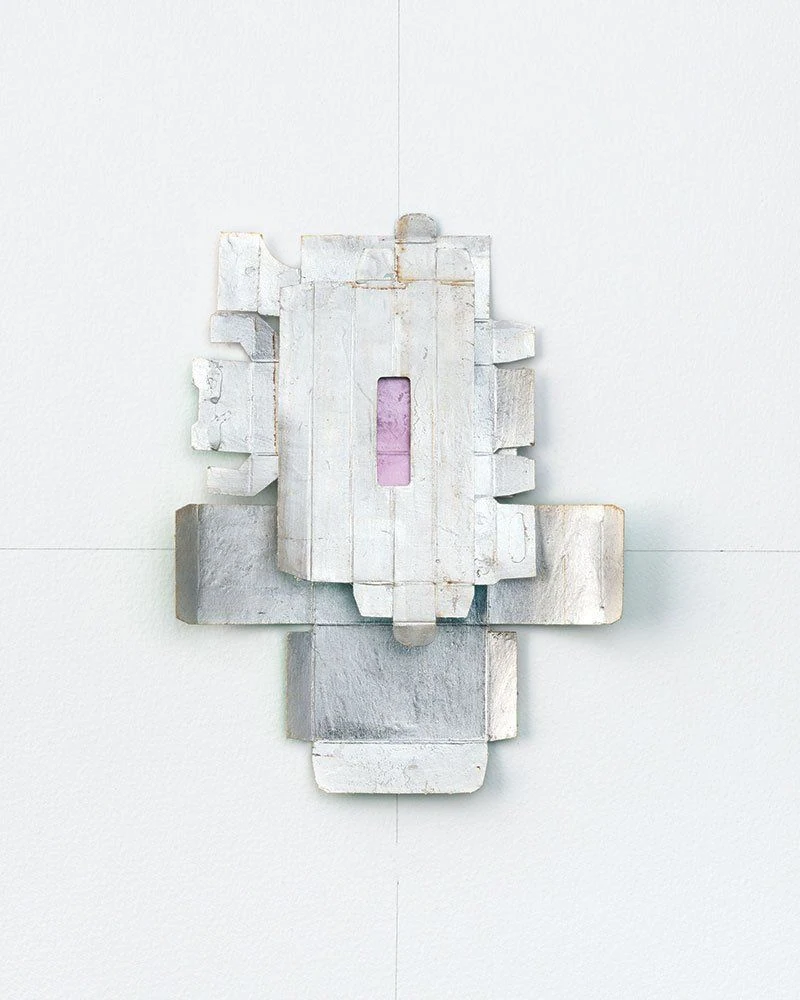
Whiteread has continued to explore casts of buildings and domestic structures. Detached 1, Detached 2 and Detached 3 (2012) render the empty interiors of garden sheds in concrete and steel. Other works from that year include casts based on doors and windows, as well as small cardboard constructions. In 2016, Cabin, a concrete reverse cast of a wooden shed, was installed on Discovery Hill on Governors Island in New York Harbour. In 2018, she created Nissen Hut at Dalby Forest in collaboration with Forestry England and 14-18 NOW. It refers to the prefabricated huts that once housed workers brought into the forest to help fight deforestation after the First World War.
Her work has also appeared in exhibitions and commissions beyond sculpture in the landscape. A 2010 retrospective of her works on paper at the Hammer Museum travelled to the Nasher Sculpture Center and Tate Britain. In 2023, she created a Christmas tree for Carlos Place in London, formed from 102 circular white neon hoops. These projects sit alongside works in plaster, resin, concrete and steel, and show the continuing reach of an approach grounded in the shape and history of particular spaces.
Whiteread was among the Young British Artists whose work featured in the Royal Academy’s Sensation exhibition in 1997. She was appointed CBE in 2006 and made a Dame Commander of the Order of the British Empire in the 2019 Birthday Honours for services to art. Her public commissions and exhibitions have brought her work into contact with audiences in Britain and abroad, while its materials and subjects remain closely connected to the rooms, streets and structures people inhabit.
Why Rachel Whiteread deserves a place in British Legacy
Rachel Whiteread deserves a place in British Legacy because she has expanded what sculpture can ask us to look at. Her casts give physical form to the space inside a wardrobe, beneath a bed or within a house. Ghost and House show how that process can carry the history of a particular building; House, in particular, placed a cast of a home in the public realm and made its removal part of the work’s contested story. Her Turner Prize in 1993 was a significant milestone: she was the first woman to win it. These are specific achievements, not simply a claim to influence. They connect a distinct artistic method with British institutions, urban settings and public debate.
Her British legacy is also visible in projects that engage with shared places and histories. The Fourth Plinth work in Trafalgar Square treated the empty pedestal as a subject in its own right, while Nissen Hut at Dalby Forest refers to the people who worked in the forest after the First World War. The Judenplatz memorial in Vienna shows how her practice can address loss beyond Britain, while also illustrating the difficult questions public memorials raise. Across these works, Whiteread makes absent spaces tangible without pretending that a sculpture can restore what has been lost. That combination of material clarity, public presence and attention to memory gives her work continuing relevance to British art and its wider conversation with the world.
Sources
Adapted in part from Rachel Whiteread by Wikipedia contributors, under CC BY-SA 4.0. Text has been edited and combined with the existing article; this adapted text is shared under the same licence. Contributor history.