Richard Long made walking both a way of encountering landscape and a means of making art. In 1967, he walked back and forth across a field until his footsteps left a visible line in the grass. The resulting work, A Line Made by Walking, offered a spare but consequential proposition: the action of moving through a place could itself become sculpture, and a record of that action could carry the work beyond the landscape where it began.
From Bristol to art school
Born in Bristol on 2 June 1945, Richard Julian Long studied at the West of England College of Art from 1962 to 1965. He then attended Saint Martin’s School of Art in London, where he studied from 1966 to 1968 under Anthony Caro and Phillip King. He became closely associated with fellow student Hamish Fulton, whose work also engaged with walking and landscape.
Long’s practice took shape around walks he began making in the mid-1960s. Rather than treating sculpture as something confined to a studio or made only from conventional materials, he explored how an action in the landscape might alter what sculpture could mean. A path pressed into grass could be the work; in other instances, a walk might be represented through a photograph, a map or text recording its route, place and time. The work could be a physical mark, a record of a journey, or the connection between the two.
A Line Made by Walking is among his best-known early works. Made in 1967, it consists of a line formed by repeatedly walking across a field. Its simplicity is central to its force: the mark is temporary, but its photographic documentation allows viewers to encounter it elsewhere. Long’s approach does not ask the landscape to serve merely as a backdrop. The place, the artist’s movement through it and the evidence left behind all contribute to the work.
Materials, routes and lasting forms
Long has made sculptures from earth, rock, mud, stone and other materials found in nature. Some works change or disappear in the landscapes where they are made; others take the form of arrangements that can be shown indoors. His practice also includes photography, text and maps. These are not simply records added after the event: they can be ways of presenting a walk and its particular relationship to a place.
His walks have taken him through landscapes in Britain and much farther afield, including the Sahara, Australia and Iceland. The varied forms of the resulting works include lines and paths made by walking, arrangements of found materials, and photographs or maps accompanied by texts. In some cases, Long deliberately changes the landscape; in others, the work represents a journey through a recorded route or description. Across these approaches, the act of making and the experience of the place remain closely connected.
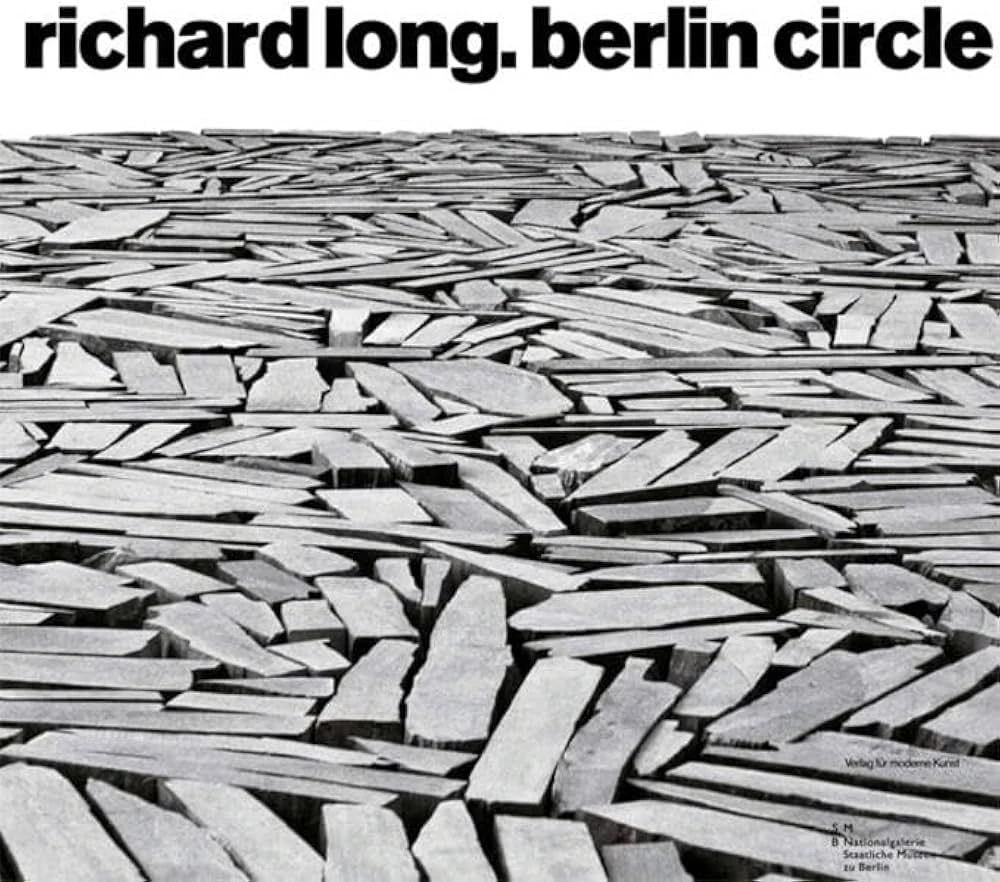
Long’s Delabole Slate Circle, acquired by Tate Modern in 1997, is now a central work at Bristol City Museum and Art Gallery. Nearly two metres in diameter, it is made from 168 pieces of slate from the Delabole quarry in Cornwall. Long has set rules for arranging the stones: they must touch, fit together securely and form a circle. The work brings a found, worked material into a carefully specified geometric form. Its construction makes visible a recurring tension in his art: natural materials meet the order imposed by human decisions.
Other works place this approach in particular settings. At Houghton Hall in Norfolk, Long made a circle of Cornish slate at the end of a path cut through the grass. At the New Art Centre in Salisbury, Tame Buzzard Line (2001) uses flint stones to echo the flight between an oak and an ash tree. His permanent installations have also included Riverlines (2006) at New York’s Hearst Tower, Planet Circle (1991) at Museum de Pont in the Netherlands, and White Water Falls (2012) at the Garvan Institute in Sydney.
Exhibitions and recognition
Long represented Britain at the Venice Biennale in 1976. He was shortlisted for the Turner Prize in 1984, 1987 and 1988, before winning it in 1989 for White Water Line. He is the only artist to have been shortlisted for the prize four times. The award recognised a practice that had already widened the terms in which sculpture could be made and encountered, bringing together physical actions, landscape and forms of documentation.
In 2001, Long was elected to the Royal Academy of Arts. He received the Praemium Imperiale for sculpture in 2009 and was named Whitechapel Gallery Art Icon in 2015; in 2023 he received the Wolf Prize in Arts. His British honours include appointment as a Commander of the Order of the British Empire in 2013 and a knighthood in 2018 for services to art.
His work has also been presented in major exhibitions in Britain. Tate Britain held a retrospective, Heaven and Earth, in 2009. In 2015, the Arnolfini in Bristol presented Richard Long: Time and Space, a major solo exhibition in his home city. Long lives and works in Bristol, where his career began; works are also on permanent display at Tate and Bristol City Museum and Art Gallery, as well as at galleries overseas.
Why Richard Long deserves a place in British Legacy
Richard Long merits a place in British Legacy because he changed what sculpture could be without abandoning the physical world that sculpture inhabits. In A Line Made by Walking, repeated footsteps turned an ordinary action into a mark in a field and, through photography, into a work that could be encountered elsewhere. Across lines, paths, stone arrangements, maps and texts, Long has treated movement through landscape as material for art. That achievement is specific and influential: it extended sculpture beyond permanent objects and conventional studio materials, making action, place and documentation integral to the work.
His British connection is visible in both his life and his practice. Born and based in Bristol, he trained at art schools in England, represented Britain at the Venice Biennale, won the Turner Prize and received national honours for services to art. Works such as Delabole Slate Circle and the Houghton Hall installation also connect his practice with places and materials in Britain, while his wider travels show how far the same artistic questions can reach. At Bristol City Museum and Art Gallery, viewers can encounter the slate circle as a substantial, enduring work; elsewhere, the records of walks preserve gestures that were temporary by nature. Long’s legacy lies in holding those different forms together and making a lasting case for landscape, movement and attention as subjects of contemporary art.
Sources
Richard Long (artist), revision 1364691779
Adapted in part from Richard Long (artist) by Wikipedia contributors, under CC BY-SA 4.0. Text has been edited and combined with the existing article; this adapted text is shared under the same licence. Contributor history.