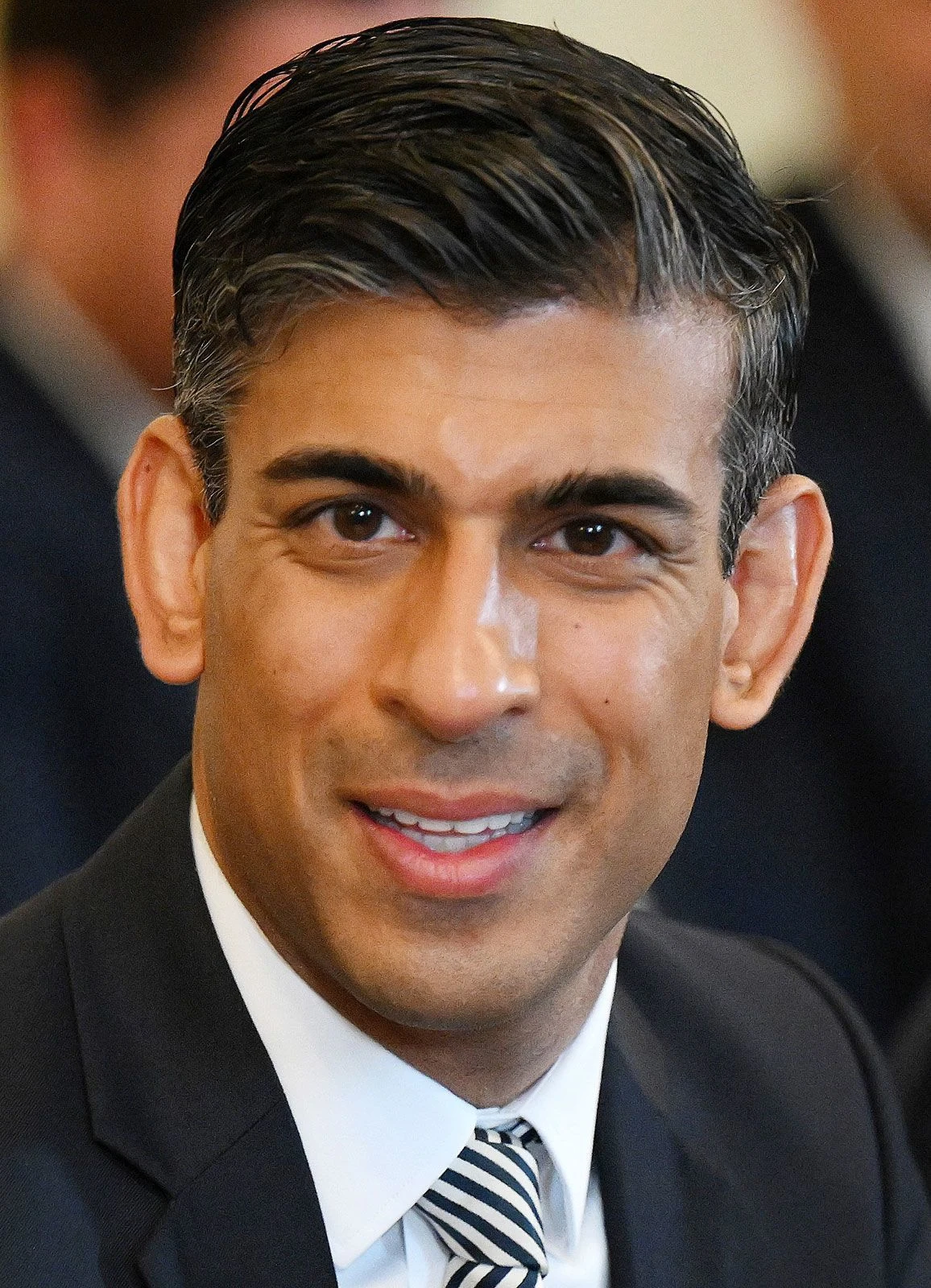
Rishi Sunak’s political career moved quickly: from a first election to Parliament in 2015 to the Treasury, and then, in October 2022, to Downing Street. As Chancellor, he led the government’s financial response to the COVID-19 pandemic, including the furlough scheme and Eat Out to Help Out. As Prime Minister, he inherited a party and government in turmoil, and led the Conservatives into the 2024 general election, which ended their 14 years in office.
From Southampton to Westminster
Sunak was born in Southampton on 12 May 1980. His parents, who were born in East Africa to Indian families, moved to Britain in 1966. His father worked as a general practitioner in the NHS; his mother was a pharmacist and owned a pharmacy in Southampton. Sunak attended Winchester College before studying philosophy, politics and economics at Lincoln College, Oxford, where he graduated with first-class honours in 2001. He later earned an MBA from Stanford University as a Fulbright Scholar.
Before entering Parliament, Sunak worked as an analyst at Goldman Sachs and later at two hedge fund firms. In 2013–15, he was a director of Catamaran Ventures, an investment firm owned by his father-in-law. He was selected as the Conservative candidate for Richmond (Yorks) in 2014 and elected MP at the 2015 general election, succeeding William Hague. He supported leaving the European Union in the 2016 referendum and served on the Environment, Food and Rural Affairs Select Committee.
His first ministerial appointment came in 2018, as Parliamentary Under-Secretary of State for Local Government. In 2019, he became Chief Secretary to the Treasury under Chancellor Sajid Javid. When Javid resigned in February 2020, Sunak succeeded him. The appointment put him in charge of the Treasury just as the pandemic was beginning to reshape public life and the economy.
The Treasury in a national emergency
In March 2020, the government introduced the Coronavirus Job Retention Scheme, known as furlough. Employers could receive grants covering 80 per cent of a worker’s wages, up to a monthly limit of £2,500 per person. It was an unprecedented employee-retention scheme in Britain. The programme was extended several times and ultimately ran until September 2021. Sunak also announced support for self-employed people, alongside emergency funding and loan programmes for businesses, including the Bounce Back Loan Scheme and the Coronavirus Business Interruption Loan Scheme.
Those interventions were intended to help employers retain staff and give businesses access to finance while restrictions disrupted trading. The support came at substantial public cost, and the decisions are best understood as emergency measures rather than ordinary Treasury policy. In July 2020, Sunak announced a further package that included a temporary cut in VAT for hospitality, a stamp duty holiday and a job-retention bonus.
That package also contained Eat Out to Help Out. For three days a week in August 2020, participating cafés, pubs and restaurants offered a government subsidy of 50 per cent on food and soft drinks, up to £10 per person. The scheme subsidised £849 million in meals. Its effect remains contested: some regarded it as a boost for hospitality, while a 2020 study found that it contributed to an increase in COVID-19 infections. The government’s medical advisers were not informed before the scheme was announced, according to evidence later given to the COVID-19 Inquiry; Sunak’s written evidence said it had been discussed with advisers, who had not objected.
Sunak’s budgets reflected the competing pressures of crisis support, public borrowing and recovery. His March 2021 budget extended furlough and announced that corporation tax would rise from 19 to 25 per cent in 2023. In his final spring statement, in March 2022, he cut fuel duty and set out help for people facing rising living costs. A £15 billion package announced in May included an energy-bill discount and payments for low-income households, pensioners and some disabled people.
From Chancellor to Prime Minister
In July 2022, Sunak resigned as Chancellor amid a government crisis, shortly before Boris Johnson announced his resignation as Conservative leader. Sunak contested the leadership election that followed, reaching the final round against Liz Truss but losing the membership vote. After Truss resigned in October, Sunak was elected Conservative leader and appointed Prime Minister by Charles III on 25 October. At 42, he was the youngest Prime Minister since 1812 and the first British Asian to hold the office.
Sunak said that economic stability and confidence would be central to his government. His five stated priorities included halving inflation, growing the economy, reducing debt, cutting NHS waiting lists and stopping small-boat crossings in the English Channel. His government negotiated the Windsor Framework with the European Union on Northern Ireland’s trading arrangements. It also pursued the Rwanda asylum plan, but the UK Supreme Court ruled the plan unlawful in November 2023. Legislation intended to enable removals to Rwanda became a contentious part of his government’s agenda.
On foreign policy, Sunak pledged support for Ukraine following Russia’s invasion and visited Kyiv in January 2024, announcing a further military-aid commitment. After the Hamas-led attacks on Israel in October 2023, he voiced support for Israel’s right to defend itself and later called for a sustainable ceasefire alongside the return of hostages and the arrival of humanitarian aid in Gaza.
Election defeat and return to the backbenches
The Conservatives suffered heavy losses in the 2023 and 2024 local elections. Sunak called a general election for 4 July 2024. Labour won a landslide, ending 14 years of Conservative government. Sunak conceded defeat on 5 July, apologised to Conservative voters and candidates, and said he would step down as party leader once the process to choose a successor was under way.
He became Leader of the Opposition after Labour took office, but remained in the role only until Kemi Badenoch succeeded him as Conservative leader in November 2024. He then returned to the backbenches as MP for Richmond and Northallerton, the constituency formed after boundary changes. The arc from first-time MP to Chancellor, Prime Minister and opposition leader had taken less than a decade; the electoral defeat that ended his premiership also set the terms for the party’s next period in opposition.
Why Rishi Sunak deserves a place in British Legacy
Sunak’s place in British political history is closely tied to the choices made during the pandemic. As Chancellor, he put the Treasury behind an employee-retention scheme on a scale and of a kind not previously used by a British government. Furlough aimed to keep workers attached to their jobs while restrictions prevented many businesses from operating normally. Support for the self-employed and business lending schemes extended the government’s response beyond employees on payrolls. These programmes provide a significant case study in how the state can use public finance to protect employment and economic activity during a national emergency.
That record includes difficult questions as well as large interventions. Eat Out to Help Out was designed to help hospitality businesses, but its relationship to the spread of infection became disputed. His budgets and later cost-of-living measures also show how emergency support gave way to arguments about borrowing, taxation and household costs. Sunak’s subsequent premiership, which ended with a decisive election defeat, belongs in the same account of recent British public life: it records both the limits of his government’s political authority and the consequences of its decisions. Remembering his career in British Legacy means considering not just the speed of his rise, but the policies he led, the people and businesses they sought to support, and the public debate that followed.
Sources
Rishi Sunak — Wikipedia revision 1378206327
Adapted in part from Rishi Sunak by Wikipedia contributors, under CC BY-SA 4.0. Text has been edited and combined with the existing article; this adapted text is shared under the same licence. Contributor history.