Robert Hooke’s work moved between scales. Through a microscope he described the honeycomb structure of cork and gave it a name still used in biology. Across London, after the Great Fire, he surveyed damaged properties and helped establish how the city would be rebuilt. In between, he investigated springs, clocks, planets, fossils and the behaviour of air. His career was not a single story of discovery but a sustained effort to make observation useful: by building instruments, testing ideas and recording what he saw.
A young mechanic in Oxford
Hooke was born on 18 July 1635 in Freshwater, on the Isle of Wight, the youngest of four children of John Hooke, an Anglican priest, and Cecily Gyles. Frail as a child, he received some instruction from his father but had little formal education at first. He showed an early aptitude for making things: after watching a brass clock being dismantled, he built a working wooden version.
After his father died in 1648, Hooke went to London intending to become an apprentice to the painter Peter Lely. Ill health made working with oil colours difficult, and he became a pupil at Westminster School, where he learnt Latin, Greek and Euclid. In 1653 he went to Christ Church, Oxford, as an organist and chorister, receiving tuition and accommodation. He did not formally matriculate until 1658 and was awarded an MA in 1662.
Oxford connected Hooke with a circle of natural philosophers. He worked as an assistant to the physician Thomas Willis and met Robert Boyle through the Oxford Philosophical Club. When Boyle moved to Oxford in 1655, Hooke became his assistant in name and a co-experimenter in practice. He designed and built an air pump for Boyle’s investigations of pressure and the possibility of a vacuum. The close work of constructing apparatus and observing its effects became a pattern: Hooke’s instruments were often part of how a question could be tested at all.
Experiments, instruments and Micrographia
Hooke joined the Royal Society as its Curator of Experiments in 1662, demonstrating experiments for its meetings and, from 1665, serving as Professor of Geometry at Gresham College. He was elected a Fellow of the Royal Society in 1663. His demonstrations ranged from experiments on air and gravity to pendulums, barometric pressure and the movement of falling bodies. He also set out a practical method for keeping weather records, using instruments including a thermometer, hygrometer and wind gauge.
In 1665 he published Micrographia, an illustrated account of observations made with microscopes and telescopes. Hooke had designed a compound microscope for his work. Its pages showed structures that could not be seen with the unaided eye, among them a flea, a louse and cork. In the cork’s small compartments he recognised a resemblance to the cells of a honeycomb and coined the word “cell”. The term arose from an observation of plant material; the book also recorded the earliest known observation of a microorganism, the microfungus Mucor.
Micrographia reached beyond microscopy. Hooke illustrated the Pleiades and lunar craters, and his observations included the structure of fossil wood. He reasoned that fossils were the remains of living things, and argued that some might belong to species that had become extinct. In geology, he proposed that earthquakes and volcanoes had helped shape the Earth’s surface. These ideas challenged assumptions of his time, including the belief that the landscape and its fossils could be explained without long-running geological change.
His work on elasticity was another lasting contribution. In 1660 Hooke discovered the relationship between the extension of a spring and the force applied to it. He first communicated the finding as an anagram, a way of registering a claim without disclosing its substance; in 1678 he published the solution, expressed as “as the extension, so the force”. He also worked on the balance spring used in watches, which helped make portable timepieces more accurate. Hooke and Christiaan Huygens disputed priority for the idea, while Huygens is credited with making the first watch to use a balance spring. Hooke’s other mechanical work included the universal joint that bears his name and improvements to clock mechanisms.
London after the Great Fire
The Great Fire of 1666 destroyed a large part of the City of London. Hooke became Surveyor to the City and worked as an architect and surveyor alongside Christopher Wren in the reconstruction. He helped map the fire-damaged area, identify property boundaries and foundations, and prepare building regulations. His careful surveys were important in resolving competing claims between neighbours and in deciding compensation where land was required for road changes. A proposed redesign with a grid of broad streets was not adopted: pressure to restore trade and housing quickly meant that the city was largely rebuilt on its original property lines.
Hooke’s work had consequences beyond the immediate reconstruction. His surveys contributed to Ogilby and Morgan’s large-scale map of London, published in 1677 and among the earliest maps of a city drawn to a stated scale. He was also appointed Surveyor of the Royal Works in 1670. His architectural projects included the Monument to the Great Fire, Montagu House, Bethlem Royal Hospital and the Royal College of Physicians, as well as churches and country houses. The Monument was designed to serve as a zenith telescope for astronomical observation, although vibration from traffic made that function impractical. Its scientific purpose was part of a broader habit in Hooke’s career: architecture and measurement could be made to serve inquiry as well as construction.
His collaboration with Wren extended to St Paul’s Cathedral. Hooke worked out that an inverted catenary—the curve formed by a hanging chain—provided a suitable shape for an arch supporting a heavy load, and proposed a circular arrangement of such arches for the cathedral’s dome. He also contributed to rebuilding churches across the city. This mix of surveying, engineering and design made him a working participant in London’s recovery, not simply a theorist commenting from outside it.
Celestial questions and a disputed reputation
Hooke’s observations also reached into astronomy. In 1664 he observed the Great Red Spot on Jupiter and recorded its movement; observations such as these helped Giovanni Cassini calculate the planet’s rotation period. Hooke studied the Moon’s craters, observed Saturn’s rings and identified the double star Gamma Arietis. To improve astronomical observation, he developed instruments including a micrometer screw and a clockwork drive. He also built a practical Gregorian telescope using a mirror.
Gravity became one of the subjects through which Hooke’s scientific reputation was most contested. He argued that celestial bodies attract one another and that their motion is continually deflected by such attraction. In a letter to Isaac Newton in 1680, Hooke proposed that attraction diminished in inverse proportion to the square of distance. But his claims and Newton’s later mathematical demonstration were not the same achievement: Hooke did not provide the proof that Newton supplied in the Principia. Newton acknowledged that Hooke and others had separately considered an inverse-square relation, while disputing the extent of Hooke’s priority and influence. Their disagreement formed part of Hooke’s long-standing association with scientific priority disputes, which also involved Huygens over watch design.
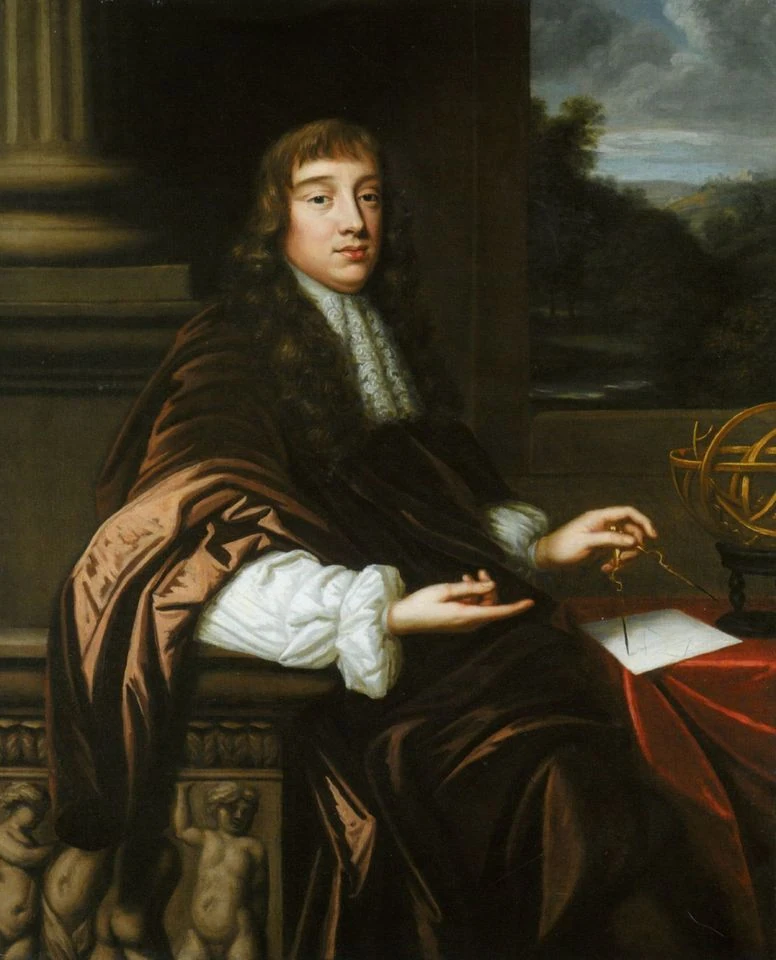
For centuries, accounts of Hooke’s character were strongly shaped by hostile descriptions from early writers and by comparisons with Newton. Later study of Hooke’s diary, published in 1935, offered a more rounded picture of his social life and relationships. No authenticated portrait of him is known to survive. A painting once proposed as his likeness was identified as depicting another scholar, and a later proposal that a portrait by Mary Beale showed Hooke remains disputed. The uncertainty around his appearance mirrors a broader difficulty: his many contributions are easier to document than to compress into a simple image of the man.
Death and the work left behind
Hooke died in London on 3 March 1703, aged 67, after becoming blind and bedridden during the final year of his life. He was buried at St Helen’s Church, Bishopsgate, although the exact location of his grave is unknown. A large quantity of money and gold was found in his room at Gresham College, but no will was discovered. His library contained more than 3,000 books. His publications included Micrographia, Lectures de potentia restitutiva, on springs, and collections of lectures on physical, mechanical, geographical and astronomical subjects.
His name has since been attached to an annual medal awarded by the British Society for Cell Biology to an emerging leader in the field. A lunar crater and a crater on Mars also bear his name. These commemorations reflect only part of his range: Hooke’s work crossed experimental science, instrument-making, surveying, architecture and natural history, often with one discipline supplying the tools for another.
Why Robert Hooke deserves a place in British Legacy
Robert Hooke belongs in British Legacy because his achievements are woven into both the scientific history of Britain and the material history of its capital. Micrographia helped make microscopic observation a subject of public interest, and Hooke’s description of cork cells gave science a term that remains fundamental. His work on elasticity and the balance spring connected mathematical relationships to working mechanisms, while the instruments he designed helped extend observation of the heavens. These were not isolated curiosities: they show how experiment, engineering and explanation could reinforce one another.
His contribution to London was equally concrete. After the Great Fire, Hooke’s surveys helped establish boundaries, settle property questions and organise rebuilding. The city’s rapid return to its existing street pattern was shaped by practical constraints, but his measurements and plans made reconstruction more orderly and documented. As a surveyor, architect and scientific observer, he applied precision to problems with lasting public consequences. Remembering Hooke means recognising a form of British achievement grounded not in a single celebrated invention but in the work of making knowledge usable: building the apparatus, recording the evidence, measuring the damaged city and designing structures for life within it.
Sources
Robert Hooke (revision 1374888483)
Adapted in part from Robert Hooke by Wikipedia contributors, under CC BY-SA 4.0. Text has been edited and combined with the existing article; this adapted text is shared under the same licence. Contributor history.