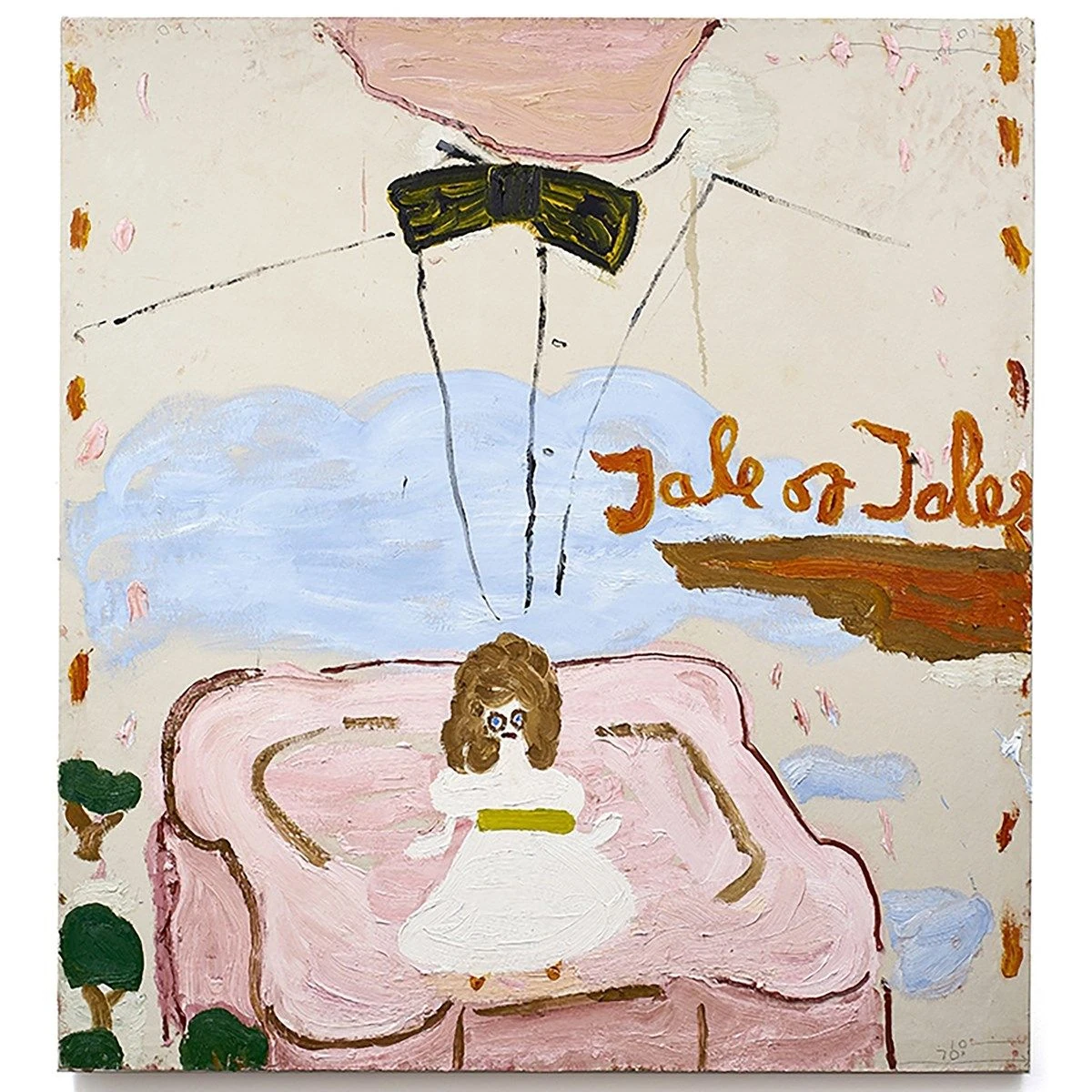
Rose Wylie’s paintings bring footballers, film scenes, animals and kitchen objects into the same visual world. Made on large areas of unprimed canvas, they retain drips, smudges and scraps as part of the image. That directness can look playful, but it is also deliberate: Wylie combines disparate subjects and words, letting their associations and contrasts do the work. Her career took an unconventional route, with broad recognition arriving in her seventies after decades of study, family life and persistent painting.
Learning to paint, then finding her way back
Wylie was born in Hythe, Kent, on 14 October 1934. She was the seventh child in her family, and her father was a civil engineer who had served as director of ordnance in India. Wylie and her family lived there while he did so. Encouraged by her mother to enrol, she studied at the Folkestone and Dover School of Art from 1952 to 1956. During her studies she worked as an artist’s model for John Ward. She later recalled herself as a rebellious student, describing a look more Brigitte Bardot than a Mills & Boon cover.
After art school, Wylie took a teacher-training course at Goldsmiths, where she met the painter Roy Oxlade. They married in 1957. When their son Luke-John was born in 1958, she stopped painting to raise her children. She later described turning her artistic energies towards “soups, jam, clothes, curtains, and Christmas cards”. She returned to painting in the late 1970s, and in 1981, aged 47, completed an MA at the Royal College of Art.
Recognition did not follow immediately. During the 1980s and 1990s, Wylie struggled to attract attention to her work. She helped fund her practice by giving informal painting classes at home and letting students camp in the garden. The long gap between study and acclaim is part of her particular story, but not a simple tale of sudden discovery: she continued developing her work through years when public recognition was limited.
Everyday subjects, unexpected combinations
Wylie draws on daily life as well as films, comic books, nature, animals, news, sport and celebrity stories. Her paintings can place what is often called high culture alongside popular imagery without treating one as more worthy than the other. Footballers, including John Terry, appear in her work; her Film Notes series takes scenes from films, including those by Quentin Tarantino. Elsewhere she has painted football matches, kitchen burners, her daughter putting on mascara and herself eating a cookie.
Some figures recur: Marilyn Monroe, Nicole Kidman, Queen Elizabeth I and Serena Williams are among the women she has painted more than once. Words and phrases also appear on the canvas. They may point to the story or memory behind an image, while functioning as shapes within the composition. The effect is not a tidy illustration of a single subject. Instead, references sit beside one another, leaving the viewer to follow the links, shifts and interruptions.
Her method makes that openness visible. Wylie paints on unstretched, unprimed canvas, using stubby brushes, her fingers or paint squeezed straight from the tube. She may stick, tack or glue scraps to the surface; marks, drips and smudges remain apparent. She has said she does not mind what others might call imperfection, preferring descriptions such as “wearing out” or “it’s got a stain on it”. The paintings do not hide their making. Their roughness is not evidence that she has overlooked finish; it is part of how she chooses to work.
A career recognised later
Wylie began receiving wider recognition in her seventies. In 2002, she made a group of paintings for Tunbridge Wells Arts Centre; two years later, Neo Rauch selected these works for the open-submission exhibition EAST in Norwich. In 2010, she was the only non-American artist represented in Women to Watch at the National Museum of Women in the Arts in Washington, DC.
Her exhibitions brought her work to major UK venues. She presented solo exhibitions at the Jerwood Gallery in 2012, Tate Britain in 2013 and the Serpentine Gallery in 2017. In 2017, she also became represented by David Zwirner Gallery. Her recognition included the Paul Hamlyn Prize for Visual Arts in 2011 and the John Moores Painting Prize in 2014. That year she was elected a Royal Academician; in 2015 she received the Charles Wollaston Award for the most distinguished work in the Royal Academy Summer Exhibition.
In February 2026, Wylie became the first British female artist to occupy all the Royal Academy of Arts’ main galleries, with The Picture Comes First. The exhibition comprised more than 50 paintings and 42 works on paper. Her work is also held in collections including Tate, the Arts Council Collection, the Jerwood Foundation, the Hammer Collection and York City Art Gallery. Wylie continues to live and work in the Kent home she once shared with Oxlade, who died in 2014. They had three children together.
Why Rose Wylie deserves a place in British Legacy
Wylie’s place in British Legacy rests first on the particular character of her painting. She has made a sustained body of work from sources that range from domestic life and nature to football, cinema and celebrity. Rather than separating these subjects into hierarchies, she lets them meet on the canvas. Her recurring figures, written phrases and abrupt shifts of scale or subject create a visual language in which familiar images can be encountered afresh. The visible marks and attached scraps matter too: the painting shows its own construction instead of presenting a polished surface as if it had appeared fully formed.
Her British connection is grounded in a life and career centred on Kent and in recognition through British institutions. She studied at Folkestone and Dover and the Royal College of Art, exhibited at Tate Britain and the Serpentine, and was elected a Royal Academician. The 2026 Royal Academy exhibition, spanning its main galleries, placed a substantial body of her work before a broad public. Wylie’s later recognition also gives her career an unusually long chronology: formal art education in the 1950s, a return to painting in the late 1970s, and major awards and exhibitions in later decades. Her achievement is not a general lesson about age, but the specific example of an artist continuing to develop a distinctive practice and receiving serious attention for it.
Sources
Adapted in part from Rose Wylie by Wikipedia contributors, under CC BY-SA 4.0. Text has been edited and combined with the existing article; this adapted text is shared under the same licence. Contributor history.