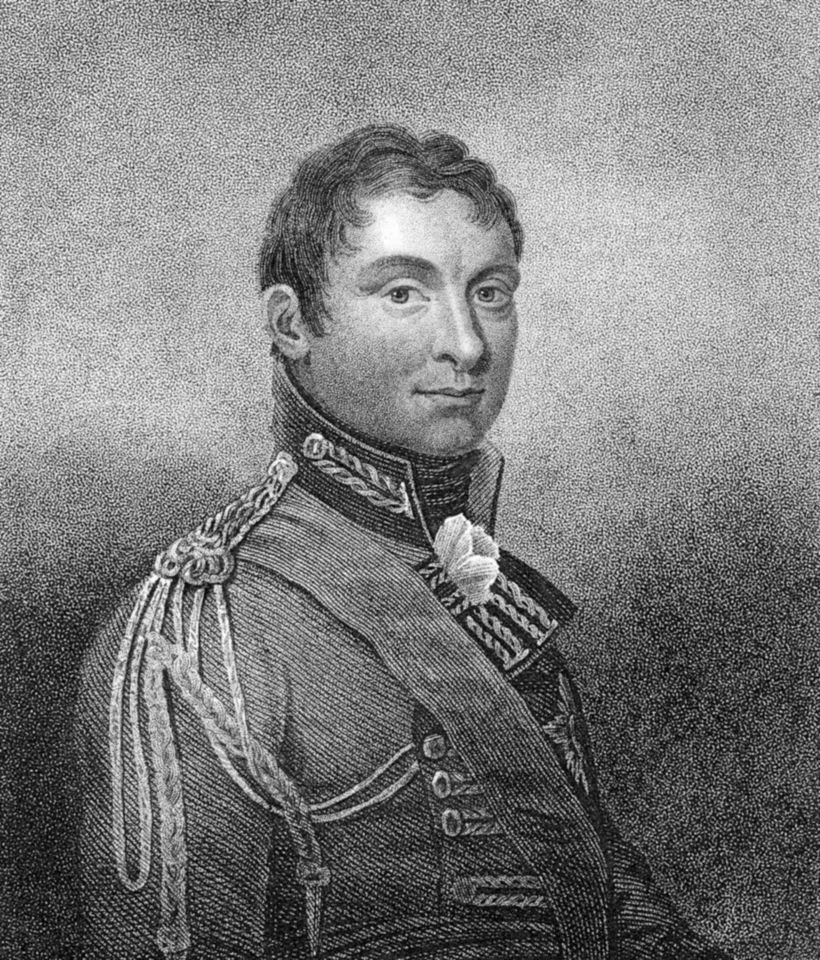
Before the Penny Black, sending a letter in Britain could mean facing a complicated charge based on distance and the number of sheets it contained. The recipient usually paid, and could refuse delivery. Rowland Hill proposed a different principle: low, uniform postage paid in advance by the sender. The adhesive stamp became the recognisable symbol of that reform, but Hill’s work was wider than a single design. It joined a practical change to the cost of communication with a broader effort to make public systems more accessible.
An educator and social reformer
Hill was born in Kidderminster, Worcestershire, on 3 December 1795. His father, Thomas Wright Hill, was an educator whose interests extended to politics and educational innovation. Rowland worked at Birmingham’s Assay Office and painted landscapes in his spare time, but education soon became central to his career. In 1819 he moved his father’s school from central Birmingham to Edgbaston, where it became Hazelwood School.
Hill and his brothers helped design the school and set out their educational ideas in Plans for the Government and Liberal Instruction of Boys in Large Numbers Drawn from Experience, published in 1822. They favoured kindness and moral influence over corporal punishment and fear, and gave pupils a substantial role in governing themselves. Hazelwood’s facilities included a science laboratory, swimming pool and forced-air heating. Its approach attracted attention beyond Birmingham: the French educational writer Marc-Antoine Jullien visited, wrote about the school and sent his son there. In 1827, an offshoot opened at Bruce Castle in Tottenham. Hill taught at Hazelwood from 1808 to 1833 and was headmaster for much of that time.
His reforming interests also encompassed colonisation and representation. In 1832 he published Home colonies, a plan addressing poverty and crime. From 1833 until 1839, he served as secretary to the South Australian Colonization Commission, which helped establish a settlement at what is now Adelaide. Hill supported a system for elections to the settlement’s council that allowed minority representation. His postal reform pamphlet took shape during this period of public service, reflecting a career concerned with how institutions could be organised.
The case for uniform postage
Hill began studying postal reform seriously in 1835. The existing system charged according to distance and the number of sheets, while recipients commonly paid on delivery. Its complicated rates and handling procedures made sending letters expensive and administratively cumbersome. Hill argued that much of the cost arose not from carrying mail but from the work involved at its points of origin and delivery. If postage were prepaid and rates simplified, he believed, the system could be cheaper to operate.
In early 1837 he published Post Office Reform: Its Importance and Practicability. Its central proposal was a low, uniform charge based on weight rather than distance, with the sender paying in advance. Hill advocated a penny for a letter weighing up to half an ounce, whether it travelled a short distance or across the country. Adhesive stamps could show that postage had been paid; prepaid letter sheets were another proposed means. Envelopes were not yet in common use, and Hill’s plan accounted for a time when a folded sheet could serve as both message and address.
The proposal met resistance. Post Office officials and the Postmaster criticised it, while merchants and other advocates of commercial reform supported change. A mercantile committee pressed for Hill’s plan, and in 1839 he received a two-year contract to run the new system. A fourpenny uniform rate began on 5 December that year, followed by the penny rate on 10 January 1840. Paid domestic correspondence rose by 120 per cent between November 1839 and February 1840, an increase attributed in the Wikipedia account to the removal of free-franking privileges and fraud as well as the change in rates.
The stamp and the expansion of the post
The first adhesive postage stamps were distributed in May 1840. The Penny Black carried an engraving of the young Queen Victoria and became the enduring emblem of the new system. Prepaid letter sheets bearing designs by William Mulready were also introduced, but attracted ridicule and fell out of favour. The contrast showed that the reform was not simply a matter of putting a new image on paper: it required workable ways to collect payment and handle mail.
Hill’s economic argument was that cheaper letters would encourage more people, including poorer people, to write. The volume of letters sent in the United Kingdom more than doubled in the first year of Penny Post and doubled again within the following decade. The model spread internationally: Switzerland and Brazil introduced stamps within three years, the United States followed later, and by 1860 stamps were used in 90 countries. Hill’s reforms were eventually associated with a postal system that made personal correspondence easier and supported commercial exchange. The British Post Office’s revenue took about 30 years to recover to its 1839 level, a reminder that wider access and immediate financial returns did not necessarily move together.
Public service, honours and remembrance
Hill’s time directing the new system was interrupted by political change. After the Conservatives returned to office in 1841, he was dismissed from the Post Office in 1842. He then became a director of the London and Brighton Railway, serving as its chairman from 1843 to 1846. During that period he lowered fares, expanded routes and introduced special excursion trains. He also joined the Friends in Council, a group that discussed political economy, and the Political Economy Club.
Hill returned to postal administration under the Whig government. He became secretary to the Postmaster General and then secretary to the Post Office, serving in the latter role from 1854 until 1864. He was knighted as a Knight Commander of the Order of the Bath in 1860, became a Fellow of the Royal Society and received an honorary degree from the University of Oxford. He died in Hampstead, London, on 27 August 1879, and was buried in Westminster Abbey.
His memory is marked in several places. Public statues stand in Birmingham, Kidderminster and London, and Hill is also included in the Victoria Monument in Lancaster. A bust is in Westminster Abbey. Commemorations extend beyond Britain: Hill’s name appears on a meeting hall at the Universal Postal Union’s headquarters in Bern, while streets in Adelaide also bear his name. The Rowland Hill Awards, established by Royal Mail and the British Philatelic Trust in 1997, recognise innovation and enterprise in philately.
Why Rowland Hill deserves a place in British Legacy
Hill deserves a place in British Legacy because he helped turn a costly, intricate postal system into one organised around a simple public principle: a letter could travel at a low, uniform rate, with the sender paying in advance. The Penny Black made that principle visible, but it was part of a larger reform involving rates, payment and the handling of correspondence. The recorded rise in letter volumes after the introduction of Penny Post shows how markedly the system changed. Its spread to other countries demonstrates that this British reform became an international model, not merely a local administrative adjustment.
His significance also lies in the range of his public work. Hill pursued educational reform at Hazelwood, served the South Australian Colonization Commission and advocated a form of minority representation, before taking on postal administration and railway management. These strands share a practical concern with how institutions serve the people who use them. Cheaper postage supported personal communication and commercial exchange; his educational ideas placed emphasis on self-government and learning. Remembering Hill therefore means more than celebrating a stamp. It means recognising an English reformer whose proposals changed access to communication and whose work helped shape public services in Britain and beyond.
Sources
Rowland Hill — revision 1369690258
Adapted in part from Rowland Hill by Wikipedia contributors, under CC BY-SA 4.0. Text has been edited and combined with the existing article; this adapted text is shared under the same licence. Contributor history.