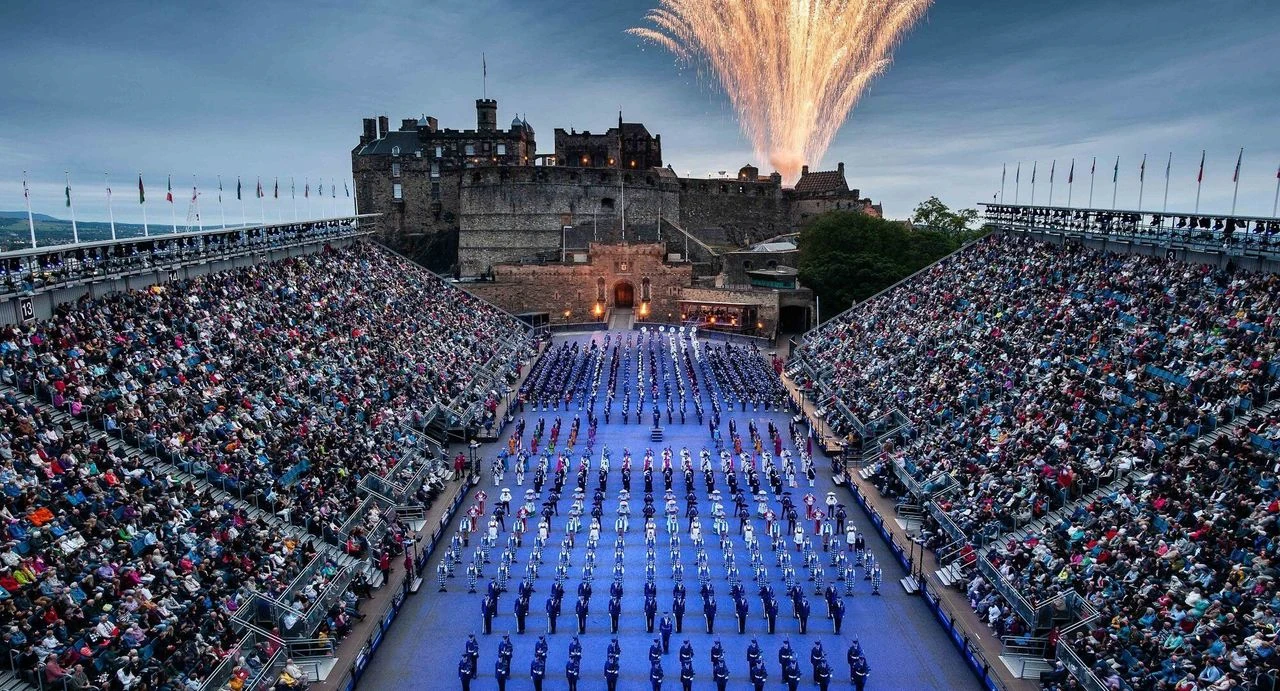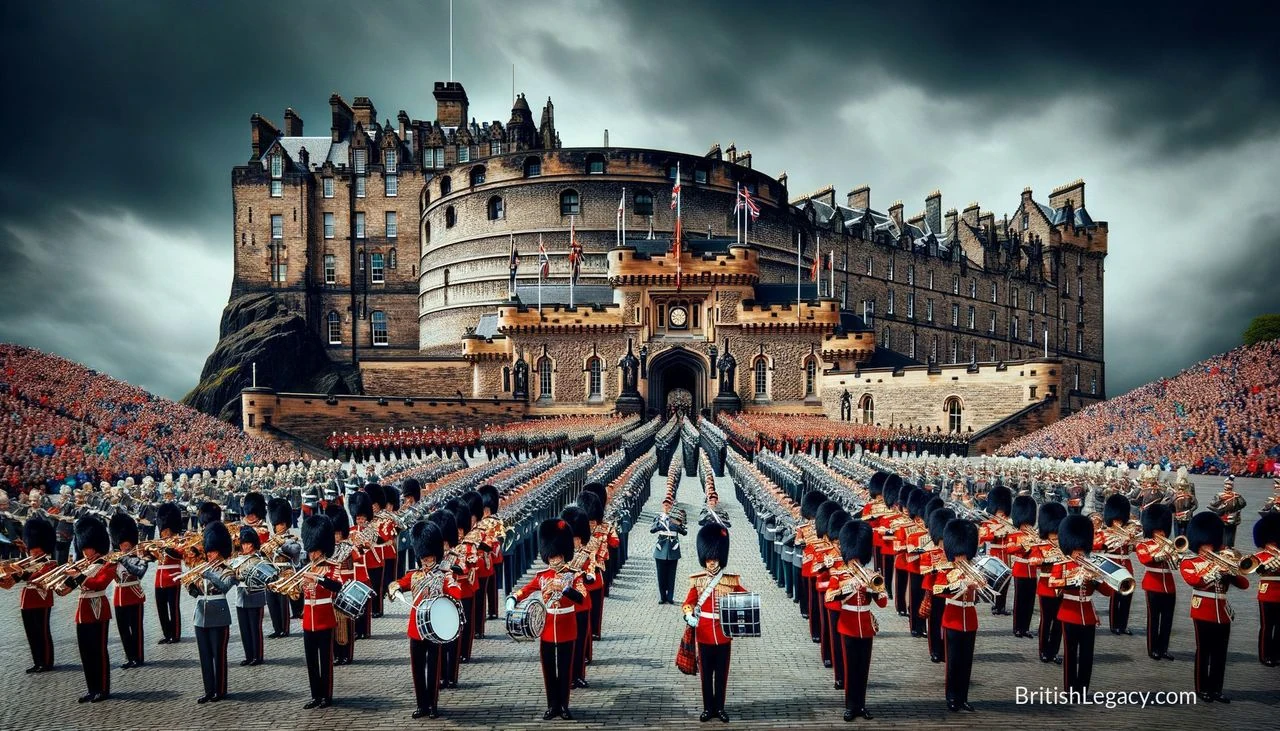
Each August, the Esplanade of Edinburgh Castle becomes a stage for massed pipes and drums, military bands and performers from around the world. The Royal Edinburgh Military Tattoo combines military ceremony with music and spectacle in a setting closely associated with Scotland’s capital. Its programme has changed over time: civilian performers joined the mainly military line-up in 1995, and the event now includes acts from many countries. The Tattoo began with a public military show in 1949; the first official Edinburgh Military Tattoo followed a year later.
A glorious tapestry of heritage and spectacle
The first public military tattoo in Edinburgh, titled Something About a Soldier, took place at the Ross Bandstand in Princes Street Gardens in 1949. Lieutenant Colonel George Malcolm of Poltalloch produced the first official Tattoo in 1950. Its programme comprised eight items, watched by about 6,000 spectators seated on basic benches and scaffolding around the Castle Esplanade. The esplanade has remained the event’s home since that first official show.
The word “tattoo” has a military history of its own. It derives from the Dutch phrase doe den tap toe, a signal for tavern keepers to close their ale taps and for soldiers to return to their lodgings. By the eighteenth century, the term described both the military’s final duty call of the day and evening entertainment performed by military musicians.
The Tattoo takes place as part of the Edinburgh Festivals, with performances throughout August. Its setting is more than a backdrop: the castle entrance and façade frame the show, while temporary stands bring audiences close to the performers. The scale of those stands has grown with the event, allowing thousands to watch each performance.
Music, ceremony and a changing programme
A fanfare usually opens each performance. The Massed Pipes and Drums then march through the castle gatehouse and perform a traditional pipe-band set, before featured acts take the stage. Scottish tunes and military marches remain part of the programme, alongside drill, dance and other performances. The show has also incorporated contemporary music and large-scale visual effects. Fireworks have featured since 2012. From 2005 to 2015, a son et lumière element projected images on to the castle façade; projection mapping followed in 2016, and lasers were used for the first time in 2018.
For its first decades, the Tattoo featured mainly acts from military organisations. Civilian performers began appearing in 1995, broadening the programme while leaving military music and display at its centre. International participation has become another defining feature: performers from 48 countries had appeared by 2018. The cast has included military bands, drill teams and cultural groups. Basel’s Top Secret Drum Corps, for example, has appeared at several editions.
In 2014 the Tattoo introduced its own house pipe band, the Royal Edinburgh Military Tattoo Pipes and Drums. It brought together individual pipers and drummers from Scotland and elsewhere, and was the first pipe band without military connections to perform at the event. A volunteer stage band of musicians from around the world was assembled for the 2019 show. The 2022 programme included Mexico’s Banda Monumental, the New Zealand Army Band and the United States Army Field Band, making its Tattoo debut.
Growing audiences and taking the show abroad
New temporary spectator stands and corporate hospitality boxes, costing £16 million, came into use in 2011. Their design reduced the time needed to erect and dismantle them from two months to one, leaving the esplanade available for other events for more of the year. By 2018, the stands could seat 8,800 people at each performance. Since the 1970s, average live attendance has been just over 220,000 across a season.
The Tattoo sold out for 22 consecutive seasons from 1998, before the 2020 and 2021 editions were cancelled because of the Covid-19 pandemic. Figures from 2020 ticket sales, presented by the Tattoo to a Scottish Parliament committee, indicated that 30 per cent of the audience came from Scotland, 32 per cent from elsewhere in the United Kingdom and 38 per cent from 69 other countries. In Britain, the BBC broadcasts the event. In 2018, it was planned for television in 40 countries, with a worldwide audience estimated at 100–300 million.
The show has also travelled overseas. It visited New Zealand in 2000 for its 50th anniversary, Australia in 2005 and Sydney again in 2010. A touring production sold 240,000 tickets in Wellington and Melbourne in 2016, and performed in Sydney in 2019. Plans for shows in Shanghai, Beijing and Guangzhou in 2020 were suspended during the pandemic. The Tattoo has also brought shortened performances to other audiences: free “Taste of the Tattoo” shows began at the Ross Bandstand in 2004, with performances in Glasgow’s George Square added from 2008.
Economic and charitable reach
The Tattoo contributes to Edinburgh’s visitor economy as well as its cultural programme. Estimates by the event itself put its annual contribution to the city’s economy at up to £100 million. Its charitable work is another part of its history: in 2017, it was estimated that the Tattoo had given £10 million over the years to arts, military and civilian charities and organisations, including the Army Benevolent Fund.
Its programme brings Scottish musical traditions and military ceremony into contact with performers from elsewhere, and the event has changed as its cast has broadened. Tours and broadcasts extend its reach beyond the Castle Esplanade, while free abridged performances have taken the show to other venues in Scotland. The result is a large-scale annual production rooted in Edinburgh but shaped by a widening range of performers and audiences.
Why Royal Edinburgh Military Tattoo deserves a place in British Legacy
The Royal Edinburgh Military Tattoo deserves a place in British Legacy because it is a sustained cultural event rooted in Scotland’s capital, with a distinctive relationship between performance and place. Since the first official Tattoo in 1950, Edinburgh Castle’s esplanade has provided its stage. Massed pipes and drums, military bands and ceremonial displays keep military music in public view, while the programme’s later inclusion of civilian performers and international groups shows how the event has adapted. Its history is not simply a pageant of military tradition: it also records a broadening of performance styles and participation.
The Tattoo’s impact reaches beyond the performances. Average live attendance has been just over 220,000 per season since the 1970s, and the event’s own estimates put its annual contribution to Edinburgh’s economy at up to £100 million. It has also given an estimated £10 million to arts, military and civilian causes and organisations. Tours, broadcasts and free performances extend its audience, while its permanent home remains the Castle Esplanade. These are specific cultural, charitable and economic connections to Scotland and the wider United Kingdom. Together, they explain why the Tattoo belongs in a British legacy: it maintains a Scottish setting and musical tradition while welcoming performers and spectators from far beyond it.
Sources
Royal Edinburgh Military Tattoo — revision 1378396765
Adapted in part from Royal Edinburgh Military Tattoo by Wikipedia contributors, under CC BY-SA 4.0. Text has been edited and combined with the existing article; this adapted text is shared under the same licence. Contributor history.