Sarah Lucas turns ordinary things into images that are difficult to look past. A mattress, a pair of melons, a bucket and a cucumber become the parts of a suggestive tableau; fried eggs and a kebab make a deliberately awkward still life. Her sculptures and photographs use sexual metaphor, visual puns and bawdy humour to unsettle assumptions about bodies and gender. Lucas emerged alongside the Young British Artists in the late 1980s, but her work has never been confined to one material or format.
Art school and the YBA years
Born in Holloway, London, on 23 October 1962, Lucas left school at 16 and later returned to art education. She studied at the Working Men’s College from 1982 to 1983, the London College of Printing from 1983 to 1984, and Goldsmiths College from 1984 to 1987, graduating with a degree in Fine Art.
In 1988, while still a student at Goldsmiths, she took part in Freeze, the group exhibition associated with the emergence of the Young British Artists. The show included work by Lucas, Damien Hirst, Angus Fairhurst and Michael Landy. In 1990 she co-organised the East Country Yard Show with Henry Bond and exhibited there. These early projects placed her among artists who treated the choice of material, the setting and the means of presenting work as part of the work itself.
Lucas’s first solo exhibition was at the south London artist-run gallery City Racing in 1992. That year she also presented the shows The Whole Joke and Penis Nailed to a Board. Her work soon moved between sculpture, photography and collage, often bringing the language of everyday life into the gallery. For six months in 1993, she and Tracey Emin ran The Shop in east London, selling artworks that included printed mugs and slogan T-shirts.
Found objects and unruly body parts
Lucas began using furniture as a substitute for the human body in the early 1990s. Au Naturel (1994), made for an exhibition organised by the artist Georg Herold at Portikus, arranges a mattress, a bucket, a pair of melons, oranges and a cucumber into a bluntly suggestive composition. Its objects do not imitate the body so much as invite viewers to complete the comparison. The everyday materials give the work a comic directness, while the sexual metaphors leave room for discomfort as well as humour.
Two Fried Eggs and a Kebab (1992) similarly makes food carry meaning beyond its use. The original article describes its fried eggs and kebab as a parody of the objectification of women’s bodies. Wikipedia’s account also identifies the work as a play on the traditional still life and notes its association with feminist artist Judy Chicago’s The Dinner Party. Lucas’s use of familiar forms makes the joke immediately legible, but not necessarily reassuring: the viewer is made to notice how easily bodies become signs to be looked at and interpreted.
Other works extend that method rather than repeat a single visual formula. In Bitch (1995), a table, a T-shirt, melons and vacuum-packed smoked fish bring tabloid culture into contact with the ready-made. Lucas had also displayed enlarged pages from the Sunday Sport. In these works, ordinary and sometimes crude materials meet the conventions of art, exposing the assumptions that travel with both. The original article also identifies Bunny Gets Snookered (1997) as a series using stuffed stockings in anthropomorphic forms, combining absurdity with an examination of expectations placed on women.
Photography, cigarettes and new settings
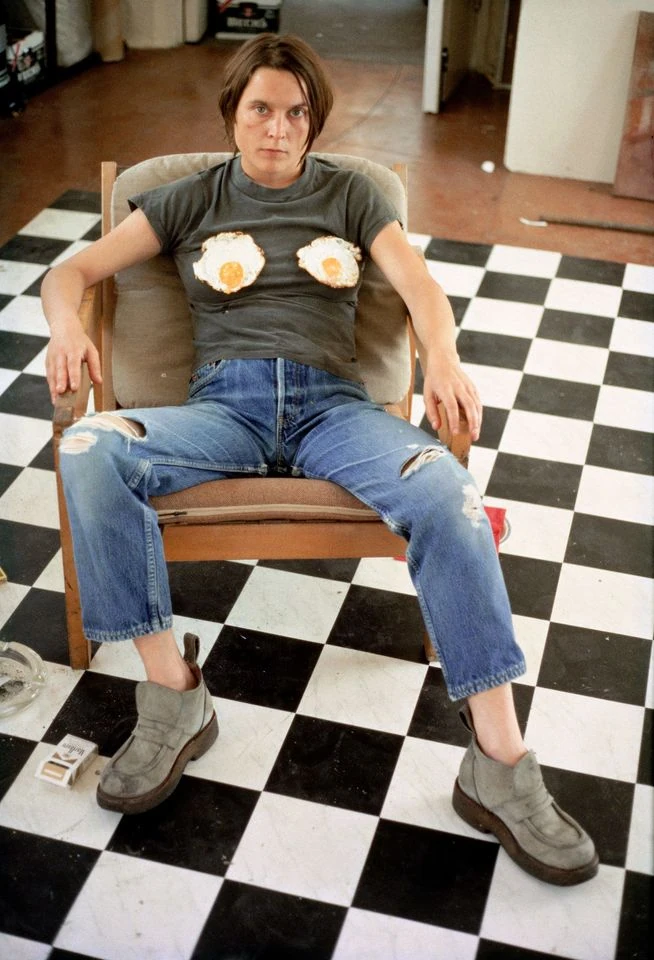
Lucas’s practice includes an ongoing interest in the artist as a subject. Her self-portraits place her own image within the same frank visual language as her sculptures. In Human Toilet Revisited (1998), a colour photograph, she sits on a toilet smoking a cigarette. Cigarettes became material in The Fag Show, her solo exhibition at Sadie Coles in 2000; the exhibition included Self-portrait with Cigarettes (2000). In 2001 she used neon tubes for New Religion, in which a transparent coffin is lit violet. George Michael acquired the work in 2004.
The settings for Lucas’s work have ranged from artist-run spaces to museums and less conventional venues. Her exhibitions included The Law, staged in an empty office building in 1997, and Beautiness, installed in a disused postal depot in Berlin in 1999. In 2000, she made an installation at the Freud Museum called Beyond the Pleasure Principle. A first solo show in New York followed at Barbara Gladstone Gallery in 1995.
Her work appeared in major surveys of British art, including Brilliant!—New Art From London at the Walker Art Center in Minneapolis in 1995, Sensation at the Royal Academy in 1997 and Intelligence—New British Art at Tate Britain in 2000. Tate Liverpool presented the first survey exhibition of her work in 2005–06. In 2013, Whitechapel Gallery in east London hosted a retrospective. These exhibitions brought together work made across different periods and media without reducing it to a single signature object.
Britain on the international stage
Lucas represented Britain at the 56th Venice Biennale in 2015 with I SCREAM DADDIO. It was an international presentation of an artist whose early career had developed through London art schools, artist-run galleries and the Young British Artists exhibitions. The original article also notes her exhibitions at Tate Modern and the New Museum; Wikipedia documents a later New Museum survey, Sarah Lucas: Au Naturel, which opened in 2018 and travelled to the Hammer Museum in Los Angeles in 2019.
Lucas has continued to work across sculpture, photography and installation. At the New Museum, the 2018 exhibition included new works such as This Jaguar’s Going to Heaven, made from a damaged car and collaged with cigarettes, and VOX POP DORIS, a pair of tall, concrete, thigh-high platform boots. The range of those materials continues a career-long habit of taking recognisable things out of their usual context and making their associations newly conspicuous.
Her work has also entered other public and institutional settings. In 2012 she curated Free at the Southbank Centre, an exhibition by the Koestler Trust featuring work by prisoners, detainees and ex-offenders. In 2017, the Legion of Honor in San Francisco invited her to bring a contemporary perspective to an exhibition accompanying its presentation of Auguste Rodin. Tate Britain presented an exhibition of her work in 2023.
Why Sarah Lucas deserves a place in British Legacy
Sarah Lucas’s place in British Legacy rests on a substantial body of work and on the particular way she has made familiar materials carry difficult questions. Her London education and early involvement in exhibitions such as Freeze connect her to a defining period in contemporary British art, but her significance is not simply that she belonged to the Young British Artists. Across sculpture, photography, collage and installation, she has developed an independent visual language: direct, frequently comic and capable of making the viewer reconsider what everyday objects imply about sex, gender and the body.
Her career also shows how British art can move between local beginnings and international exchange. Lucas exhibited in artist-run spaces in London, presented work in museums and galleries across Europe and the United States, and represented Britain at the Venice Biennale in 2015. That trajectory has brought attention to British contemporary art without softening the challenge of her work. Her participation in the 2012 Free exhibition at the Southbank Centre adds another dimension: it placed her curatorial work alongside art made by prisoners, detainees and ex-offenders. Lucas’s legacy lies in the combination of material invention, sharp observation and sustained public reach—not in a general claim to national importance, but in a career whose works have helped make contemporary British art visible, debated and difficult to categorise.
Sources
Sarah Lucas — Wikipedia revision 1372010942
Adapted in part from Sarah Lucas by Wikipedia contributors, under CC BY-SA 4.0. Text has been edited and combined with the existing article; this adapted text is shared under the same licence. Contributor history.