Each April, Stratford-upon-Avon marks the birthday of its best-known native son with a celebration that brings Shakespeare’s work into the town’s streets and theatres. A parade, live performances and workshops are among the event’s features, combining public spectacle with opportunities to encounter the playwright’s words and theatrical traditions.
A celebration rooted in Stratford
Stratford-upon-Avon, in Warwickshire, is closely associated with Shakespeare’s life and work. The celebration centres on that connection: it honours a writer born in the town while welcoming people to take part in a public event there. Its focus is not only commemorative. The programme described for the occasion links Shakespeare’s legacy with performance, participation and the continuing study of his writing.
Shakespeare was born on 23 April 1564 and died on 23 April 1616, according to the account of the celebration. The date gives the annual event its focus, while the town provides its setting. Stratford’s historic streets and the church associated with Shakespeare’s baptism and burial figure in the day’s observances, connecting a contemporary gathering with places linked to his life.
Procession, performances and participation
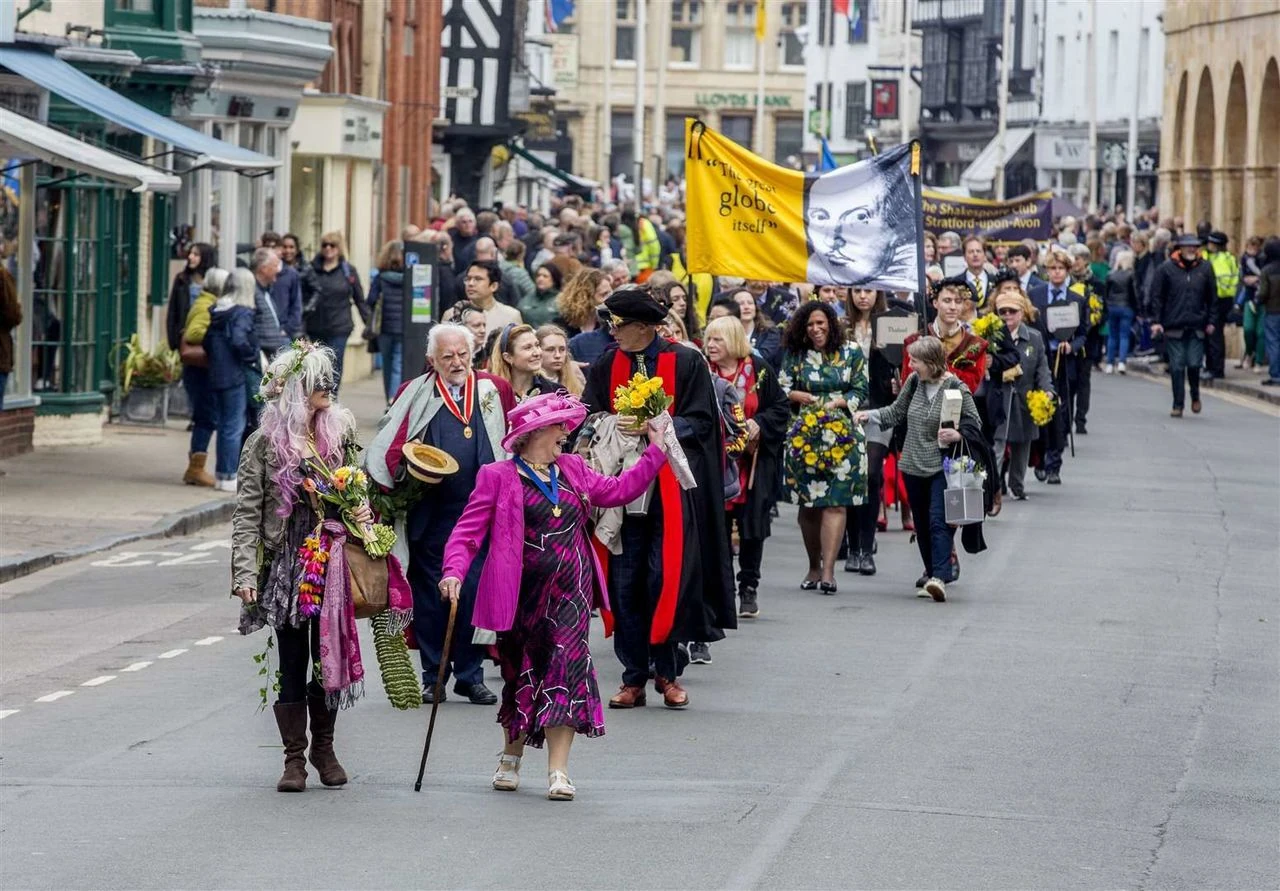
The parade is a central feature. Townspeople, actors, scholars and visitors take part in a procession through Stratford, with participants wearing Elizabethan-style costume. It often ends at Holy Trinity Church, where floral tributes are laid at Shakespeare’s grave. The combination of a public procession and a ceremony at his burial place makes remembrance visible beyond a theatre or classroom.
Performance gives the event another route into Shakespeare’s work. The programme described includes productions by the Royal Shakespeare Company, alongside activity in local theatres and open-air venues. Plays such as Hamlet and A Midsummer Night’s Dream illustrate the range represented: tragedy as well as comedy. Actors also recite passages and soliloquies, bringing familiar writing into a shared, live setting.
Workshops invite visitors to engage with the craft behind the performances. Topics include Elizabethan acting techniques and sonnet writing, with sessions intended for people of different ages. Rather than treating Shakespeare solely as a figure to commemorate, these activities give participants ways to try theatrical and literary forms for themselves. Performance, procession and workshop therefore serve distinct purposes within the same celebration: remembering the writer, presenting his work and encouraging new creative responses.
A local event with an international reach
Shakespeare’s plays have travelled well beyond Stratford. The celebration is presented as a local occasion with a wider cultural context: his works have been translated, studied internationally and adapted for film and books. That reach helps explain why the event attracts visitors from elsewhere, while its setting keeps the focus on the Warwickshire town associated with his life.
The festivities bring together several ways of encountering a writer’s legacy. A procession makes the anniversary a public occasion; performances put the plays back before an audience; and workshops offer practical engagement with acting and writing. The event thus connects a particular place and date with work that continues to be read, performed and adapted. Its significance lies in that combination rather than in a single ceremony or production.
Why Shakespeare’s Birthday Celebration deserves a place in British Legacy
The celebration merits attention because it gives a distinctively local form to a literary legacy with international reach. Stratford-upon-Avon is not simply a backdrop: the event connects Shakespeare’s birth and burial associations with a procession through the town and tributes at Holy Trinity Church. Those details make the annual observance specific to its place, rather than a general event about Shakespeare detached from the landscape associated with his life.
Its programme also brings remembrance together with active engagement. Performances by the Royal Shakespeare Company and other local venues keep the plays in theatrical circulation, while workshops in acting and sonnet writing invite participants to explore creative practices themselves. The celebration therefore serves audiences in more than one way: it offers a public act of commemoration, presents Shakespeare’s writing on stage and opens space for learning and participation. That enduring connection between Stratford, performance and the continuing use of Shakespeare’s work is the event’s particular contribution to Britain’s cultural heritage.