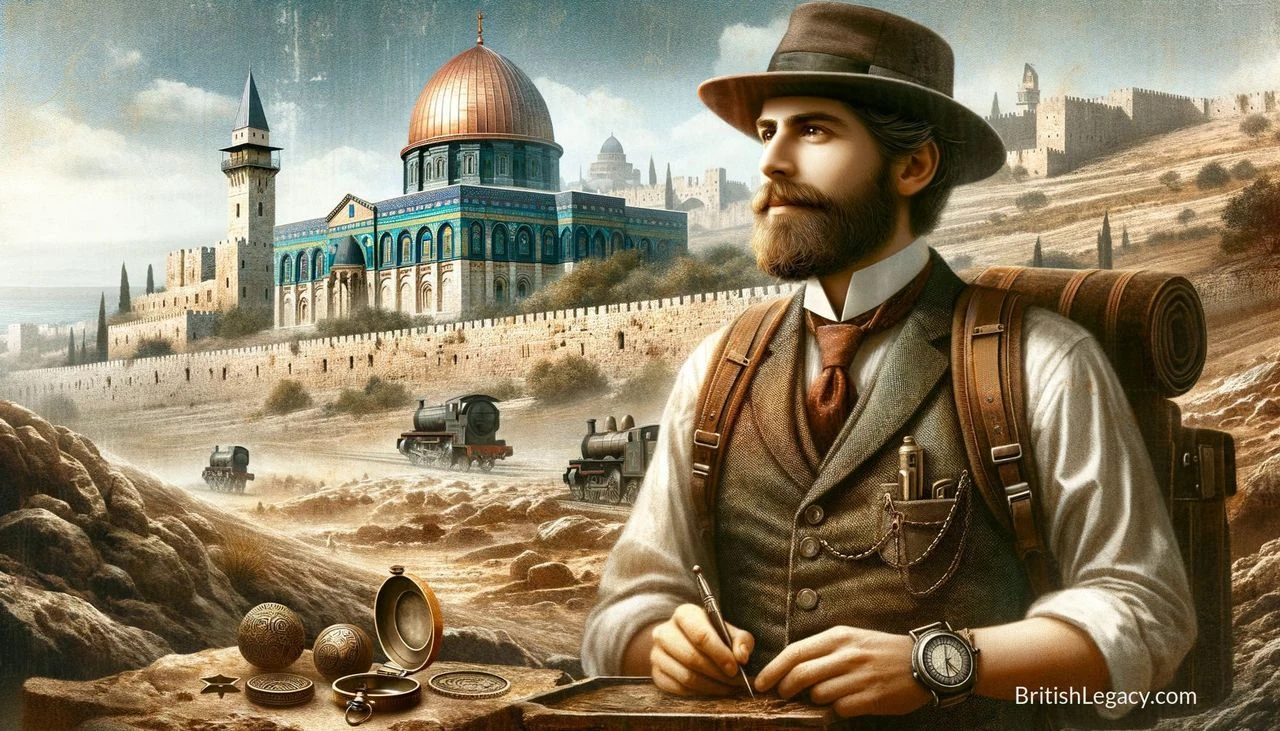
Sir Charles Warren’s career ranged from excavations beneath Jerusalem to command of the Metropolitan Police during the Jack the Ripper murders, and later service in the South African wars. He was a Royal Engineers officer trained in surveying, whose work for the Palestine Exploration Fund helped document the topography and underground structures of Jerusalem. His life also included conspicuous failures: his handling of the police force drew fierce criticism, and his command at Spion Kop during the Second Boer War was judged deeply flawed.
A Welsh-born officer trained to survey
Warren was born in Bangor, Wales, on 7 February 1840, the son of Major-General Sir Charles Warren. He attended Bridgnorth Grammar School and Wem Grammar School in Shropshire, and spent a term at Cheltenham College before studying at the Royal Military College, Sandhurst, and the Royal Military Academy at Woolwich. On 27 December 1857, he received his commission as a second lieutenant in the Royal Engineers. This was the start of a military career that combined engineering and surveying with colonial administration, police leadership and command in war.
Between 1861 and 1865, Warren surveyed Gibraltar. Using trigonometry, he produced detailed scale models of the Rock and its harbour, depicting roads and buildings as well as the landscape. One model was kept at Woolwich; the other is held at the Gibraltar Museum. He went on to teach surveying at the School of Military Engineering in Chatham, and was promoted to captain for this work. Surveying was not a brief prelude to his archaeological career: it provided the practical discipline that shaped much of his later fieldwork.
Excavating Jerusalem and recording its structures
In 1867, the Palestine Exploration Fund recruited Warren to carry out archaeological reconnaissance in the Holy Land, then part of Ottoman Syria. His work at the Temple Mount in Jerusalem became one of the early major excavation projects in the area. Rather than simply searching for objects, Warren’s team investigated shafts and recorded features of the structures below and around the mount. A water shaft now known as Warren’s Shaft and a series of tunnels were among the most notable results.
The work also improved the topographic map of Jerusalem. Warren and his team recorded architectural details at different levels, including features of the Temple Mount’s outer walls, Robinson’s Arch and the Herodian street below it. Their maps were not the last word: the position Warren assigned to Acra, for example, has since been corrected. That continuing revision is part of the history of archaeological survey, not a reason to overlook the value of recording what excavators could see.
Warren also made the first excavations at Tell es-Sultan, the site of Jericho. He returned to Britain in 1870 and wrote about the expedition. His books on the region included The Recovery of Jerusalem (1871), The Land of Promise (1875) and Underground Jerusalem (1876). In 1884, the Palestine Exploration Fund published The Survey of Western Palestine: Jerusalem, written with C. R. Conder, as well as a portfolio of his excavation plans, elevations and sections. These records made his work available beyond the immediate setting of the excavations.
Service in southern Africa and the Palmer investigation
After serving at Dover and Shoeburyness, Warren was appointed in 1876 to survey the boundary between Griqualand West and the Orange Free State. He received the Companion of the Order of St Michael and St George in 1877. During the Transkei War of 1877–78, he commanded the Diamond Fields Horse and was badly wounded at Perie Bush. He was mentioned in despatches and promoted to brevet lieutenant-colonel. He later investigated affairs in Bechuanaland, commanded troops during the Northern Border Expedition and became administrator of Griqualand West in 1879. Warrenton in South Africa’s Northern Cape Province was named after him.
Back in England in 1880, Warren became chief instructor in surveying at the School of Military Engineering. In 1882, the Admiralty sent him to Sinai to establish what had happened to Professor Edward Henry Palmer’s archaeological expedition. Warren found that the expedition members had been robbed and murdered, located their remains and brought those responsible to justice. For this work he was made a Knight Commander of the Order of St Michael and St George in 1883; he also received the Ottoman Order of the Medjidie, Third Class. He was elected a Fellow of the Royal Society in 1884.
In December 1884, Warren was sent as special commissioner to lead an expedition to Bechuanaland. Its purpose was to assert British sovereignty amid competing claims and suppress the Boer freebooter states of Stellaland and Goshen, which the account of the expedition describes as backed by the Transvaal and encroaching on Tswana land and cattle. The force of British and local troops reached its objectives without bloodshed. Warren returned in 1885 and was appointed a Knight Grand Cross of the Order of St Michael and St George. Later that year he stood unsuccessfully as an independent Liberal candidate for Sheffield Hallam, losing by 690 votes.
Scotland Yard and the Ripper murders
Warren became Commissioner of Police of the Metropolis in 1886, after a short appointment to command at Suakin. London’s police force was experiencing strained relations and difficult economic conditions. Warren was concerned about officers’ welfare, including the quality of their boots, but his military approach and reintroduction of drill attracted press derision. His relations with Home Secretary Henry Matthews, the force’s senior officers and its financial administration were poor. During the demonstration known as Bloody Sunday, on 13 November 1887, a large police and military force broke up a protest in Trafalgar Square; the response intensified criticism of Warren in the radical press.
The Jack the Ripper murders became the most enduring controversy of his commissionership. Warren faced blame for the failure to catch the killer, although allegations about the investigation have often been contested. The Home Office, rather than Warren, rejected a proposal to offer a reward. Claims that he assigned too few investigators or favoured uniformed constables over detectives are described as untrue or uncertain in the historical account. Warren published his own views in Murray’s Magazine, including support for vigilante action, and was censured by the Home Office for revealing police operations without permission.
Warren resigned in 1888, shortly before the murder of Mary Jane Kelly, but stayed in post until 1 December while his successor was appointed. His departure followed sustained criticism and conflict within the force; it does not establish that he was responsible for the murderer’s escape. He was appointed a Knight Commander of the Order of the Bath in January 1888. During his tenure he also changed the titles of district superintendents to chief constables and sought to establish a chief constable for the Criminal Investigation Department, a proposal that provoked a dispute with Assistant Commissioner James Monro.
Later commands and an uneven wartime record
After leaving the Metropolitan Police, Warren returned to military service. In 1889 he took command of the garrison in Singapore, where he remained until 1895; he became a major-general in 1893. He later commanded the Thames District and was promoted to lieutenant-general in 1897. In 1899, he presented a challenge shield for a cutter race on the River Medway between Royal Engineers and Royal Navy crews, a connection with the sailing tradition that developed into the Royal Engineer Yacht Club.
At the outbreak of the Second Boer War in 1899, Warren returned to active service to command the 5th Division of the South African Field Force. He was 59 and had limited experience leading troops in battle. In January 1900, he commanded the second attempt to relieve Ladysmith, a flanking movement across the Tugela River. At Spion Kop on 23 and 24 January, delays and indecision contributed to a disastrous defeat. His superior, General Sir Redvers Buller, criticised him, and Warren was recalled to Britain in August 1900. He never again commanded troops in the field.
Warren continued to hold military appointments. He became an honorary colonel of the 1st Gloucestershire Royal Engineers (Volunteers) in 1901, was promoted to general in 1904 and became Colonel-Commandant of the Royal Engineers in 1905. His record, then, cannot be reduced either to the celebrated Jerusalem work or to the failures in London and South Africa: it encompasses technical contributions, public office and serious shortcomings in command.
Scouting, books and final years
From 1908, Warren was involved with Robert Baden-Powell in the creation of the Boy Scout movement. He also had connections with the Church Lads’ Brigade and the 1st St Lawrence Scout Group in Ramsgate, known as Sir Charles Warren’s Own Scouts. His later writing included On the Veldt in the Seventies (1902), The Ancient Cubit and Our Weights and Measures (1903) and The Early Weights and Measures of Mankind (1914), alongside his books on archaeology and Jerusalem.
Warren died of pneumonia, following influenza, at his home in Weston-super-Mare, Somerset, on 21 January 1927. He was 86. After a military funeral in Canterbury, he was buried beside his wife, Fanny Margaretta Haydon, in the churchyard at Westbere, Kent. Their marriage, which began in 1864, produced two sons and two daughters. A biography by his son-in-law, the Reverend Watkin Wynn Williams, appeared in 1941.
Why Sir Charles Warren deserves a place in British Legacy
Warren’s place in British history rests in part on the durable record of his Jerusalem fieldwork. His surveys and excavation plans documented the Temple Mount’s underground features and the city’s topography at a time when archaeological investigation there was still in its early stages. Warren’s Shaft bears his name, while his published accounts and the Palestine Exploration Fund’s portfolio of plans and sections preserve observations that later scholars could examine and revise. His work at Tell es-Sultan and his contribution to the survey of Jerusalem show how engineering skills could serve historical inquiry through measurement, mapping and careful recording.
His British connection is also visible in a career that crossed institutions: the Royal Engineers, the Admiralty, the Metropolitan Police, the Royal Society and the early Scout movement. That range should not be mistaken for unqualified success. His police leadership was contentious, and Spion Kop exposed grave weaknesses in command. Including those failures makes his legacy more useful, not less: Warren’s story joins the value of systematic documentation to the risks of authority exercised under pressure. For British Legacy, he is a figure through whom readers can explore both Britain’s role in nineteenth-century archaeology and the complicated consequences of British military and administrative power abroad.
Sources
Charles Warren — revision 1379832340 · Charles Warren
Adapted in part from Charles Warren by Wikipedia contributors, under CC BY-SA 4.0. Text has been edited and combined with the existing article; this adapted text is shared under the same licence. Contributor history.