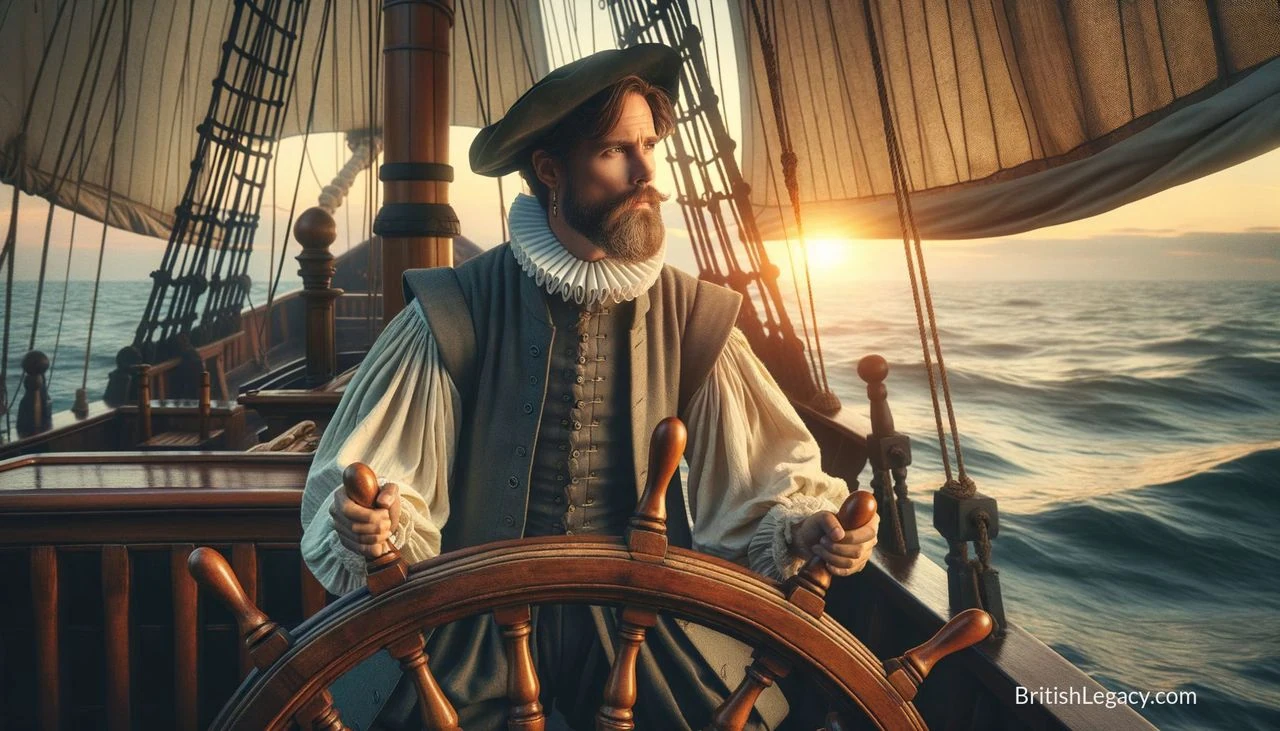
In 1594, after sailing from England to the South American coast in the galleon Dainty, Richard Hawkins surrendered to Spanish forces. He had been wounded, 27 of his men had been killed, and his vessel was nearly sinking. The defeat was a turning point in a career that had already taken him from service against the Spanish Armada to an expedition across the South Sea. Hawkins was an English seaman, explorer and privateer whose voyages and later account of them belong to the history of Elizabethan maritime ambition.
A seafaring family and early service
Born around 1562, Hawkins was the son of Admiral Sir John Hawkins. He was familiar with ships and the sea from an early age. In 1582 he accompanied his uncle, William Hawkins, to the West Indies; three years later, he served as captain of a galliot on Francis Drake’s expedition to the Spanish Main. These journeys placed him within the seafaring networks of a family and an era closely associated with England’s expansion into Atlantic waters.
Hawkins’s career included service for the Crown as well as voyages overseas. In 1588 he commanded a queen’s ship against the Spanish Armada. In 1590 he joined his father’s expedition off the coast of Portugal. Such appointments gave him experience in royal service before his most ambitious independent voyage. His later reputation as an explorer should therefore be understood alongside his work as a naval commander and privateer, rather than as the story of a traveller removed from the conflicts of his age.
The Dainty and the South Sea expedition
In 1593 Hawkins purchased the Dainty, a galleon originally built for his father and intended for discovery. He sailed for the West Indies, the Spanish Main and the South Seas. The expedition’s purpose is not entirely straightforward: Hawkins later described it as geographical discovery, while the account of his plans also points to an intention to prey on Spain’s overseas possessions. His voyage thus combined exploration with the risks and rivalries of privateering.
After visiting the coast of Brazil, the Dainty encountered a storm near the mouth of the Strait of Magellan and was blown east. On 2 February 1594, Hawkins sighted land he had not expected to see so soon. He named it Hawkins Maidenland, describing it in honour of Elizabeth I; it is now known as the Falkland Islands. He then returned towards the South American mainland and passed through the Strait of Magellan, eventually reaching Valparaíso. There the expedition plundered the town before continuing north.
In June 1594, about a year after leaving Plymouth, Hawkins reached the Bay of San Mateo, at the mouth of the Esmeraldas River in what is now Ecuador. Two Spanish ships attacked the Dainty. Hawkins’s crew resisted, but the English vessel was badly damaged. Wounded and facing the deaths of 27 of his men, Hawkins surrendered on 1 July. He did so on the promise that he and his crew would be given safe conduct out of the country; that promise was not kept.
Captivity, office and a seaman’s account
In 1597 Hawkins was sent to Spain, where he was imprisoned first in Seville and then in Madrid. He was released in 1602 and returned to England. The following year he was knighted and elected mayor of Plymouth, linking his overseas experience to civic life in the port city from which he had sailed.
In 1604 Hawkins became Member of Parliament for Plymouth and Vice-Admiral of Devon. The latter role brought responsibilities in a period when piracy was a serious problem along the coast. English privateering had been prohibited in 1603, but the transition did not make enforcement simple. Hawkins was reportedly more sympathetic to English pirates than to their often-Spanish victims, and he rarely brought them to trial, instead taking their loot or selling them a discharge before releasing them. He held the vice-admiralty until 1610, apart from a short suspension between August 1606 and April 1607.
Hawkins was also among the 557 founding members named in the Spanish Company’s charter of 1605. In 1620–21 he served as vice-admiral under Sir Robert Mansell in a fleet sent to the Mediterranean against the Algerian corsairs. He died in London on 17 April 1622.
His account of the South Sea voyage, published in 1622 as Voiage into the South Sea, preserves his perspective on the expedition. It was republished by the Hakluyt Society in 1847 and later reworked by Charles Kingsley in Westward Ho! (1855). Hawkins’s account did not present the Spanish only as enemies: he described Spaniards in the Americas as “temperate” and “gentle”. The work is therefore both a record of a hazardous voyage and a window on how its English author represented the people and places he encountered.
Seafaring knowledge and the limits of the record
Hawkins also wrote about the use of citrus fruit against scurvy. During the voyage he observed the apparent efficacy of sour oranges and lemons, calling their value a “wonderful secret” and a remedy for the disease. His observation preceded James Lind’s later association with establishing the benefits of citrus. The available account does not make Hawkins the author of a clinical test or establish the extent to which his advice was adopted; it records his conviction that the fruit helped sailors.
That detail sits naturally beside the practical demands of his voyages. Long-distance sailing exposed crews to illness, storms and uncertain routes, while encounters with Spanish ships could turn an expedition into a fight for survival. Hawkins’s written observations bring together those hazards and the navigational experience gained at sea. They also require care in interpretation: his own later explanation of the voyage as geographical exploration sits beside evidence of privateering aims, and neither aspect alone describes the whole undertaking.
Why Sir Richard Hawkins deserves a place in British Legacy
Hawkins merits a place in British Legacy because his career shows how Elizabethan seafaring combined several roles that are often treated separately. He served the Crown against the Spanish Armada, travelled with Drake, commanded an expedition of his own, and later held civic and maritime offices in Plymouth and Devon. His experience makes visible the connections between naval service, privateering, overseas commerce and local government in a period when England’s maritime reach was expanding.
His South Sea voyage left a specific record of that expansion: the sighting and naming of the Falkland Islands, the passage through the Strait of Magellan, and the eventual defeat and capture of the Dainty’s crew off the coast of present-day Ecuador. The account published as Voiage into the South Sea carried those experiences into print and continued to circulate through later editions and adaptation. Hawkins’s observations on citrus and scurvy also preserve a practical piece of early seafaring knowledge, without requiring claims beyond what he recorded. Remembering him means recognising both the ambition and the violence of voyages directed at Spanish possessions, as well as the civic responsibilities and written testimony that followed. That complexity makes his life more illuminating than a simple celebration of exploration.
Sources
Adapted in part from Richard Hawkins by Wikipedia contributors, under CC BY-SA 4.0. Text has been edited and combined with the existing article; this adapted text is shared under the same licence. Contributor history.