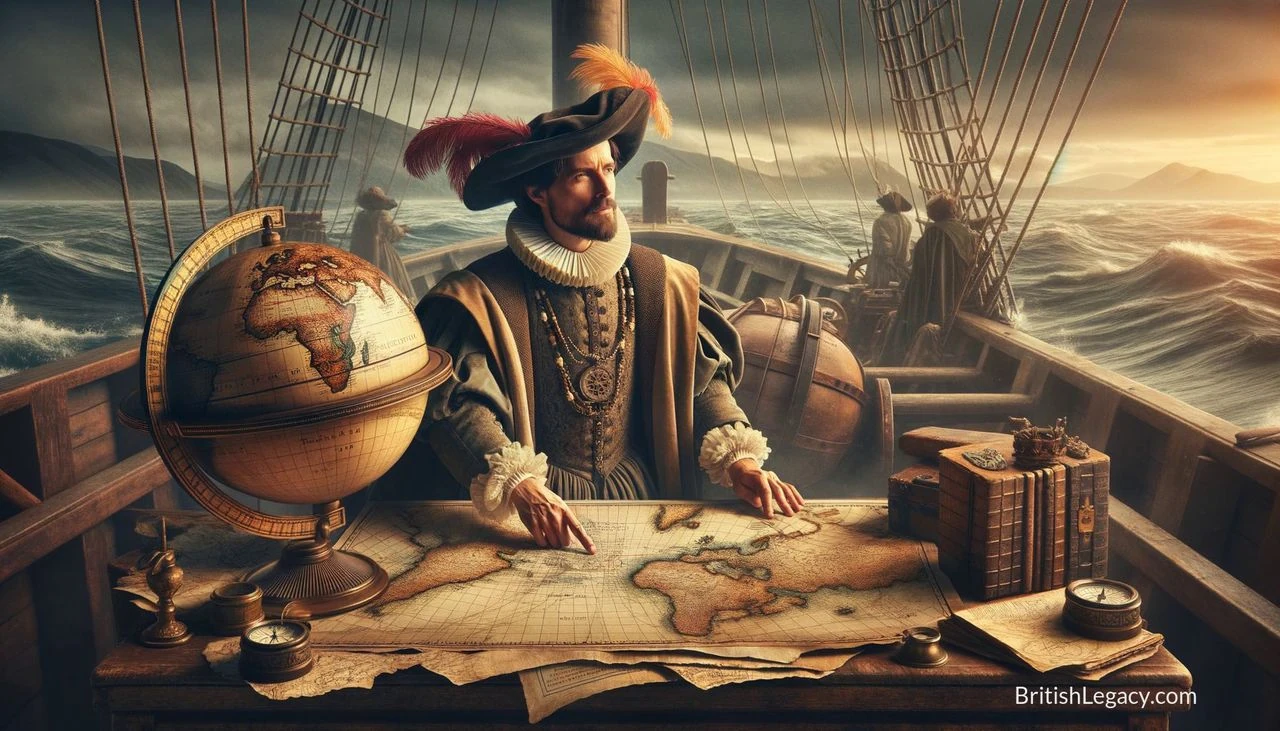
Robert Dudley’s life crossed two very different worlds. The son of one of Elizabeth I’s most prominent courtiers, he led an English expedition across the Atlantic in 1594. After failing to establish his legitimacy in court, he left England for good and made a career in Tuscany as an engineer, shipbuilder and author. His lasting achievement, Dell’Arcano del Mare, brought together sea charts and practical knowledge of navigation and shipbuilding in a work whose reach extended beyond the Americas.
A courtier’s son with an uncertain inheritance
Dudley was born at Richmond Palace on 7 August 1574, the son of Robert Dudley, 1st Earl of Leicester, and Douglas Sheffield. His parents were not married, and his legitimacy would later become central to his fortunes. His father was a favourite of Queen Elizabeth I and provided his son with an excellent education. Dudley entered Christ Church, Oxford, in 1587, recorded as the son of an earl.
When Leicester died in 1588, his will left Dudley a substantial inheritance, including Kenilworth Castle. That inheritance did not give him the title he would later seek, but it gave him a position and resources of his own. In 1591 he married Margaret Cavendish in secret; she soon died without children. The marriage briefly brought him into conflict with the Queen, but he was soon back at court.
The 1594 expedition
In 1594, Dudley assembled a fleet for an expedition against Spanish interests in the Atlantic. Queen Elizabeth did not approve his original plans, but commissioned him as a general and directed him towards Guiana. The fleet sailed in November, then a storm scattered its ships. Dudley continued with part of the force, despite losing the Earwig and struggling to find suitable targets.
After capturing Spanish ships near Tenerife, Dudley’s expedition reached Trinidad in January 1595. He claimed an island for the English crown and named it Dudleiana. A journey up the Orinoco in search of a gold mine came to nothing when the guide deserted the party. The fleet later captured a Spanish merchant ship and encountered a Spanish man-of-war on its return voyage. Dudley outmanoeuvred and damaged the warship in a two-day battle, but did not board it. He reached St Ives in Cornwall at the end of May; one of his captains had captured three ships.
The following year Dudley served as commander of the Nonpareil in the expedition against Cádiz led by Robert Devereux, Earl of Essex. He was knighted for his conduct there, though the details of his actions are not recorded in the article. He later married Alice Leigh. In 1597, he sent a trading fleet towards China; its ships did not return.
A failed case, and a new life in Tuscany
In 1603 Dudley began trying to prove that his parents had secretly married, which would have strengthened his claim to the earldoms of Leicester and Warwick and to further family estates. The case was heard by the Star Chamber in 1604–05. His mother supported the claim, but the court rejected the evidence, fined several witnesses and concluded that Dudley had been deceived by Thomas Drury. King James I confirmed the judgement.
Dudley left England in 1605 with Elizabeth Southwell, his cousin and lover. The two converted to Catholicism, and married in Lyon the following year after receiving a papal dispensation. Since Dudley’s marriage to Alice Leigh was still recognised under English law, the second marriage was regarded there as bigamous. James I ordered him to return and provide for his wife and family. Dudley refused; he was declared an outlaw and his English estate was confiscated.
In Florence, Dudley found a new working life in the service of the Medici grand dukes. He designed and built warships for the arsenal at Livorno, advised Grand Duke Ferdinand I on naval affairs and undertook engineering projects in Tuscany. These included work on Livorno’s breakwater and harbour defences, draining swamps and building a palace in Florence. He also designed galleys and wrote about navigation and seamanship.
His connections with England did not end immediately. Dudley corresponded with Henry Frederick, Prince of Wales, on navigation and shipbuilding, and in 1611 tried to arrange a marriage between the prince and a daughter of the Grand Duke of Tuscany. He also negotiated over Kenilworth Castle, which the prince wanted to buy. The proposed payment was not completed before Henry’s death in 1612, and the subsequent settlement of the estate was complicated.
Charting the sea
Dudley’s most substantial work was Dell’Arcano del Mare, or The Secrets of the Sea. Published in Florence in six volumes, it combined a treatise on navigation and shipbuilding with a collection of 130 sea charts. Dudley created the charts himself rather than copying existing maps, an unusual approach for the period. They covered the world’s seas and included an early use of the Mercator projection. The atlas also set out a proposed fleet of ships in five sizes, designed and described by Dudley.
The work gathered contemporary knowledge of navigation, shipbuilding and astronomy into a single ambitious project. Dudley had developed his expertise through practical service as an expedition leader, engineer and naval adviser; the atlas gave that knowledge a form that could be studied and used beyond the Tuscan court. He also prepared a maritime directory for the Tuscan navy, although it was not published.
Dudley’s final years were marked by more disputes over titles and inheritance. In 1644 Charles I recognised his legitimacy and made his second wife, Alice, Duchess of Dudley for life, but did not restore Dudley’s English titles or estate. Dudley died at Villa Rinieri, outside Florence, on 6 September 1649, and was buried at San Pancrazio in Florence. His scientific instruments later formed part of a collection displayed at the Museo Galileo in that city.
Why Sir Robert Dudley deserves a place in British Legacy
Dudley’s place in British Legacy rests on a career formed in England but completed in Italy. His early expeditions belonged to the maritime world of Elizabethan England: in 1594 he led a fleet across the Atlantic, reached Trinidad and returned to Cornwall after an uneven voyage of capture, loss and combat. His career also shows how closely exploration was bound to the politics of the period. The failed claim to his father’s titles and the confiscation of his estate ended his English career, but did not end his work as a navigator and engineer.
In Tuscany, Dudley turned practical experience into an unusually broad body of work. He designed warships, advised a grand duke, worked on harbour and drainage projects, and produced an atlas that joined charts to instruction in navigation and shipbuilding. Dell’Arcano del Mare is a specific and enduring achievement: its 130 original charts covered the world’s seas, while its text gathered knowledge useful to sailors and ship designers. His story belongs in a British account not because every part of his later life took place in Britain, but because his English upbringing, expedition and contested inheritance shaped the path that carried his expertise abroad. The resulting legacy connects English exploration with European engineering and cartography.
Sources
Robert Dudley (explorer), revision 1373917781
Adapted in part from Robert Dudley (explorer) by Wikipedia contributors, under CC BY-SA 4.0. Text has been edited and combined with the existing article; this adapted text is shared under the same licence. Contributor history.