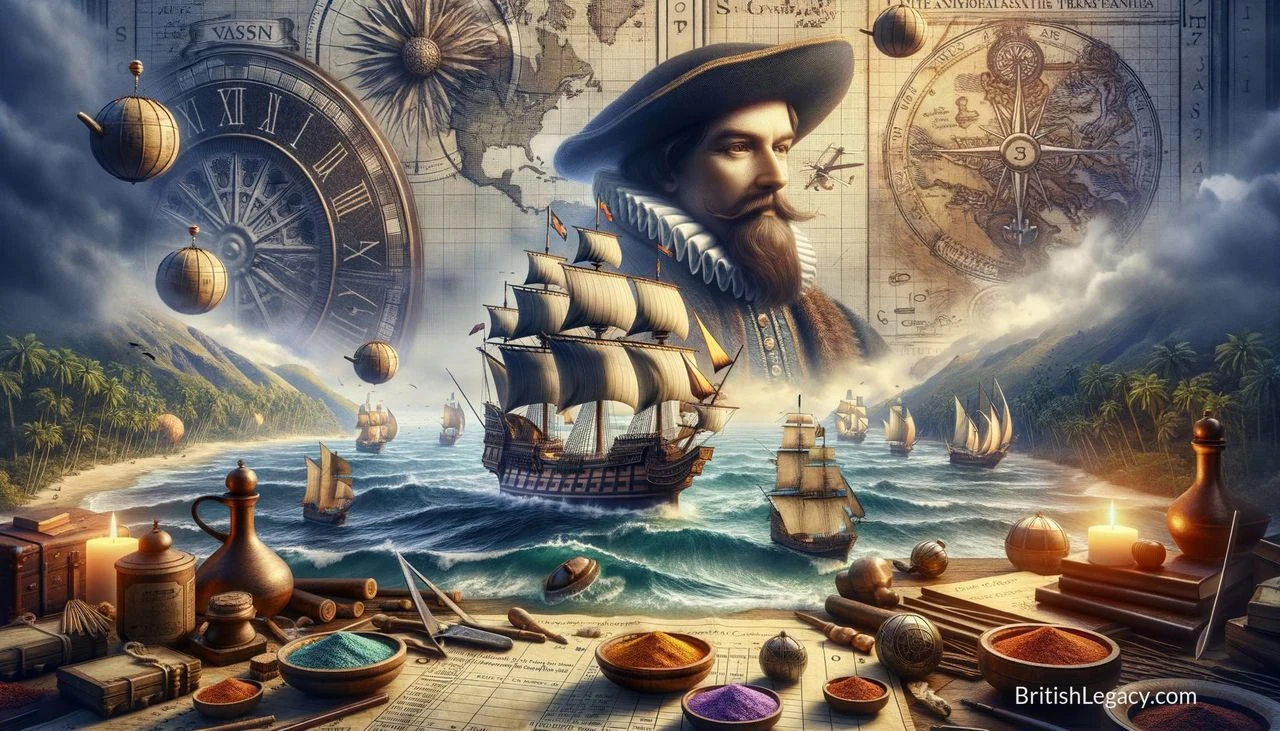
Sir James Lancaster’s career joined privateering, long-distance trade and the early expansion of the East India Company. His 1591 voyage to the East Indies was an arduous failure in human terms: after ships were lost and the crews pressed to return, only 25 officers and men survived to reach England. A decade later, he commanded the Company’s first voyage, establishing an alliance with Aceh and a trading factory at Bantam in Java. He also made an early recorded attempt to prevent scurvy at sea by giving his crew lemon juice. These episodes reveal not a simple story of inevitable British maritime dominance, but the difficult, risky beginnings of English trading ventures overseas.
A merchant before the voyages
Lancaster was born around 1554 and came from Basingstoke in Hampshire. He was brought up in Portugal as a merchant and soldier, then returned to England in 1587. In London he worked for the merchant Thomas Cordell and commanded Cordell’s ship, the Edward Bonaventure. In 1588, that vessel sailed with the fleet opposing the Spanish Armada, under Sir Francis Drake.
This experience connected Lancaster’s commercial work with the naval conflict of Elizabethan England. He would later command expeditions that mixed trading ambitions with armed force. His voyages were not simply exploratory journeys: they sought access to valuable goods and operated in a world where English merchants competed with established Portuguese interests and where ships might seize enemy cargoes.
The disastrous voyage of 1591
On 10 April 1591, Lancaster sailed from Torbay with George Raymond and Samuel Foxcroft on what became his major early voyage to the East Indies. The three ships were the Penelope, the Marchant Royal and the Edward Bonaventure. The fleet reached Table Bay on 1 August. After losing one ship off Cape Correntes, the remaining squadron stopped to rest and refit at Zanzibar in February 1592, then rounded Cape Comorin and reached Penang in June.
Lancaster remained at Penang until September and made a journey to the mainland, where the expedition encountered Orang Asli people. The voyage continued to Ceylon, but the crews insisted on returning home. The journey back was disastrous. Only 25 officers and men survived to reach England in May 1594; Lancaster himself arrived at Rye on 24 May. The expedition had not made him rich through a successful trading network, but it became one of the early English attempts to reach the Indian Ocean by sea. Along with Ralph Fitch’s overland explorations and trading, it helped make the case for a company-backed expedition.
Privateering and the Company’s first expedition
In 1594, Lancaster led a privateering expedition against Pernambuco and Recife in Brazil. It aimed to seize the cargo of a Portuguese carrack damaged by a storm while returning from India. The expedition captured the town and held it for several weeks, with Dutch traders joining the effort. Lancaster’s force took the carrack’s cargo and local produce, including Brazil-wood, a source of red dye used in the woollen textile industry. The episode shows how trade, armed seizure and maritime competition could overlap in the period.
In 1600, Lancaster was appointed to command the East India Company’s first voyage. The fleet of four ships sailed from Torbay on 22 April 1601, with Lancaster aboard the Red Dragon. He also carried credentials as Queen Elizabeth’s special envoy to rulers in the East. After rounding the Cape of Good Hope on 1 November 1601, the expedition visited the Nicobar Islands, Sumatra and Java.
At Aceh, Lancaster established an alliance. At Bantam in Java, the Company set up its first factory, or trading station, and sent a commercial mission to the Moluccas. The voyage also included the seizure and looting of a large Portuguese galleon. Lancaster returned to England in September 1603 after a swift and prosperous homeward passage. In October, James I knighted him. The expedition’s commercial and diplomatic achievements gave the newly chartered Company a practical foothold in the region, though they should not be confused with the much later reach of British rule in Asia.
Lemon juice, leadership and later ventures
Lancaster’s name is also associated with an early use of citrus to prevent scurvy. On the 1601 voyage, he gave the men aboard the Red Dragon three spoonfuls of bottled lemon juice each morning. By the time the fleet reached Table Bay in September, scurvy had badly affected the men on the other three ships; Lancaster’s crew were in better health and helped bring the others into harbour. He later spent time in Madagascar obtaining more lemon juice and other citrus. The Admiralty received his report, but the general provision of lemon juice to sailors did not become mandatory until 1795.
After returning from the voyage, Lancaster remained an influential figure in the Company. He continued as one of its chief directors until his death in June 1618. Early Stuart voyages to India and expeditions seeking the Northwest Passage were undertaken under his sponsorship and direction. In 1616, the explorer William Baffin named Lancaster Sound, the entrance to the Northwest Passage on the north-west side of Baffin Bay, after him.
A charitable provision in his will
Lancaster’s will, dated 18 April 1618, established two charitable trusts administered by the Skinners’ Company. One was intended to benefit officials and poor people in Basingstoke. A court order transferred it to Basingstoke Corporation in 1717. The other trust supported poor students of divinity at Oxford and Cambridge; the Skinners’ Company continues to provide grants to such students.
These provisions offer a different measure of his legacy from the voyages and commercial ventures. His work helped create opportunities for English merchants overseas, while his will directed resources towards people in his home town and students pursuing religious study. The trust for divinity students outlasted Lancaster by centuries, linking his name to continuing charitable support as well as to maritime history.
Why Sir James Lancaster deserves a place in British Legacy
Lancaster’s place in British history rests on specific work at a formative point in English overseas trade. His 1601 expedition was the East India Company’s first, and it established an alliance with Aceh and a trading station at Bantam. These were practical beginnings: a diplomatic relationship and a base from which the Company could pursue commerce. Lancaster’s earlier voyage, although marked by catastrophic loss of life, also formed part of the experience that helped make a later company-backed expedition possible. His career shows how the growth of English trade depended on difficult voyages, commercial planning and negotiation, but also unfolded amid privateering and armed seizure.
His association with lemon juice adds a further, concrete dimension. Lancaster took bottled lemon juice on the 1601 voyage and gave it regularly to his crew; the difference in their health compared with the other ships became an early demonstration of its value against scurvy. The later adoption of lemon juice throughout the Royal Navy came much later, but his experiment belongs to the history of maritime health. Lancaster’s legacy also extends beyond the sea: the charitable trusts established by his will supported people in Basingstoke and students at Oxford and Cambridge, with one student grant continuing through the Skinners’ Company. Together, these achievements connect English exploration and trade with practical care for sailors and lasting charitable provision.
Sources
James Lancaster — Wikipedia, revision 1361174564 · James Lancaster — Wikipedia
Adapted in part from James Lancaster by Wikipedia contributors, under CC BY-SA 4.0. Text has been edited and combined with the existing article; this adapted text is shared under the same licence. Contributor history.