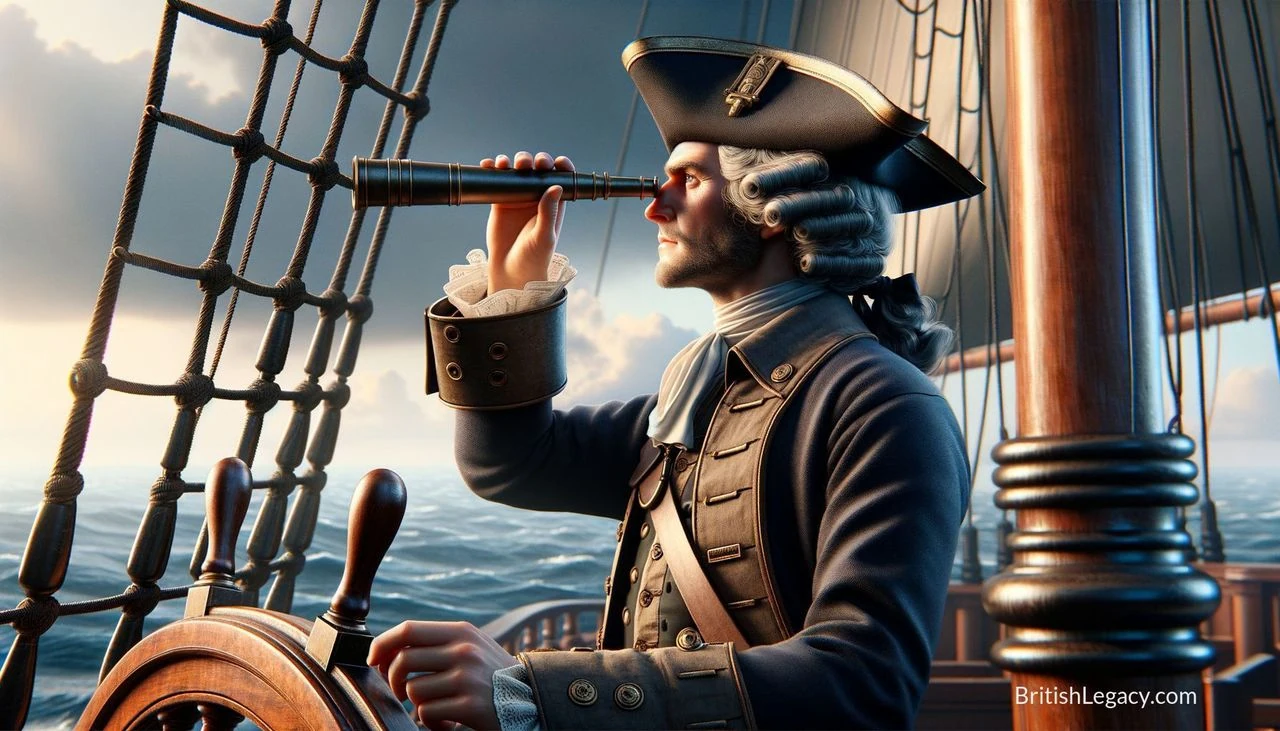
Sir William Penn’s career moved between causes and regimes. He fought for Parliament in the English Civil War, served Oliver Cromwell’s Commonwealth at sea, and returned to public office after the restoration of Charles II. A skilled naval commander and later a member of Parliament, he also helped formulate tactical instructions for the English navy. His connection to Pennsylvania came not through a grant to him, but through the land awarded to his son in settlement of money owed by the Crown to his father. The colony’s name would preserve the admiral’s instead.
A Bristol seaman in turbulent times
Penn was born in Bristol on 23 April 1621, in St Thomas parish, to Captain Giles Penn and Joan Gilbert. His father was an English military officer and consul of Salé, Morocco; William served his apprenticeship at sea with him. The record supports a maritime upbringing, though it does not establish the more specific claim that he began a naval career at 15.
During the First English Civil War, fought from 1642 to 1646, Penn served the Parliamentary side. He commanded a ship in the squadron operating against Charles I in the Irish seas. In 1648 he was arrested and sent to London, then released and returned to service as rear-admiral aboard Assurance. The reason for his arrest is not known. The account of his career describes him as maintaining contact with Royalists while continuing to serve whichever government offered him employment, a reminder that military advancement in this period could involve political calculation as well as seamanship.
After 1650 he commanded the southern fleet in the Atlantic and Mediterranean, pursuing Royalists under Prince Rupert. Following an action at Macroom in County Cork, he received Macroom Castle. Penn later claimed that he had not set foot ashore for more than a year before returning home on 18 March 1651.
War at sea and a changing allegiance
In the First Anglo-Dutch War (1652–54), Penn commanded squadrons at the battles of the Kentish Knock, Portland, the Gabbard and Scheveningen. At Scheveningen in 1653, a sniper from his ship killed the Dutch admiral Maarten Tromp aboard the Brederode. Penn’s service was not confined to naval battles between European powers: in 1654, after offering to take his fleet over to Charles II, he accepted command of Cromwell’s expedition to the West Indies.
The expedition’s 1655 attack on the Spanish colony of Hispaniola failed. The account attributes the repulse at Santo Domingo to panic among the troops, rather than to Penn. The English force did, however, seize Jamaica, where Penn established the Jamaica Station. On his return, he and his military colleague Robert Venables were sent to the Tower. Penn made a submission and, after release, retired to estates in Ireland that he had received from confiscated lands.
Penn was knighted at Dublin Castle by Henry Cromwell on 20 December 1658. That Protectorate honour passed into oblivion at the Restoration in 1660; it is therefore misleading to date his knighthood to that year. The distinction matters in a life repeatedly reshaped by changes in government: Penn’s service under Parliament and the Protectorate preceded his renewed position under the restored monarchy.
Public office and the navy’s fighting instructions
In April 1660 Penn was elected for Weymouth and Melcombe Regis and sat in the Convention Parliament. In May he was aboard the Naseby, the Earl of Sandwich’s ship sent to bring Charles II back to England from exile in Amsterdam. During the voyage Penn made the acquaintance of the Duke of York, soon to become Lord High Admiral. He was re-elected for Weymouth and Melcombe Regis in 1661 and served as a commissioner of the Navy Board from 1660.
His political return did not end his naval service. In the Second Anglo-Dutch War he was flag captain under the Duke of York at the Battle of Lowestoft in 1665, and later that year became admiral of a fleet sent to intercept Michiel de Ruyter, despite suffering from gout. His practical experience also informed naval organisation. In 1653, as admiral and General at Sea for Parliament, he helped draw up Duties of a Commander at Sea, a code of tactics for the English navy. Penn advocated fighting in line ahead, a formation intended to bring the fleet’s firepower to bear. The instructions became the basis for the Duke of York’s later sailing and fighting instructions.
Penn’s record has a less flattering contemporary witness in Samuel Pepys, his colleague at the Navy Board and neighbour in Seething Lane. Pepys repeatedly criticised him in his diary, although the account notes that such judgements should be read with an awareness of Pepys’s apparent jealousy. His entries were not uniformly dismissive: after discussing the lessons of the Four Days’ Battle with Penn in July 1666, Pepys wrote that he had never taken more pleasure in hearing anyone discourse. Together, the diary and Penn’s naval record show both the friction of office and the professional respect his knowledge could command.
How the admiral’s name reached Pennsylvania
Penn did not receive the American land grant described in the earlier account. After his death, his son William accepted a grant of land in the American colonies in lieu of money owed by the Crown to his father. It was the son who shaped the colony’s name. He proposed “Sylvania”; the Council added “Penn” to honour the late admiral. William Penn protested, but ultimately accepted the name. The son, not the admiral, founded the Province of Pennsylvania, and the religious-freedom and democratic principles associated with that project belong to his colonial enterprise rather than to a personal colonial administration by his father.
William Penn the admiral died on 16 September 1670 at Walthamstow, Essex, aged 49. He was buried at St Mary Redcliffe in Bristol. His helmet and half-armour, together with banners from Dutch ships captured in battle, were hung in the church. His story also survives in Samuel Pepys’s diary and in the colony that bears his name, though those traces record different aspects of his life: naval service, public dealings and a family legacy shaped after his death.
Why Sir William Penn deserves a place in British Legacy
Penn’s place in British history rests on identifiable work, not on a sweeping claim that he single-handedly made Britain a maritime power. He commanded fleets during the Civil War and the Anglo-Dutch conflicts, served in the West Indies expedition and held office at the Navy Board. Most significantly, his contribution to the 1653 tactical code helped establish instructions later used as the basis for the Duke of York’s sailing and fighting rules. His advocacy of line-ahead fighting reflected a practical concern: arranging ships to concentrate their guns. The combination of command experience and written guidance gives his naval reputation a specific foundation.
His British connection is also visible in the course of his public life. Born in Bristol, he served successive English governments through civil conflict and the Restoration, represented Weymouth and Melcombe Regis in Parliament, and was buried in his native city. The Pennsylvania connection should be told accurately: the admiral did not found the colony or receive its land grant. His son accepted the grant owed to his father, and the Council attached the admiral’s name to the son’s preferred “Sylvania”. That distinction makes the legacy more, not less, revealing. Penn’s name travelled across the Atlantic through the consequences of his career and the decisions of his family, while his own most direct achievement remained his service to England’s navy.
Sources
William Penn (Royal Navy officer), revision 1379821102 · William Penn (Royal Navy officer)
Adapted in part from William Penn (Royal Navy officer) by Wikipedia contributors, under CC BY-SA 4.0. Text has been edited and combined with the existing article; this adapted text is shared under the same licence. Contributor history.