
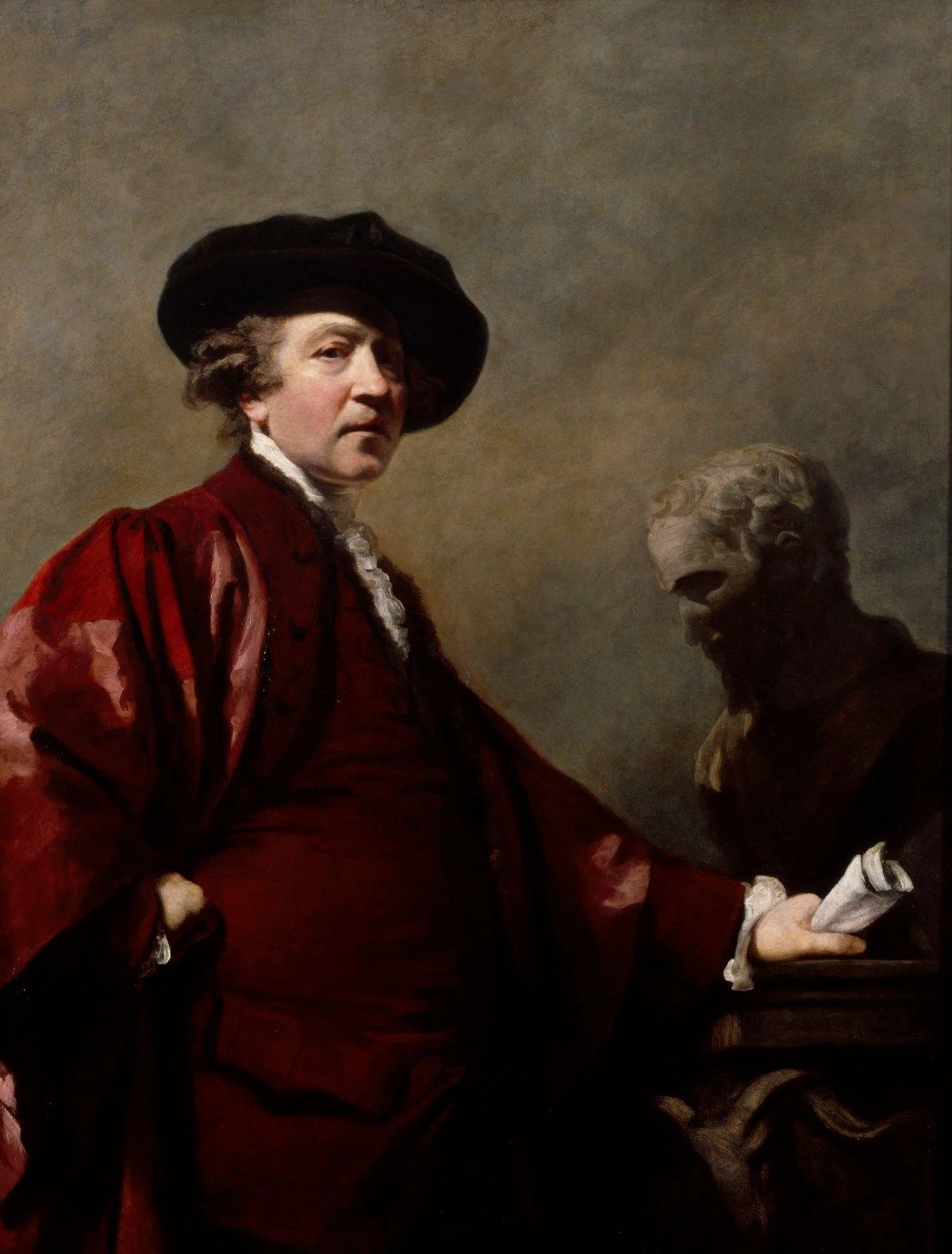
Sir Joshua Reynolds built a career on portraits, but his ambitions extended beyond likeness. He sought to give painting the intellectual standing of the older arts, promoted what he called the Grand Style and became the first president of the Royal Academy of Arts. His paintings brought him close to the political and social figures of his day; his lectures set out principles for artists who would follow. The two strands of his work—making pictures and arguing for the place of art—helped shape British painting in the eighteenth century.
A Devon upbringing and a London apprenticeship
Reynolds was born in Plympton, Devon, on 16 July 1723, the third son of the Reverend Samuel Reynolds, master of the town’s free grammar school. His sister Mary Palmer, who was interested in drawing, helped support his training. In 1740 she contributed towards the premium for his apprenticeship with Thomas Hudson, a fashionable London portrait painter. Reynolds studied with Hudson for four years, though he left in 1743 and began working as a portrait painter in Plymouth Dock, now Devonport.
After his father died in 1745, Reynolds lived in Plymouth Dock with his sisters. His career took a decisive turn when Commodore Augustus Keppel invited him aboard HMS Centurion in 1749 for a Mediterranean voyage. Reynolds visited ports including Lisbon, Cádiz and Algiers before travelling from Minorca to Italy. He spent two years in Rome studying earlier masters and developing his interest in the Grand Style. He returned to England in October 1752, then established himself in London the following year.
Success came quickly. Reynolds painted aristocrats and other prominent sitters, moving in circles that included Samuel Johnson, Edmund Burke, Oliver Goldsmith and David Garrick. His practice was exceptionally busy: during the social season in the late 1750s, he could receive five or six sitters a day. He used assistants and specialist painters for some elements of portraits, including clothing, while concentrating his own efforts on the parts of the work he considered most important.
Portraits, patrons and the Grand Style
Reynolds worked in several formats, from large, full-length portraits to smaller likenesses and character studies. The Grand Style aimed to raise the treatment of a subject through idealisation, drawing on the example of earlier art rather than relying on literal description alone. Reynolds’s approach was not simply a matter of polish: he adapted poses from earlier painters and experimented with composition and materials throughout his career.
His portraits could also engage with the public events surrounding their sitters. In his 1787 portrait of George Augustus Eliott, Baron Heathfield, Reynolds showed the military commander holding a key associated with Gibraltar, which he had defended during the Great Siege. In his portrait of Augustus Keppel, he placed the admiral’s hand on his sword, a gesture that referred to Keppel’s acquittal at court martial. Such choices gave portraits a meaning beyond the appearance of the person depicted.
Reynolds’s work included portraits of children and subjects drawn from literature and history. The Age of Innocence, a character study of a child painted in 1788, became one of his best-known works, although the child’s identity is uncertain. His portrait of the actress Sarah Siddons as the Tragic Muse made a different kind of statement, presenting a celebrated performer through the elevated, theatrical language associated with his approach. The Wikipedia article’s gallery dates the painting to 1789; the earlier article gives 1784, so the published account follows the former.
Reynolds’s studio produced a large body of work. The Wikipedia account describes a lifetime output of more than 2,000 paintings, while also noting that only a smaller group stands out for success, originality or influence. The scale of the practice reflects both his standing with patrons and the organisation needed to meet demand. In 1760 he moved to a large house at Leicester Fields, now Leicester Square, where he could display paintings and accommodate assistants.
The Royal Academy and the case for art
Reynolds helped establish the Royal Academy of Arts and became its first president in 1768, holding the office until his death. He was knighted by George III in 1769, the second English artist to receive that honour. His position gave him a platform to argue that art required serious study and judgement, not merely technical skill or fashionable display.
Between 1769 and 1790 he delivered a series of lectures to the Academy’s students, later known as the Discourses. They addressed artistic practice, invention and the study of earlier masters. Reynolds argued that invention involved combining images already gathered in the mind, and his lectures drew on classical learning as well as close observation of other artists’ work. Their reception was not uniformly favourable: William Blake later published hostile annotations. Yet the lectures remain central to understanding how Reynolds wanted artists to think about their profession.
He also helped bring together the circle that became the Club, whose members met for conversation and supper. Its early membership included figures such as Burke and Goldsmith, and later included Garrick and James Boswell. Reynolds’s friendships and professional connections made him a central participant in London’s intellectual life, but his institutional role was more enduring: the Academy provided a setting for teaching, exhibiting and debating art.
Final years and remembrance
In 1789 Reynolds lost the sight of his left eye and was forced to retire from painting. He had remained president of the Royal Academy, although ill health increasingly limited his ability to take the chair. He died at his house in Leicester Fields on 23 February 1792 and was buried in St Paul’s Cathedral. Edmund Burke, who was present when he died, wrote a eulogy praising his contribution to the arts and to the standing of his country.
Reynolds’s later reputation has also been revisited through the study of his working methods. The Wallace Collection launched the Reynolds Research Project in 2010 with partner institutions, examining and conserving paintings and investigating how they were made. An exhibition and catalogue, Joshua Reynolds: Experiments in Paint, followed in 2015. The project highlighted his use of materials, collaboration with patrons, engagement with other artists and the ways he organised and displayed work.
Why Sir Joshua Reynolds deserves a place in British Legacy
Reynolds deserves a place in British Legacy because his achievement joined artistic production to institution-building. He became one of the leading portrait painters of eighteenth-century Britain, creating images that recorded prominent people while also shaping how viewers understood them. His portraits could draw on earlier art, respond to public events and give sitters a carefully constructed presence. The range and volume of his work demonstrate the demands of a successful studio, while the surviving paintings and continuing research into his methods keep that practice open to study.
His work at the Royal Academy gave his influence another form. As its first president, Reynolds helped establish a platform for teaching and exhibiting artists, and his Discourses made a sustained case for the intellectual seriousness of painting. That argument mattered in a culture where the status of artists and their work was still being negotiated. His legacy is not a claim that one painter alone defined British art; it lies in the combination of ambitious portraiture, public advocacy and an institutional role that encouraged later generations to learn, exhibit and debate. The Academy and the ongoing examination of his paintings offer tangible ways to understand that contribution.
Sources
Joshua Reynolds — Wikipedia, revision 1366232364 · Joshua Reynolds — Wikipedia
Adapted in part from Joshua Reynolds by Wikipedia contributors, under CC BY-SA 4.0. Text has been edited and combined with the existing article; this adapted text is shared under the same licence. Contributor history.
FXD.jpg)