Peter Paul Rubens came to England as a painter and diplomat, not as a British artist. His visit placed one of Europe’s leading Baroque painters at the court of Charles I, a king whose collecting and patronage made the arts part of royal ambition. Rubens’s English stay lasted only months, but it produced an important gift for the king and formed part of a wider relationship between his art, the royal collection and the painters working around the court.
A Flemish artist with a European career
Rubens was born in Siegen, in the Holy Roman Empire, on 28 June 1577, to parents from Antwerp. The family returned to Antwerp in 1589, where Rubens received a humanist education before training with the painters Tobias Verhaecht, Adam van Noort and Otto van Veen. He became an independent master in 1598 and travelled to Italy in 1600. There he studied ancient sculpture and the work of Italian painters, experiences that helped shape the colour, movement and dramatic compositions for which he became known.
After returning to Antwerp in 1608, Rubens established a large studio and became court painter to the rulers of the Spanish Netherlands. His practice extended well beyond paintings made entirely by his own hand: he supervised assistants, collaborated with specialist painters and had engravers reproduce his designs. The workshop enabled him to fulfil ambitious commissions and helped spread his compositions across Europe. His pupils and collaborators included Anthony van Dyck, who worked in the studio before becoming an important painter in his own right.
Rubens was also a scholar, collector and diplomat. His diplomatic assignments for the Spanish Habsburgs took him between European courts, combining political work with the business of an artist whose services were sought by rulers and collectors. He was knighted by Charles I in 1630, as well as by Philip IV of Spain. That double recognition reflects the international character of his career: Rubens moved through a courtly world in which art, diplomacy and royal prestige overlapped.
At the court of Charles I
Rubens travelled to England in 1629 during diplomatic efforts to secure peace between Spain and the Dutch Republic. He spent time at the court of Charles I and remained in London until April 1630. While there, he gave the king Allegory of Peace and War, now in the National Gallery. The painting’s subject made it a fitting gift from a diplomat involved in negotiations, while its scale and polished allegorical language suited the interests of a monarch who valued art collecting.
Rubens’s visit belongs to a longer history of artistic exchange rather than a claim that he founded a British style. Van Dyck, his former pupil and collaborator, was already closely connected to his practice. After Rubens’s English visit, Van Dyck became the leading court painter to Charles I. Their association helps explain how the Flemish master’s approach reached the English court: through the movement of artists, commissions and works, as well as through the circulation of designs and ideas.
Rubens also received an important commission for the ceiling of the Banqueting House at Whitehall, designed by Inigo Jones. The canvases, which celebrate the reign and authority of James I, were painted in Antwerp and installed after Rubens’s English visit. They are not evidence that he painted a ceiling during his brief stay; they show instead how a British royal commission could be undertaken across borders. The project joined the work of a Flemish painter to an English building and the ambitions of the Stuart court.
Painting, workshops and the Baroque language
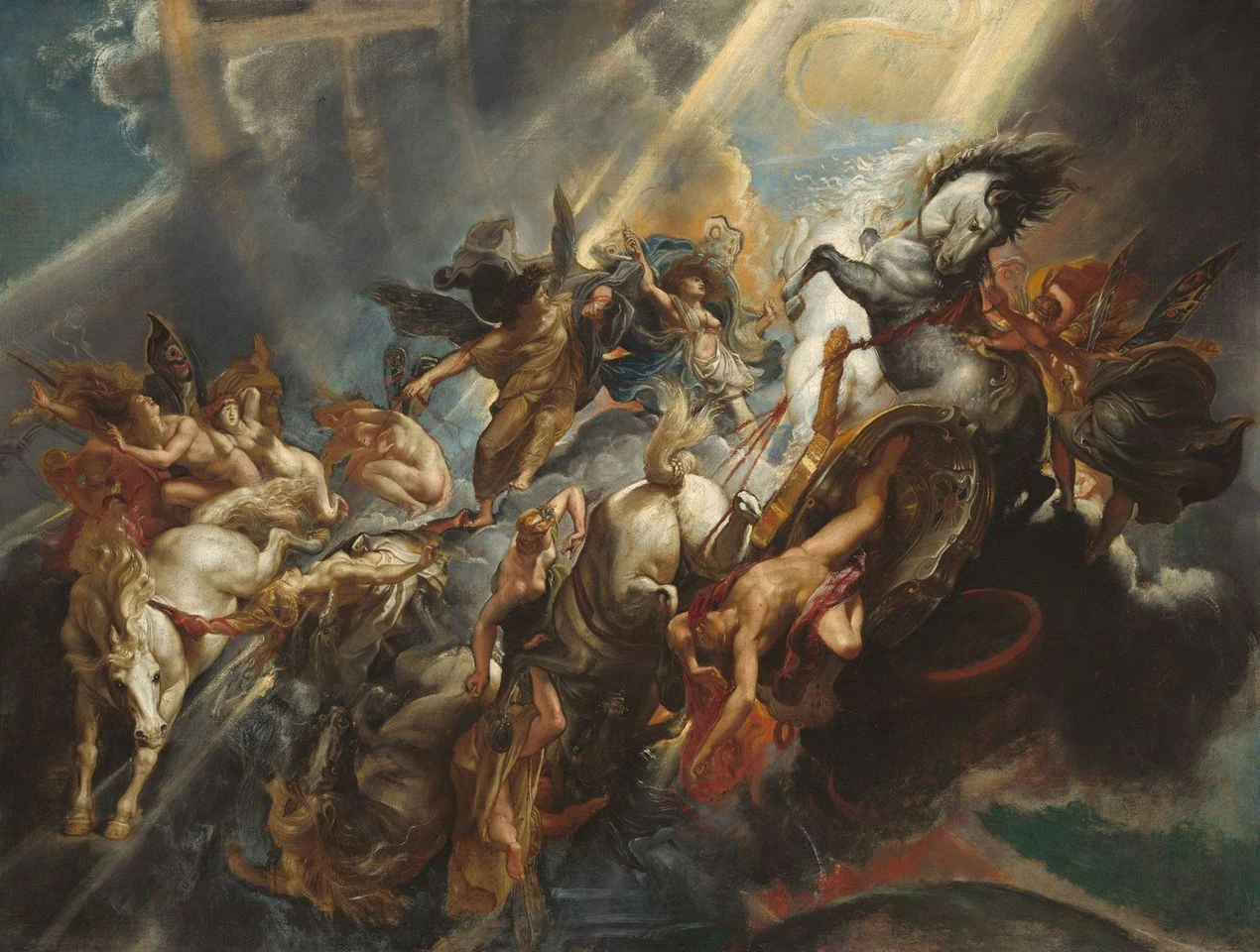
Rubens’s art ranged across religious history, classical myth, portraits, landscapes, tapestry designs and prints. His paintings often use vigorous movement, strong colour and crowded, carefully organised groups of figures to make a story legible and emotionally forceful. In Antwerp, The Raising of the Cross and The Descent from the Cross, painted for the Cathedral of Our Lady, helped establish his standing as a major religious painter. Their dramatic treatment of the human body and the action of the scene shows the qualities that later audiences associated with his Baroque style.
The Descent from the Cross is a significant work in Rubens’s career, but the evidence does not establish that this painting itself redirected British taste. His relevance to Britain is more concretely demonstrated by the English royal commission, the gift to Charles I, his knighthood and the connection with Van Dyck. Rubens’s example formed part of a broad European culture of artistic exchange; claims that British artists collectively adopted his techniques or that he decisively transformed national taste go beyond what these episodes alone can show.
His workshop was central to that international reach. Rubens prepared designs and models, while assistants and fellow artists contributed to works made under his supervision. He also worked with specialists, including animal painter Frans Snyders and flower painter Jan Brueghel the Elder. Engravers translated his compositions into prints, giving them a life beyond the original painting. This combination of authorship, collaboration and reproduction helps explain why his influence could travel further than his own movements between courts.
Later years and lasting works
Rubens spent his final decade in and around Antwerp, continuing to take major commissions while also painting landscapes and works with a more personal character. In 1635 he bought the estate known as the Steen. His later landscapes, including A View of Het Steen in the Early Morning, reflect a different register from the large religious and allegorical works that had secured his reputation. He died in Antwerp on 30 May 1640, aged 62, and was buried in Saint James’s Church.
His work’s British story continued beyond his lifetime through royal collections, commissions and the presence of paintings and drawings in British institutions. The Banqueting House ceiling remains a particularly visible result of his connection to England: a cycle by a Flemish artist, conceived for a Stuart king and made for an English building. His gift of Allegory of Peace and War likewise gives that connection a surviving work in a national collection.
Why Peter Paul Rubens deserves a place in British Legacy
Rubens belongs in British Legacy not because he was British—he was a Flemish painter born in the Holy Roman Empire—but because his career left specific traces in British cultural history. His time at the court of Charles I connected diplomatic negotiations with royal patronage. The king received Allegory of Peace and War, and Rubens’s commission for the Banqueting House ceiling brought his art into one of the most important royal buildings of the period. Those works make the relationship tangible: the British connection is recorded in a painting held by the National Gallery and in a ceiling cycle created for Whitehall.
His relationship with Anthony van Dyck adds another dimension. Van Dyck’s experience in Rubens’s Antwerp workshop linked the master’s practice to the painter who became Charles I’s leading court artist. This is a more defensible account of influence than the claim that Rubens single-handedly changed British painting. His achievements show how British art and architecture developed through international exchange: artists travelled, rulers commissioned work from abroad, and paintings and designs crossed borders. Rubens’s place in this story is therefore both substantial and clearly defined. He was a European master whose English visit, royal gift, knighthood and Whitehall commission made his legacy part of Britain’s artistic record.
Sources
Adapted in part from Peter Paul Rubens by Wikipedia contributors, under CC BY-SA 4.0. Text has been edited and combined with the existing article; this adapted text is shared under the same licence. Contributor history.